



 Chat with AI
Exam 3: Seasonal and Daily Temperatures

Exam 1: Earth and Its Atmosphere95 Questions
Exam 2: Energy: Warming Earth and the Atmosphere110 Questions
Exam 3: Seasonal and Daily Temperatures116 Questions
Exam 4: Atmospheric Humidity78 Questions
Exam 5: Condensation: Dew, Fog, and Clouds119 Questions
Exam 6: Stability and Cloud Development82 Questions
Exam 7: Precipitation78 Questions
Exam 8: Air Pressure and Winds121 Questions
Exam 9: Wind: Small-Scale and Local Systems104 Questions
Exam 10: Wind: Global Systems75 Questions
Exam 11: Air Masses and Fronts99 Questions
Exam 12: Middle-Latitude Cyclones63 Questions
Exam 13: Weather Forecasting131 Questions
Exam 14: Thunderstorms79 Questions
Exam 15: Tornadoes48 Questions
Exam 16: Hurricanes76 Questions
Exam 17: Earths Changing Climate69 Questions
Exam 18: Global Climate77 Questions
Exam 19: Air Pollution84 Questions
Select questions type


Describe the seasons that you would experience at two widely different locations on Earth. How might seasonal variations affect a region's culture and traditions?
(Essay)
4.8/5  (71)
(71) Suppose the temperature at night is going to drop to -5°C, and a fairly stiff wind is predicted. Assuming that cost is not a factor, which of the following methods is probably the best way to protect an orchard against a hard freeze?
(Multiple Choice)
4.7/5 (81)
(81) Why does the warmest weather in middle latitudes normally occur several weeks after the summer solstice?
(Short Answer)
4.9/5 (79)
(79) Suppose the air temperature is -5°C, the wind is blowing at 55 km/h, and the wind chill temperature is -15.3°C. Which of the following temperatures and wind speeds are equivalent to these conditions?
(Multiple Choice)
4.8/5 (77)
(77) Suppose the minimum temperature reported in the newspaper is 2°C, but you notice ice crystals (frost) on the grass in the morning. Which of the following describes the most likely reason for this apparent discrepancy?
(Multiple Choice)
4.9/5 (84)
(84) Referring to the diagram, sunlight energy is added at equal rates to soil and water. Which of the following factors contributes to the different temperatures of the two surfaces? 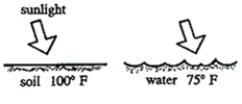
(Multiple Choice)
4.8/5 (83)
(83) Consider the scenario in which peas are planted in Ontario on May 1. If the peas need 1200 growing degree-days before they can be picked, and if the mean temperature for each day from May to July is 21°C, in about how many days will the peas be ready to pick? (Assume a base temperature of 4°C).
(Multiple Choice)
5.0/5 (84)
(84) In the Northern Hemisphere, which of the following days has the fewest hours of daylight?
(Multiple Choice)
4.9/5 (79)
(79) During which of the following months does Indian summer most likely occur?
(Multiple Choice)
4.8/5 (74)
(74) Under which of the following conditions do the strongest radiation inversions occur?
(Multiple Choice)
4.8/5 (62)
(62) Explain why highest summer temperatures usually occur over desert regions as opposed to humid areas with more vegetation.
(Essay)
4.9/5 (89)
(89) In which of the following circumstances is a radiation inversion most commonly observed?
(Multiple Choice)
4.9/5 (84)
(84) Assume that the night will remain clear, calm, and unsaturated, and the predicted minimum temperature is 0°C. Suddenly the wind speed increases and remains gusty throughout the night. What would be the most likely minimum temperature?
(Multiple Choice)
4.7/5 (78)
(78) In meteorology, which of the following defines "insolation"?
(Multiple Choice)
4.8/5 (79)
(79) At Lima, Peru (latitude 12°S), on which of the following days is the sun overhead?
(Multiple Choice)
4.7/5 (74)
(74) At which of the following locations are the days and nights of equal length all year long?
(Multiple Choice)
4.8/5 (85)
(85) 
Filters
- Essay(0)
- Multiple Choice(0)
- Short Answer(0)
- True False(0)
- Matching(0)