



 Chat with AI
Exam 13: Fiscal Policy Appendix Taxes and the Multiplier

Exam 1: First Principles233 Questions
Exam 2: Economic Models319 Questions
Exam 3: Supply and Demand292 Questions
Exam 5: International Trade 5274 Questions
Exam 6: Macroeconomics: the Big Picture168 Questions
Exam 7: Gdp and Cpi: Tracking the Macroeconomy434 Questions
Exam 8: Unemployment and Inflation354 Questions
Exam 9: Long-Run Economic Growth316 Questions
Exam 10: Savings, Investment Spending, and the Financial System402 Questions
Exam 13: Fiscal Policy Appendix Taxes and the Multiplier382 Questions
Exam 14: Money, Banking, and the Federal Reserve System468 Questions
Exam 15: Monetary Policy359 Questions
Exam 16: Inflation, Disinflation, and Deflation240 Questions
Exam 17: Crises and Consequences214 Questions
Exam 18: Events and Ideas322 Questions
Exam 19: Open-Economy Macroeconomics467 Questions
Exam 20: Graphs in Economics75 Questions
Exam 21: toward a Fuller Understanding of Present Value36 Questions
Select questions type


If there is a recessionary gap, discretionary fiscal policy would likely include action to:
(Multiple Choice)
4.8/5  (80)
(80) Use the following to answer questions:
Figure: Inflationary and Recessionary Gaps  -(Figure: Inflationary and Recessionary Gaps) Look at the figure Inflationary and Recessionary Gaps. At E1, the economy:
 (Multiple Choice)
4.9/5 (82)
(82) Use the following to answer questions :
Figure: Fiscal Policy Choices 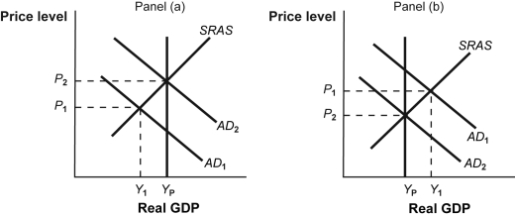 -(Figure: Fiscal Policy Choices) Look at the figure Fiscal Policy Choices. In panel (b), if real GDP is equal to Y1, there is:
 (Multiple Choice)
4.8/5 (89)
(89) An increase in government spending for goods and services is an autonomous increase in aggregate demand.
(True/False)
4.9/5 (77)
(77) Use the following to answer questions :
Figure: Short- and Long-Run Equilibrium  -(Figure: Short- and Long-Run Equilibrium) Look at the figure Short- and Long-Run Equilibrium. If the economy is at equilibrium at E1, the government should use _____ fiscal policy to shift the aggregate demand curve to the _____ .
 (Multiple Choice)
4.9/5 (71)
(71) The decision to build more aircraft carriers to keep employment high is an example of:
(Multiple Choice)
4.7/5 (76)
(76) Congress increases personal income tax rates to balance the budget. Automatic stabilizers will _____ the _____ effect of the _____ in aggregate demand.
(Multiple Choice)
4.9/5 (86)
(86) An expansionary fiscal policy either _____ government spending or _____ taxes.
(Multiple Choice)
4.8/5 (86)
(86) Use the following to answer questions:
Figure: Inflationary and Recessionary Gaps
-(Figure: Inflationary and Recessionary Gaps) Look at the figure Inflationary and Recessionary Gaps. At E3, the economy:
-(Figure: Inflationary and Recessionary Gaps) Look at the figure Inflationary and Recessionary Gaps. At E3, the economy: (Multiple Choice)
5.0/5 (69)
(69) Assume that the marginal propensity to consume is 0.8 and potential output is $800 billion. If real GDP is $700 billion:
(Multiple Choice)
4.8/5 (84)
(84) A cut in taxes will have the most effect on aggregate demand if it is given to:
(Multiple Choice)
4.8/5 (79)
(79) Contractionary fiscal policy shifts the aggregate demand curve to the _____ and is used to close a(n) _____ gap.
(Multiple Choice)
4.9/5 (82)
(82) Use the following to answer questions :
Scenario: Fiscal Policy
Consider the economy of Arcadia. Its households spend 75% of increases in their income. There are no taxes and no foreign trade. Its currency is the arc. Potential output is 600 billion arcs.
-(Scenario: Fiscal Policy) Look at the scenario Fiscal Policy. Suppose actual real GDP in Arcadia is 500 billion arcs. This economy has:
(Multiple Choice)
4.8/5 (77)
(77) Automatic stabilizers are government spending and taxation rules that cause fiscal policy to be automatically expansionary when the economy contracts and automatically contractionary when the economy expands.
(True/False)
4.8/5 (76)
(76) Suppose the marginal propensity to consume is 0.8. If the government cut taxes by $100 billion, then real GDP would increase by $400 billion.
(True/False)
4.8/5 (65)
(65) If policy makers want to increase real GDP by $100 billion and the marginal propensity to consume is 0.75, they should increase government purchases of goods and services by $75 billion.
(True/False)
4.9/5 (86)
(86) Assume that the marginal propensity to consume is 0.8 and potential output is $800 billion. If real GDP is $850 billion, to bring the economy to potential output the government should:
(Multiple Choice)
4.9/5 (88)
(88) 
Filters
- Essay(0)
- Multiple Choice(0)
- Short Answer(0)
- True False(0)
- Matching(0)