



 Chat with AI
Exam 10: Consumer Choice and Behavioral Economics

Exam 1: Economics: Foundations and Models233 Questions
Exam 2: Trade-Offs, comparative Advantage, and the Market System259 Questions
Exam 3: Where Prices Come From: the Interaction of Demand and Supply242 Questions
Exam 4: Economic Efficiency, government Price Setting, and Taxes208 Questions
Exam 5: Externalities, environmental Policy, and Public Goods267 Questions
Exam 6: Elasticity: The Responsiveness of Demand and Supply295 Questions
Exam 7: The Economics of Health Care169 Questions
Exam 8: Firms, the Stock Market, and Corporate Governance278 Questions
Exam 9: Comparative Advantage and the Gains From International Trade189 Questions
Exam 10: Consumer Choice and Behavioral Economics302 Questions
Exam 11: Technology, production, and Costs330 Questions
Exam 12: Firms in Perfectly Competitive Markets298 Questions
Exam 13: Monopolistic Competition: the Competitive Model in a More Realistic Setting278 Questions
Exam 14: Oligopoly: Firms in Less Competitive Markets262 Questions
Exam 15: Monopoly and Antitrust Policy271 Questions
Exam 16: Pricing Strategy263 Questions
Exam 17: The Markets for Labor and Other Factors of Production286 Questions
Exam 18: Public Choice,taxes,and the Distribution of Income258 Questions
Select questions type


In the ultimatum game,allocators usually offer recipients at least a 40 percent share of the money,and recipients almost always reject offers of less than a 10 percent share.Which of the following does not explain why allocators offer recipients a relatively generous share and why recipients reject meager offers?
(Multiple Choice)
4.8/5  (93)
(93) Economists do not think it is possible to compare the relative utility that two people get from consuming an additional unit of a particular good.
(True/False)
4.9/5 (69)
(69) Table 10-6
 Table 10-6 lists Jay's marginal utilities for burgers and Pepsi. Jay has $7 to spend on these two goods. The price of a burger is $2 and the price of a can of Pepsi is $1.
-Refer to Table 10-6.If Jay can eat all the burgers he wants for free,how many burgers will he consume?
Table 10-6 lists Jay's marginal utilities for burgers and Pepsi. Jay has $7 to spend on these two goods. The price of a burger is $2 and the price of a can of Pepsi is $1.
-Refer to Table 10-6.If Jay can eat all the burgers he wants for free,how many burgers will he consume? (Multiple Choice)
5.0/5 (83)
(83) Consider the following factors:
a.culture
b.religion
c.customs
d.prices
e.income
Which of the factors above are likely to influence the choices consumers make?
(Multiple Choice)
4.8/5 (74)
(74) The demand curve for canned peas is downward sloping.If the price of canned peas,an inferior good,rises
(Multiple Choice)
4.8/5 (79)
(79) Figure 10-2 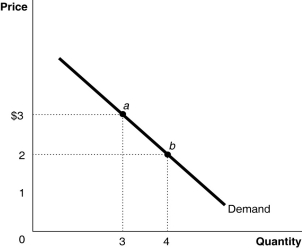 Figure 10-2 represents the demand for ice cream cones.
-Refer to Figure 10-2.Which of the following statements is true?
Figure 10-2 represents the demand for ice cream cones.
-Refer to Figure 10-2.Which of the following statements is true? (Multiple Choice)
4.8/5 (76)
(76) Table 10-2
 Table 10-2 above shows Keira's utility from soup and sandwiches. The price of soup is $2 per cup and the price of a sandwich is $3. Keira has $18 to spend on these two goods.
-Refer to Table 10-2.What is Keira's marginal utility per dollar spent on the third cup of soup?
Table 10-2 above shows Keira's utility from soup and sandwiches. The price of soup is $2 per cup and the price of a sandwich is $3. Keira has $18 to spend on these two goods.
-Refer to Table 10-2.What is Keira's marginal utility per dollar spent on the third cup of soup? (Multiple Choice)
4.9/5 (72)
(72) If Marlowe obtains 9 units of utility per dollar spent on apples and 6 units of utility per dollar spent on oranges,then Marlowe
(Multiple Choice)
4.9/5 (69)
(69) Which of the following statements about utility and preferences is false?
(Multiple Choice)
4.8/5 (77)
(77) Maurice Allais,Reinhard Selten and Vernon Smith all were awarded the Nobel Prize in Economics in part because
(Multiple Choice)
4.9/5 (79)
(79) An economist observes two consumers in a supermarket.One of the consumers buys a case of Coca-Cola and the other buys a case of Pepsi-Cola.Both colas sell for the same price and the ages and incomes of the consumers are also the same.Based on this information,how would the economist explain the consumers' choices?
(Multiple Choice)
4.9/5 (67)
(67) Table 10-5
 -Refer to Table 10-5,which lists the values of Harry Taber's marginal utility and marginal utility per dollar for Italian submarine (sub)sandwiches and tacos.Assume that the price of the sub sandwiches is $4 and the price of tacos is $2.When Harry's income is $14 he buys two Italian sub sandwiches and three tacos.The last column lists the values of the marginal utility per dollar for tacos when the price of tacos decreases to $1.Complete this statement: As a result of the change in price
 (Multiple Choice)
4.9/5 (84)
(84) Each price-quantity combination on a consumer's demand curve shows the utility-maximizing quantity at the given price.
(True/False)
4.8/5 (79)
(79) You wish to buy only one CD.Use the rule of equal marginal utility per dollar to determine which one to purchase: (a)Usher's latest CD for $15 which gives you 75 units of utility,or (b)Tom Petty and the Heartbreakers' Greatest Hits for $10 that gives you 100 units of utility?
(Essay)
4.8/5 (86)
(86) Lilly Davis has $5 per week to spend on any combination of ice cream and candy.The price of an ice cream cone is $2 and the price of a candy bar is $1.The table below shows Lilly's utility values.Use the table to answer the questions that follow the table.
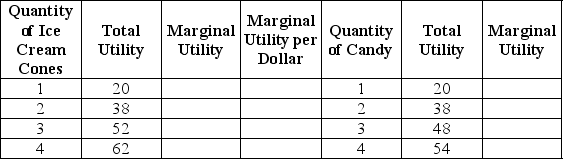 a.Complete the table by filling in the blank spaces.
b.Suppose Lilly purchases 2 ice cream cones and 1 candy bar.Is she consuming the optimal consumption bundle? If so,explain why.If not,what combination should she buy and why?
a.Complete the table by filling in the blank spaces.
b.Suppose Lilly purchases 2 ice cream cones and 1 candy bar.Is she consuming the optimal consumption bundle? If so,explain why.If not,what combination should she buy and why? (Essay)
4.9/5 (80)
(80) Which of the following is not a common mistake made by consumers?
(Multiple Choice)
4.7/5 (79)
(79) A network externality refers to a situation in which the usefulness of a product decreases with the number of consumers who use it.
(True/False)
4.9/5 (84)
(84) Table 10-1
 Keegan has $30 to spend on Pita Wraps and Bubble Tea. The price of a Pita Wrap is $6 and the price of a glass of Bubble Tea is $3. Table 10-1 shows his total utility from different quantities of the two items.
-Refer to Table 10-1.If Keegan can drink all the bubble tea he wants for free,how many glasses will he consume?
Keegan has $30 to spend on Pita Wraps and Bubble Tea. The price of a Pita Wrap is $6 and the price of a glass of Bubble Tea is $3. Table 10-1 shows his total utility from different quantities of the two items.
-Refer to Table 10-1.If Keegan can drink all the bubble tea he wants for free,how many glasses will he consume? (Multiple Choice)
4.7/5 (84)
(84) 
Filters
- Essay(0)
- Multiple Choice(0)
- Short Answer(0)
- True False(0)
- Matching(0)