



 Chat with AI
Exam 5: Externalities, environmental Policy, and Public Goods

Exam 1: Economics: Foundations and Models233 Questions
Exam 2: Trade-Offs, comparative Advantage, and the Market System259 Questions
Exam 3: Where Prices Come From: the Interaction of Demand and Supply242 Questions
Exam 4: Economic Efficiency, government Price Setting, and Taxes208 Questions
Exam 5: Externalities, environmental Policy, and Public Goods267 Questions
Exam 6: Elasticity: The Responsiveness of Demand and Supply295 Questions
Exam 7: The Economics of Health Care169 Questions
Exam 8: Firms, the Stock Market, and Corporate Governance278 Questions
Exam 9: Comparative Advantage and the Gains From International Trade189 Questions
Exam 10: Consumer Choice and Behavioral Economics302 Questions
Exam 11: Technology, production, and Costs330 Questions
Exam 12: Firms in Perfectly Competitive Markets298 Questions
Exam 13: Monopolistic Competition: the Competitive Model in a More Realistic Setting278 Questions
Exam 14: Oligopoly: Firms in Less Competitive Markets262 Questions
Exam 15: Monopoly and Antitrust Policy271 Questions
Exam 16: Pricing Strategy263 Questions
Exam 17: The Markets for Labor and Other Factors of Production286 Questions
Exam 18: Public Choice,taxes,and the Distribution of Income258 Questions
Select questions type


Figure 5-2 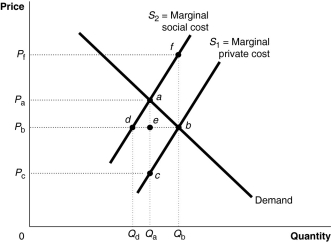 Figure 5-2 shows a market with a negative externality.
-Refer to Figure 5-2.The size of marginal external costs can be determined by
Figure 5-2 shows a market with a negative externality.
-Refer to Figure 5-2.The size of marginal external costs can be determined by (Multiple Choice)
4.9/5  (88)
(88) In England during the Middle Ages each village had an area of pasture on which any family in the village was allowed to graze its cows and sheep without charge.Eventually,the grass in the pasture would be depleted and no family's cow or sheep would get enough to eat.The reason the grass was depleted was
(Multiple Choice)
4.9/5 (83)
(83) Private producers have no incentive to provide public goods because
(Multiple Choice)
4.8/5 (63)
(63) Consider the following characteristics:
a.low transaction costs
b.small levels of pollution
c.high levels of pollution
d.clear assignment of property rights.
Which of the above are assumptions behind the Coase Theorem?
(Multiple Choice)
4.9/5 (91)
(91) How does the construction of a market demand curve for a private good differ from that for a public good?
(Multiple Choice)
4.7/5 (88)
(88) 
Filters
- Essay(0)
- Multiple Choice(0)
- Short Answer(0)
- True False(0)
- Matching(0)