



 Chat with AI
Exam 5: Externalities, environmental Policy, and Public Goods

Exam 1: Economics: Foundations and Models233 Questions
Exam 2: Trade-Offs, comparative Advantage, and the Market System259 Questions
Exam 3: Where Prices Come From: the Interaction of Demand and Supply242 Questions
Exam 4: Economic Efficiency, government Price Setting, and Taxes208 Questions
Exam 5: Externalities, environmental Policy, and Public Goods267 Questions
Exam 6: Elasticity: The Responsiveness of Demand and Supply295 Questions
Exam 7: The Economics of Health Care169 Questions
Exam 8: Firms, the Stock Market, and Corporate Governance278 Questions
Exam 9: Comparative Advantage and the Gains From International Trade189 Questions
Exam 10: Consumer Choice and Behavioral Economics302 Questions
Exam 11: Technology, production, and Costs330 Questions
Exam 12: Firms in Perfectly Competitive Markets298 Questions
Exam 13: Monopolistic Competition: the Competitive Model in a More Realistic Setting278 Questions
Exam 14: Oligopoly: Firms in Less Competitive Markets262 Questions
Exam 15: Monopoly and Antitrust Policy271 Questions
Exam 16: Pricing Strategy263 Questions
Exam 17: The Markets for Labor and Other Factors of Production286 Questions
Exam 18: Public Choice,taxes,and the Distribution of Income258 Questions
Select questions type


Briefly explain the command-and-control approach in dealing with an externality such as pollution.Give an example of the U.S.government using the command-and-control approach to deal with the pollution problem.
(Essay)
4.9/5  (86)
(86) If transactions costs are low,private bargaining will always result in an efficient solution to the problem of externalities.
(True/False)
4.7/5 (83)
(83) Which of the following best illustrates the free rider problem?
(Multiple Choice)
4.9/5 (86)
(86) Haiti was once a heavily forested country.Today,80 percent of Haiti's forests have been cut down,primarily to be burned to create charcoal.The reduction in the number of trees has lead to devastating floods when it rains heavily.This is an example of
(Multiple Choice)
4.9/5 (70)
(70) When a negative externality exists,the private market produces
(Multiple Choice)
4.9/5 (77)
(77) Figure 5-4 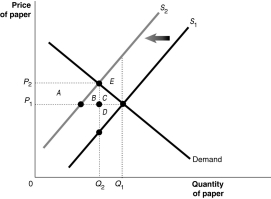 Suppose there are several paper mills producing paper for a market. These mills, located upstream from a fishing village, discharge a large amount of wastewater into the river. The waste material affects the number of fish in the river, and the use of the river for recreation and as a public water supply source. Figure 5-4 shows the paper market. Use this Figure to answer the following question(s).
-Refer to Figure 5-4.What is the deadweight loss from producing at the market equilibrium?
Suppose there are several paper mills producing paper for a market. These mills, located upstream from a fishing village, discharge a large amount of wastewater into the river. The waste material affects the number of fish in the river, and the use of the river for recreation and as a public water supply source. Figure 5-4 shows the paper market. Use this Figure to answer the following question(s).
-Refer to Figure 5-4.What is the deadweight loss from producing at the market equilibrium? (Multiple Choice)
4.9/5 (81)
(81) If the social cost of producing a good or service exceeds the private cost
(Multiple Choice)
4.9/5 (86)
(86) Which of the following displays rivalry and excludability in consumption?
(Multiple Choice)
5.0/5 (56)
(56) Figure 5-9  Companies producing toilet paper bleach the paper to make it white. The bleach is discharged into rivers and lakes and causes substantial environmental damage. Figure 5-9 illustrates the situation in the toilet paper market.
-Refer to Figure 5-9.The private profit-maximizing output level is
Companies producing toilet paper bleach the paper to make it white. The bleach is discharged into rivers and lakes and causes substantial environmental damage. Figure 5-9 illustrates the situation in the toilet paper market.
-Refer to Figure 5-9.The private profit-maximizing output level is (Multiple Choice)
4.8/5 (76)
(76) In the past the federal government often employed what is called a "command and control" approach to the reduction of pollution emissions.Many economists are critical of this approach because
(Multiple Choice)
4.8/5 (86)
(86) Overuse of a common resource may be avoided by all of the following methods except
(Multiple Choice)
4.9/5 (86)
(86) Public goods are distinguished by two primary characteristics.What are they?
(Multiple Choice)
5.0/5 (100)
(100) Which of the following is an example of a common resource?
(Multiple Choice)
4.9/5 (76)
(76) If you burn your trash in the back yard in spite of regulations against it,then you are
(Multiple Choice)
4.8/5 (85)
(85) 
Filters
- Essay(0)
- Multiple Choice(0)
- Short Answer(0)
- True False(0)
- Matching(0)