



 Chat with AI
Exam 10: Monopoly and Antitrust

Exam 1: Economics: Foundations and Models160 Questions
Exam 2: Trade-Offs, comparative Advantage, and the Market System191 Questions
Exam 3: Where Prices Come From: the Interaction of Demand and Supply241 Questions
Exam 4: Market Efficiency and Market Failure226 Questions
Exam 5: The Economics of Healthcare169 Questions
Exam 6: Firms,the Stock Market,and Corporate Governance255 Questions
Exam 7: Consumer Choice and Elasticity270 Questions
Exam 8: Technology, production, and Costs277 Questions
Exam 9: Firms in Perfectly Competitive Markets351 Questions
Exam 10: Monopoly and Antitrust253 Questions
Exam 11: Monopolistic Competition and Oligopoly304 Questions
Exam 12: GDP: Measuring Total Production and Income200 Questions
Exam 13: Unemployment and Inflation207 Questions
Exam 14: Economic Growth, the Financial System and Business Cycles172 Questions
Exam 15: Aggregate Demand and Aggregate Supply Analysis120 Questions
Exam 16: Money, banks, and the Federal Reserve System139 Questions
Exam 17: Monetary Policy180 Questions
Exam 18: Fiscal Policy131 Questions
Exam 19: Comparative Advantage, international Trade, and Exchange Rates247 Questions
Select questions type


In labour economics,the term 'customer discrimination' refers to a situation where customers are charged different prices for services rendered by a firm.
(True/False)
4.9/5  (78)
(78) If the demand for labour is unchanged,an increase in the supply of labour will lead to
(Multiple Choice)
4.9/5 (83)
(83) The total amount of copper in the earth is not increasing.Does this mean that in the market for copper,the supply curve is perfectly inelastic? Explain.
(Essay)
4.7/5 (90)
(90) A monopsony restricts the quantity of a factor demanded to force down the price of the factor and increase profits.
(True/False)
4.8/5 (63)
(63) Figure 10-1 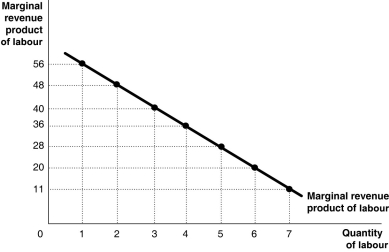 Figure 10-1 shows the marginal revenue product for Dale's Hand-Sewn Doilies, a producer of linen doilies.
-Refer to Figure 10-1.If the wage rate is $40,how many workers should Dale hire?
Figure 10-1 shows the marginal revenue product for Dale's Hand-Sewn Doilies, a producer of linen doilies.
-Refer to Figure 10-1.If the wage rate is $40,how many workers should Dale hire? (Multiple Choice)
4.8/5 (84)
(84) How will an increase in population affect the labour market?
(Multiple Choice)
4.7/5 (84)
(84) If the labour supply curve shifts to the right and the labour demand curve remains unchanged,what will happen to the equilibrium wage and the equilibrium level of employment? Illustrate your answer with a graph.
(Essay)
4.9/5 (81)
(81) Consider the market for nurses in a given city.In each of the following cases,explain what happens to the equilibrium wage rate and the quantity of nurses hired.
a.One of the major hospitals in the city closes.
b.A record number of students graduate with bachelor's degrees in nursing.
c.Traditionally,nursing is a field that attracts women.However,changes in access to education and to the labour force participation rate by women have led to a greater demand for the services of women in a wide range of occupations.The demand for nurses,however,does not change.
d.Advances in medical technology reduce the amount of time physicians must spend with patients in intensive care and increase the time that nurses spend with patients.
(Essay)
4.8/5 (83)
(83) Table 10-2
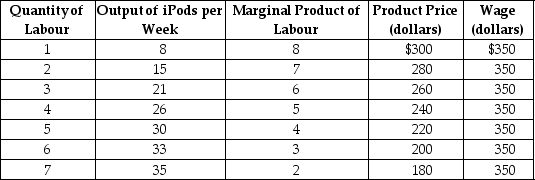 -Refer to Table 10-2.The firm represented in the table
 (Multiple Choice)
4.9/5 (87)
(87) a.What are the two effects of an increase in the wage rate on an individual's labour supply decision? Briefly explain each effect.
b.Explain how a labour supply curve could be backward bending.
(Essay)
4.8/5 (83)
(83) An increase in wages raises the opportunity cost of leisure and leads to an increase in the quantity supplied of labour.
(True/False)
4.9/5 (65)
(65) Consider the market for opticians.What is likely to happen to the equilibrium wage and quantity of opticians if more and more people turn to laser eye surgery instead of wearing glasses or contact lens?
(Multiple Choice)
4.7/5 (78)
(78) When workers are paid on a piece-rate basis,an employer must be able to easily measure each worker's output.
(True/False)
4.8/5 (82)
(82) Which of the following is a reason why it is difficult to estimate the extent of economic discrimination in the labour market?
(Multiple Choice)
4.7/5 (78)
(78) Suppose the following two events occur in the domestic market for radiologists:
a.Some hospitals are outsourcing some radiology services such as reading x-rays.
b.Some medical schools have closed down their radiology departments as fewer students enrol in this field.
What is likely to happen to the equilibrium wage and quantity of radiologists following these two events?
(Multiple Choice)
4.8/5 (91)
(91) How much is a bond that pays $50 in coupon payments for 3 years and $1000 at the end of the third year worth if the interest rate is 10%?
(Multiple Choice)
4.8/5 (85)
(85) An increase in the price of grape juice causes an increase in the marginal revenue product of labour used to produce grape juice.
(True/False)
4.9/5 (77)
(77) Figure 10-3  -Refer to Figure 10-3.In Panel A,at low wages (segment i)
 (Multiple Choice)
4.8/5 (87)
(87) Paying a person a lower wage or excluding a person from an occupation on the basis of an irrelevant characteristic such as race or gender
(Multiple Choice)
4.8/5 (82)
(82) 
Filters
- Essay(0)
- Multiple Choice(0)
- Short Answer(0)
- True False(0)
- Matching(0)