



 Chat with AI
Exam 13: Long Term Liabilities

Exam 1: Uses of Accounting Information and the Financial Statements167 Questions
Exam 2: Analyzing Business Transactions189 Questions
Exam 3: Measuring Business Income171 Questions
Exam 4: Completing the Accounting Cycle176 Questions
Exam 5: Financial Reporting and Analysis177 Questions
Exam 6: The Operating Cycle and Merchandising Operations145 Questions
Exam 7: Internal Control117 Questions
Exam 8: Inventories154 Questions
Exam 9: Cash and Receivables177 Questions
Exam 10: Current Liabilities and Fair Value Accounting180 Questions
Exam 11: Long Term Assets241 Questions
Exam 12: Contributed Capital189 Questions
Exam 13: Long Term Liabilities194 Questions
Exam 14: The Corporate Income Statement and the Statement of Stockholders Equity176 Questions
Exam 15: The Statement of Cash Flows149 Questions
Exam 16: Financial Performance Measurement163 Questions
Exam 17: Partnerships129 Questions
Exam 18: The Changing Business Environment-A Managers Pers130 Questions
Exam 19: Cost Concepts and Cost Allocation188 Questions
Exam 20: Costing Systems: Job Order Costing88 Questions
Exam 21: Costing Systems Process Costing136 Questions
Exam 22: Activity-Based Systems-Abm and Lean152 Questions
Exam 23: Cost Behavior Analysis166 Questions
Exam 24: The Budgeting Process116 Questions
Exam 25: Performance Management and Evaluation117 Questions
Exam 26: Standard Costing and Variance Analysis120 Questions
Exam 27: Short Run Decision Analysis90 Questions
Exam 28: Capital Investment Analysis123 Questions
Select questions type


A $200,000 bond issue with a carrying value of $194,000 is called at 101 and retired. The entry to record the retirement of bonds is: 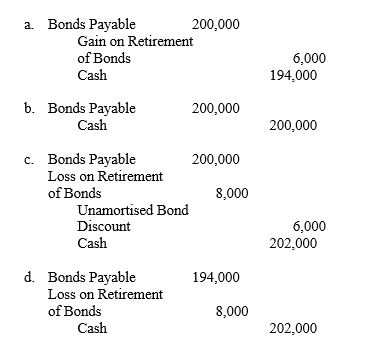
(Short Answer)
4.8/5  (83)
(83) Bonds that contain a provision that allows the holders to exchange the bonds for other securities of the issuing corporation are called
(Multiple Choice)
4.9/5 (72)
(72) On January 2, 2010, Barham Corporation issued ten-year bonds payable with a face value of $400,000 and a face interest rate of 9 percent. The bonds were issued to yield a market interest rate of 10 percent. Interest is payable semiannually on January 2 and July 1. In calculating the present value of the bond issue on January 2, 2010,
(Multiple Choice)
4.7/5 (75)
(75) Unamortized Bond Premium is added to Bonds Payable on the balance sheet.
(True/False)
4.7/5 (74)
(74) West Valley Corporation issues $800,000 of 20-year, 9 percent bonds at 95. Interest is paid semiannually, and the effective interest method is used for amortization. Assume that the market interest rate for similar investments is 10 percent and that the bonds are issued on an interest date.
a. What amount was received for the bonds?
b. How much interest is paid each interest period?
c. How much bond interest expense is recorded on the first interest date (after the issue date)?
d. What is the carrying value of the bonds after the first interest date (after the issue date)?
(Essay)
4.9/5 (102)
(102) The market interest rate is also called the effective interest rate.
(True/False)
4.8/5 (85)
(85) Lassen Corporation issued ten-year term bonds on January 1, 2010, with a face value of $800,000. The face interest rate is 6 percent and interest is payable semi-annually on June 30 and December 31. The bonds were issued for $690,960 to yield an effective annual rate of 8 percent. The effective interest method of amortization is to be used. How much bond interest expense (rounded to the nearest dollar) should be reported on the income statement for the year ended December 31, 2010?
(Multiple Choice)
4.8/5 (81)
(81) When bonds are issued at a premium, the total interest cost of the bonds over the life of the bonds is equal to the amount of
(Multiple Choice)
4.7/5 (74)
(74) The amount of unamortized discount at the end of an interest period is equal to the amount of the unamortized discount at the beginning of the period minus the amount of discount that was amortized during the period.
(True/False)
4.8/5 (83)
(83) When bonds are sold between the interest payment dates, the issuing corporation
collects from investors the interest that has accrued since the last interest
payment date.
(True/False)
4.8/5 (82)
(82) If the market interest rate is higher than the face interest rate at the date of issuance, bonds will
(Multiple Choice)
4.8/5 (81)
(81) When bonds have been issued at a premium, the periodic amortization of the premium will
(Multiple Choice)
4.9/5 (79)
(79) On January 2, 2010, McGowan Corporation issued 20-year bonds payable with a face value of $300,000 and a face interest rate of 8 percent. The bonds were issued to yield a market interest rate of 9 percent. Interest is payable annually on January 2. In calculating the present value of the bond issue of January 2, 2010, the
(Multiple Choice)
4.9/5 (80)
(80) When the terms of a lease require that the lessee record an asset and a liability, the two accounts are recorded at the present value of the total lease payments required.
(True/False)
4.8/5 (82)
(82) A bond with a face value of $1,000 has a current price quote of 99.00. This bond is selling for
(Multiple Choice)
4.8/5 (82)
(82) A corporation issues bonds that pay interest each February 1 and August 1. The corporation's December 31 adjusting entry might include a
(Multiple Choice)
4.9/5 (69)
(69) All of the following are advantages of issuing bonds rather than stock except
(Multiple Choice)
5.0/5 (77)
(77) It is the bondholder rather than the issuer who may exercise the call feature of a callable bond.
(True/False)
4.8/5 (86)
(86) Which of the following statements best describes the behavior over time of the components of equal mortgage payments?
(Multiple Choice)
4.9/5 (73)
(73) If a 20-year bond pays interest of 8 percent semiannually, the present value of the bond is calculated based upon 4 percent and 40 periods.
(True/False)
4.9/5 (89)
(89) 
Filters
- Essay(0)
- Multiple Choice(0)
- Short Answer(0)
- True False(0)
- Matching(0)