



 Chat with AI
Exam 13: Long Term Liabilities

Exam 1: Uses of Accounting Information and the Financial Statements167 Questions
Exam 2: Analyzing Business Transactions189 Questions
Exam 3: Measuring Business Income171 Questions
Exam 4: Completing the Accounting Cycle176 Questions
Exam 5: Financial Reporting and Analysis177 Questions
Exam 6: The Operating Cycle and Merchandising Operations145 Questions
Exam 7: Internal Control117 Questions
Exam 8: Inventories154 Questions
Exam 9: Cash and Receivables177 Questions
Exam 10: Current Liabilities and Fair Value Accounting180 Questions
Exam 11: Long Term Assets241 Questions
Exam 12: Contributed Capital189 Questions
Exam 13: Long Term Liabilities194 Questions
Exam 14: The Corporate Income Statement and the Statement of Stockholders Equity176 Questions
Exam 15: The Statement of Cash Flows149 Questions
Exam 16: Financial Performance Measurement163 Questions
Exam 17: Partnerships129 Questions
Exam 18: The Changing Business Environment-A Managers Pers130 Questions
Exam 19: Cost Concepts and Cost Allocation188 Questions
Exam 20: Costing Systems: Job Order Costing88 Questions
Exam 21: Costing Systems Process Costing136 Questions
Exam 22: Activity-Based Systems-Abm and Lean152 Questions
Exam 23: Cost Behavior Analysis166 Questions
Exam 24: The Budgeting Process116 Questions
Exam 25: Performance Management and Evaluation117 Questions
Exam 26: Standard Costing and Variance Analysis120 Questions
Exam 27: Short Run Decision Analysis90 Questions
Exam 28: Capital Investment Analysis123 Questions
Select questions type


Lassen Corporation issued ten-year term bonds on January 1, 2010, with a face value of $800,000. The face interest rate is 6 percent and interest is payable semi-annually on June 30 and December 31. The bonds were issued for $690,960 to yield an effective annual rate of 8 percent. The effective interest method of amortization is to be used. The carrying value of the bonds payable on the December 31, 2010, balance sheet date should be
(Multiple Choice)
4.9/5  (79)
(79) Lenz Corporation issued ten-year, 8 percent bonds payable in 2009 at a premium. During 2010, the company's accountant failed to amortize any of the bond premium. The omission of the premium amortization will
(Multiple Choice)
4.9/5 (72)
(72) Lassen Corporation issued ten-year term bonds on January 1, 2010, with a face value of $800,000. The face interest rate is 6 percent and interest is payable semiannually on June 30 and December 31. The bonds were issued for $690,960 to yield an effective annual rate of 8 percent. The effective interest method of amortization is to be used. The entry to record the bond interest expense on the first interest payment date is: (Round answer to the nearest dollar.) 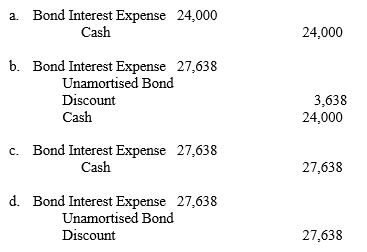
(Short Answer)
4.8/5 (80)
(80) A $100,000 bond issue with a carrying value of $103,000 is called at 101 and retired. The entry to record the retirement of bonds is: 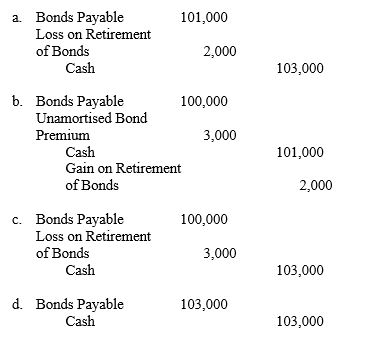
(Short Answer)
5.0/5 (78)
(78) Failure to make interest payments on debt can force a company into bankruptcy.
(True/False)
4.8/5 (92)
(92) On July 1, 2010, Halo Corporation issued bonds with a face value of $500,000. The bonds carry a face interest rate of 10 percent that is payable each July 1 and January 1.
a. Prepare the entry in journal form without explanation for the issuance assuming the bonds are issued at 97.
b. Prepare the entry in journal form without explanation for the issuance assuming the bonds are issued at 102.
(Essay)
4.9/5 (79)
(79) On January 2, 2010, Horst Corporation issued ten-year, 8 percent bonds with a face value of $1,000,000. The semiannual interest dates are June 30 and December 31. The bonds were issued for $875,480 to yield a market interest rate of 10 percent. The accounting year ends on December 31. Prepare entries in journal form without explanations to record the bond issue on January 2, 2010, and the payments of interest and amortization of discount on June 30 and December 31, 2010. Use the straight-line method of amortization. Round answers to the nearest dollar.
(Essay)
4.8/5 (77)
(77) When a bond sells at a premium, what is probably true about the market interest rate versus the face interest rate? Discuss.
(Essay)
4.9/5 (77)
(77) If bonds are retired by an issuer by purchase on the open market at a price below the bonds' carrying value, a gain will result.
(True/False)
4.9/5 (79)
(79) When determining the value of a bond using present value, what are the two components used in the calculation?
(Essay)
4.8/5 (84)
(84) A company has $803,000 in bonds payable with an unamortized premium of $20,000. If one-fourth of the bonds are converted to common stock, the carrying value of the bonds will decrease by
(Multiple Choice)
4.8/5 (79)
(79) Lassen Corporation issued ten-year term bonds on January 1, 2010, with a face value of $800,000. The face interest rate is 8 percent and interest is payable semi-annually on June 30 and December 31. The bonds were issued for $690,960 to yield an effective annual rate of 10 percent. The effective interest method of amortization is to be used. The entry on June 30, 2010, to record the payment of interest and amortization of discount is: 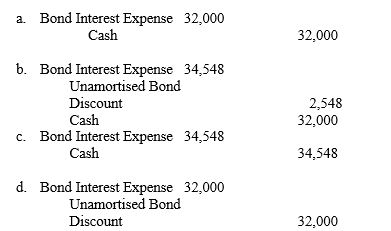
(Short Answer)
4.8/5 (74)
(74) Any unamortized bond discount should be reported on the balance sheet of the issuing corporation as a(n)
(Multiple Choice)
4.8/5 (79)
(79) The carrying value of a bond is also referred to as its present value.
(True/False)
4.7/5 (74)
(74) The entry to record the issuance of bonds between interest payment dates will include a debit to Bond Interest Expense.
(True/False)
4.8/5 (88)
(88) When bonds payable are converted into stock, the carrying value of the bonds should be
(Multiple Choice)
4.8/5 (83)
(83) 
Filters
- Essay(0)
- Multiple Choice(0)
- Short Answer(0)
- True False(0)
- Matching(0)