



 Chat with AI
Exam 23: Cost Behavior Analysis

Exam 1: Uses of Accounting Information and the Financial Statements167 Questions
Exam 2: Analyzing Business Transactions189 Questions
Exam 3: Measuring Business Income171 Questions
Exam 4: Completing the Accounting Cycle176 Questions
Exam 5: Financial Reporting and Analysis177 Questions
Exam 6: The Operating Cycle and Merchandising Operations145 Questions
Exam 7: Internal Control117 Questions
Exam 8: Inventories154 Questions
Exam 9: Cash and Receivables177 Questions
Exam 10: Current Liabilities and Fair Value Accounting180 Questions
Exam 11: Long Term Assets241 Questions
Exam 12: Contributed Capital189 Questions
Exam 13: Long Term Liabilities194 Questions
Exam 14: The Corporate Income Statement and the Statement of Stockholders Equity176 Questions
Exam 15: The Statement of Cash Flows149 Questions
Exam 16: Financial Performance Measurement163 Questions
Exam 17: Partnerships129 Questions
Exam 18: The Changing Business Environment-A Managers Pers130 Questions
Exam 19: Cost Concepts and Cost Allocation188 Questions
Exam 20: Costing Systems: Job Order Costing88 Questions
Exam 21: Costing Systems Process Costing136 Questions
Exam 22: Activity-Based Systems-Abm and Lean152 Questions
Exam 23: Cost Behavior Analysis166 Questions
Exam 24: The Budgeting Process116 Questions
Exam 25: Performance Management and Evaluation117 Questions
Exam 26: Standard Costing and Variance Analysis120 Questions
Exam 27: Short Run Decision Analysis90 Questions
Exam 28: Capital Investment Analysis123 Questions
Select questions type


Total variable and fixed costs will be the same regardless of how many units are produced.
(True/False)
4.9/5  (85)
(85) The contribution margin income statement enables managers to view revenue and cost relationships on a per unit basis or as a percentage of sales.
(True/False)
4.9/5 (75)
(75) The high-low method allows you to differentiate between fixed and variable costs when dealing with mixed costs.
(True/False)
5.0/5 (77)
(77) Margin of safety is the excess of actual sales over break even sales.
(True/False)
4.9/5 (86)
(86) Projected cost information for a new product to be produced by Kolier Manufacturing is as follows:
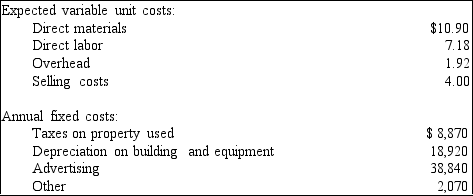 The product is to be sold for $49.
a. Compute the number of units that must be sold to earn a profit of $80,000.
b. Compute the number of units that must be sold if advertising costs rise by $12,000 and a targeted profit of $120,000 is to be obtained.
c. Use the original information and sales of 10,000 units to compute the new selling price that the company must use to obtain a profit of $200,000.
d. The most in annual sales that could be projected is 20,000 units. Determine the added amount that could be spent on fixed advertising costs if the highest possible selling price that management believes can be charged is $50 and if there is a targeted profit of $225,000.
The product is to be sold for $49.
a. Compute the number of units that must be sold to earn a profit of $80,000.
b. Compute the number of units that must be sold if advertising costs rise by $12,000 and a targeted profit of $120,000 is to be obtained.
c. Use the original information and sales of 10,000 units to compute the new selling price that the company must use to obtain a profit of $200,000.
d. The most in annual sales that could be projected is 20,000 units. Determine the added amount that could be spent on fixed advertising costs if the highest possible selling price that management believes can be charged is $50 and if there is a targeted profit of $225,000. (Essay)
4.7/5 (73)
(73) When managers plan, they may use cost behavior to decide how to change the mix of products to meet changing demand.
(True/False)
4.9/5 (80)
(80) Cost behavior is defined as the manner in which costs respond to changes in volume or activity.
(True/False)
4.9/5 (74)
(74) Neverlate is world famous for its precision pocket watches. The company has estimated that variable manufacturing costs and variable selling costs per watch will be $72 and $43, respectively, for 20xx. Also during 20xx, the company is expecting fixed manufacturing costs to total $291,600 and fixed general and administrative expenses to amount to $253,175. The anticipated selling price of each watch is $500. Compute (a) the breakeven point in sales units and (b) the breakeven point in sales dollars.
(Essay)
4.9/5 (81)
(81) Breakeven sales in dollars can be obtained without knowing the contribution margin per unit.
(True/False)
4.8/5 (83)
(83) Cost-volume-profit analysis assumes costs and revenues have a close linear approximation.
(True/False)
4.8/5 (67)
(67) Dapper Hat Makers is in the business of designing and producing specialty hats. The material used for derbies costs $4.50 per unit, and Dapper pays each of its two full-time employees $250 per week. If Employee A makes 15 derbies in one week, what is the variable cost per derby? (Round to two decimal places where necessary.)
(Multiple Choice)
4.8/5 (75)
(75) Identify the following as fixed costs, variable costs, or mixed costs:
_____________a. Direct materials
_____________b. Electricity
_____________c. Factory building rent
_____________d. Advertising expense
_____________e. Shipping expense
_____________f. Insurance on the factory building
_____________g. Cost of goods sold
_____________h. Direct labor
(Essay)
4.8/5 (79)
(79) Excerpts from a cost-volume-profit analysis indicate fixed costs of $30,000, a variable cost per unit of $36, a selling price of $60, and a sales level of $125,000. The targeted level of profit must be
(Multiple Choice)
4.8/5 (87)
(87) When using the high-low method, the accountant assumes the fixed portion of mixed costs to be the lowest fixed amount incurred during the period under review.
(True/False)
4.9/5 (76)
(76) Explain what cost-volume-profit analysis is and how managers use it. Give examples of some purposes for which it might be used.
(Essay)
5.0/5 (81)
(81) Christian Company's sales revenue for 20xx was $144,000. Christian's product sells for $5.50 and has a 30 percent contribution margin. Christian has fixed costs of $33,000. What is Christian Company's breakeven point in sales dollars?
(Multiple Choice)
4.9/5 (68)
(68) Given the following cost and activity observations for Notwen Company's maintenance costs, use the high-low method to calculate Notwen's monthly fixed costs for maintenance. Cost Units Produced January \ 130,000 25,000 February 180,500 35,000 March 151,100 28,000
(Multiple Choice)
4.9/5 (78)
(78) 
Filters
- Essay(0)
- Multiple Choice(0)
- Short Answer(0)
- True False(0)
- Matching(0)