



 Chat with AI
Exam 23: Cost Behavior Analysis

Exam 1: Uses of Accounting Information and the Financial Statements167 Questions
Exam 2: Analyzing Business Transactions189 Questions
Exam 3: Measuring Business Income171 Questions
Exam 4: Completing the Accounting Cycle176 Questions
Exam 5: Financial Reporting and Analysis177 Questions
Exam 6: The Operating Cycle and Merchandising Operations145 Questions
Exam 7: Internal Control117 Questions
Exam 8: Inventories154 Questions
Exam 9: Cash and Receivables177 Questions
Exam 10: Current Liabilities and Fair Value Accounting180 Questions
Exam 11: Long Term Assets241 Questions
Exam 12: Contributed Capital189 Questions
Exam 13: Long Term Liabilities194 Questions
Exam 14: The Corporate Income Statement and the Statement of Stockholders Equity176 Questions
Exam 15: The Statement of Cash Flows149 Questions
Exam 16: Financial Performance Measurement163 Questions
Exam 17: Partnerships129 Questions
Exam 18: The Changing Business Environment-A Managers Pers130 Questions
Exam 19: Cost Concepts and Cost Allocation188 Questions
Exam 20: Costing Systems: Job Order Costing88 Questions
Exam 21: Costing Systems Process Costing136 Questions
Exam 22: Activity-Based Systems-Abm and Lean152 Questions
Exam 23: Cost Behavior Analysis166 Questions
Exam 24: The Budgeting Process116 Questions
Exam 25: Performance Management and Evaluation117 Questions
Exam 26: Standard Costing and Variance Analysis120 Questions
Exam 27: Short Run Decision Analysis90 Questions
Exam 28: Capital Investment Analysis123 Questions
Select questions type


In cost-volume-profit analysis, sales revenue is computed by multiplying units sold by the selling price per unit, and the targeted profit is projected by management.
(True/False)
4.8/5  (83)
(83) A digitized music tuner has been a staple in Smooth Sounds' product line for several years. Annual fixed costs of production and administration related to this product in the past have been $643,500. Variable costs of production and sales have been $17 per unit. The selling price in the past has been $28 per unit. Based on the appearance of competing products on the market, management has asked you to do the following:
a. Compute the breakeven point in units and sales dollars for the present product.
b. Compute the breakeven point in units and sales dollars if the variable costs increased by $3 per unit and the fixed costs increased by $14,375 per month.
c. Using the information from (b), an expected additional monthly advertising charge of $10,000, and a monthly sales rate of 15,000 units, compute the competitive selling price that the company must obtain in order to have a profit of $32,000 per month.
(Essay)
4.8/5 (86)
(86) Theoretical operating capacity is the level at which management expects to operate during a normal business environment.
(True/False)
4.9/5 (80)
(80) All variable costs except manufacturing costs are subtracted from sales to determine the total contribution margin.
(True/False)
4.9/5 (67)
(67) Regression analysis can be performed using one or more activities to predict costs.
(True/False)
4.8/5 (80)
(80) Campground, Inc., is considering the production and sale of propane lamps. Annual fixed costs associated with the project are expected to total $60,000. In addition, each lamp would sell for $12 and would require $7 in variable costs. Calculate (a) the breakeven point in units, (b) the breakeven point in dollars, (c) the number of lamps that must be sold to earn a profit of $120,000, and (d) the operating income or loss at a sales volume of 16,000 lamps.
(Essay)
4.9/5 (78)
(78) Adding the contribution margin as a component to cost-volume-profit computations will not change the resulting amount of breakeven units in a given situation.
(True/False)
4.9/5 (84)
(84) a. What is the formula for breakeven units?
b. How is knowledge of the contribution margin of a product helpful?
In your answer, explain two possible benefits of computing the contribution margin of a product.
(Essay)
4.8/5 (77)
(77) In breakeven analysis adjusted for a profit factor, increasing the unit sales price will decrease the number of units needed to meet the targeted profit.
(True/False)
5.0/5 (88)
(88) The Raquet Business is considering the manufacture of a new type of tennis ball. Each tennis ball would sell for $3.75 and would require $1.75 in variable costs. In addition, annual fixed costs associated with the project would total $64,000.
a. Use the contribution margin approach to calculate:
(1) the breakeven point in units
(2) the breakeven point in dollars
b. Determine the operating income or loss at a sales volume of 30,000 tennis balls.
c. Determine the number of tennis balls that must be sold to earn a profit of $80,000.
(Essay)
4.8/5 (83)
(83) The engineering method of separating costs is sometimes called a time and motion study.
(True/False)
4.8/5 (87)
(87) Ryan's Landscaping sells a quality brand of hoes, shovels, and rakes in a sales mix of 2:4:2. The company's fixed costs are $61,600. Product data include the following:
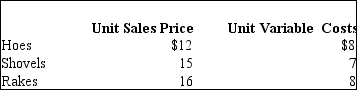 a. Compute the weighted-average contribution margin.
b. Determine the weighted-average breakeven point.
c. Calculate the breakeven point for each product.
d. Determine the breakeven point in sales dollars.
a. Compute the weighted-average contribution margin.
b. Determine the weighted-average breakeven point.
c. Calculate the breakeven point for each product.
d. Determine the breakeven point in sales dollars. (Essay)
4.7/5 (74)
(74) Depreciation calculated using the production or units of output method is an example of a fixed cost.
(True/False)
4.7/5 (78)
(78) The contribution margin and the gross margin can be used interchangeably.
(True/False)
4.8/5 (74)
(74) Mixed costs are fixed and variable costs that are recorded in the same general ledger account.
(True/False)
4.8/5 (81)
(81) For profit planning purposes, the following equation is used: Target Sales Units = (FC + P) CM per Unit.
(True/False)
4.9/5 (82)
(82) Is breakeven analysis a tool that can be used for a service-oriented business? Explain your answer.
(Essay)
4.8/5 (73)
(73) 
Filters
- Essay(0)
- Multiple Choice(0)
- Short Answer(0)
- True False(0)
- Matching(0)