



 Chat with AI
Exam 21: Electrochemistry: Chemical Change and Electrical Work

Exam 1: Keys to the Study of Chemistry66 Questions
Exam 2: The Components of Matter91 Questions
Exam 3: Stoichiometry of Formulas and Equations90 Questions
Exam 4: Three Major Classes of Chemical Reactions84 Questions
Exam 5: Gases and the Kinetic-Molecular Theory93 Questions
Exam 6: Thermochemistry: Energy Flow and Chemical Change71 Questions
Exam 7: Quantum Theory and Atomic Structure72 Questions
Exam 8: Electron Configuration and Chemical Periodicity70 Questions
Exam 9: Models of Chemical Bonding60 Questions
Exam 10: The Shapes of Molecules94 Questions
Exam 11: Theories of Covalent Bonding49 Questions
Exam 12: Intermolecular Forces: Liquids,solids,and Phase Changes89 Questions
Exam 13: The Properties of Solutions73 Questions
Exam 14: The Main-Group Elements: Applying Principles of Bonding and Structure58 Questions
Exam 15: Organic Compounds and the Atomic Properties of Carbon95 Questions
Exam 16: Kinetics: Rates and Mechanisms of Chemical Reactions76 Questions
Exam 17: Equilibrium: the Extent of Chemical Reactions85 Questions
Exam 18: Acid-Base Equilibria90 Questions
Exam 19: Ionic Equilibria in Aqueous Systems96 Questions
Exam 20: Thermodynamics: Entropy, free Energy, and the Direction of Chemical Reactions84 Questions
Exam 21: Electrochemistry: Chemical Change and Electrical Work97 Questions
Exam 22: The Transition Elements and Their Coordination Compounds72 Questions
Exam 23: Nuclear Reactions and Their Applications75 Questions
Select questions type


A voltaic cell is prepared using copper and silver.Its cell notation is shown below.
Cu(s)| Cu2+(aq)|| Ag+(aq)| Ag(s)
Which of the following processes occurs at the cathode?
(Multiple Choice)
4.8/5  (73)
(73) A concentration cell is based on the aqueous reaction
Cu2+(1.00 M) Cu2+(0.0100 M)
The cell consists of copper electrodes dipping into solutions of Cu2+ ions.The anions present are sulfate ions.Write the shorthand cell notation for this cell.
(Essay)
4.8/5 (95)
(95) In a fuel cell,an external source of electrical power is used to drive a non-spontaneous reaction in which a fuel is produced.
(True/False)
4.8/5 (84)
(84) Oxidation occurs at the cathode of a galvanic cell,but at the anode of an electrolytic cell.
(True/False)
4.9/5 (77)
(77) Examine the following half-reactions and select the strongest reducing agent among the species listed.
HgO(s)+ H2O(l)+ 2e-  Hg(l)+ 2OH-(aq);E° = 0.0977 V
Zn(OH)2(s)+ 2e-
 Zn(s)+ 2OH-(aq);E° = -1.25 V
Ag2O(s)+ H2O(l)+ 2e-
 Ag(s)+ 2OH-(aq);E° = 0.342 V
B(OH)3(aq)+ 7H+(aq)+ 8e-
 BH4-(aq)+ 3H2O(l);E° = -0.481 V
Hg(l)+ 2OH-(aq);E° = 0.0977 V
Zn(OH)2(s)+ 2e-
Zn(s)+ 2OH-(aq);E° = -1.25 V
Ag2O(s)+ H2O(l)+ 2e-
Ag(s)+ 2OH-(aq);E° = 0.342 V
B(OH)3(aq)+ 7H+(aq)+ 8e-
BH4-(aq)+ 3H2O(l);E° = -0.481 V (Multiple Choice)
4.7/5 (80)
(80) Calculate E°cell and indicate whether the overall reaction shown is spontaneous or nonspontaneous.
I2(s)+ 2e-  2I-(aq);E°= 0.53 V
Cr3+(aq)+ 3e-
 Cr(s);E°= -0.74 V
Overall reaction:
2Cr(s)+ 3I2(s) 2Cr3+(aq)+ (aq)+ 6I-(aq)
2I-(aq);E°= 0.53 V
Cr3+(aq)+ 3e-
Cr(s);E°= -0.74 V
Overall reaction:
2Cr(s)+ 3I2(s) 2Cr3+(aq)+ (aq)+ 6I-(aq) (Multiple Choice)
4.9/5 (73)
(73) A galvanic cell is constructed using the two hypothetical half-reactions 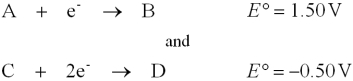 a.Write down the balanced equation representing the cell reaction.
b.Calculate the standard potential of this cell,E°cell.
c.Calculate G° for the cell reaction.
a.Write down the balanced equation representing the cell reaction.
b.Calculate the standard potential of this cell,E°cell.
c.Calculate G° for the cell reaction. (Essay)
4.7/5 (91)
(91) Which of the following solids is commonly used as an inactive electrode in electrochemical cells?
(Multiple Choice)
4.9/5 (84)
(84) A concentration cell consists of two Zn/Zn2+ electrodes.The electrolyte in compartment A is 0.10 M Zn(NO3)2 and in compartment B is 0.60 M Zn(NO3)2.What is the voltage of the cell at 25°C?
(Multiple Choice)
4.8/5 (84)
(84) A solution is prepared by dissolving 32.0 g of NiSO4 in water.What current would be needed to deposit all of the nickel in 5.0 hours?
(Multiple Choice)
4.8/5 (85)
(85) What is the value of the equilibrium constant for the cell reaction below at 25°C? E°cell = 0.30 V
Sn2+(aq)+ Fe(s)  Sn(s)+ Fe2+(aq)
 (Multiple Choice)
4.9/5 (88)
(88) The value of the equilibrium constant for the reaction of nickel(II)ions with cadmium metal is 1.17 105.Calculate G° for the reaction at 25°C.
(Multiple Choice)
4.9/5 (82)
(82) A concentration cell is based on the aqueous reaction
Cu2+(1.00 M) Cu2+(0.0100 M)
The cell consists of copper electrodes dipping into solutions of Cu2+ ions.The anions present are sulfate ions.Draw a neat diagram to represent this cell,showing and labeling all necessary components including: anode,cathode,electron flow,cation flow and anion flow.
(Essay)
4.8/5 (87)
(87) The value of E°cell for the reaction
2Cr3+(aq)+ 6Hg(l) 2Cr(s)+ 3Hg22+(aq)
Is 1.59 V.Calculate G° for the reaction.
(Multiple Choice)
4.9/5 (84)
(84) A voltaic cell consists of a Ag/Ag+ electrode (E° = 0.80 V)and a Fe2+/Fe3+ electrode (E° = 0.77 V)with the following initial molar concentrations: [Fe2+] = 0.30 M;[Fe3+] = 0.10 M;[Ag+] = 0.30 M.What is the equilibrium concentration of Fe3+? (Assume the anode and cathode solutions are of equal volume,and a temperature of 25°C. )
(Multiple Choice)
4.8/5 (76)
(76) Electrolytic cells utilize electrical energy to drive non-spontaneous redox reactions.
(True/False)
4.9/5 (84)
(84) A concentration cell consists of two Al/Al3+electrodes.The electrolyte in compartment A is 0.050 M Al(NO3)3 and in compartment B is 1.25 M Al(NO3)3.What is the voltage of the cell at 25°C?
(Multiple Choice)
4.7/5 (79)
(79) In the electrolyte of an electrochemical cell,current is carried by electrons moving from the anode to the cathode.
(True/False)
4.8/5 (76)
(76) A concentration cell is based on the aqueous reaction
Cu2+(1.00 M) Cu2+(0.0100 M)
Calculate the potential of this cell if it operates at 25.0°C.
(Short Answer)
4.7/5 (72)
(72) The following half-reactions occur in the mercury battery used in calculators.If E°cell = 1.357 V,calculate the equilibrium constant for the cell reaction at 25°C.(Assume the stoichiometric coefficients in the cell reaction are all equal to 1. )
HgO(s)+ H2O(l)+ 2e-  Hg(l)+ 2OH-(aq)
ZnO(s)+ H2O(l)+ 2e-
 Zn(s)+ 2OH-(aq)
Hg(l)+ 2OH-(aq)
ZnO(s)+ H2O(l)+ 2e-
Zn(s)+ 2OH-(aq) (Multiple Choice)
4.8/5 (74)
(74) 
Filters
- Essay(0)
- Multiple Choice(0)
- Short Answer(0)
- True False(0)
- Matching(0)