



 Chat with AI
Exam 10: The Blood Vessels and Blood Pressure

Exam 1: Introduction to Physiology and Homeostasis111 Questions
Exam 2: Cell Physiology181 Questions
Exam 3: The Plasma Membrane and Membrane Potential214 Questions
Exam 4: Principles of Neural and Hormonal Communication230 Questions
Exam 5: The Central Nervous System250 Questions
Exam 6: The Peripheral Nervous System: Afferent Division and Special Senses244 Questions
Exam 7: The Peripheral Nervous System: Efferent Division150 Questions
Exam 8: Muscle Physiology333 Questions
Exam 9: Cardiac Physiology284 Questions
Exam 10: The Blood Vessels and Blood Pressure204 Questions
Exam 11: The Blood and Body Defenses247 Questions
Exam 12: The Respiratory System203 Questions
Exam 13: The Urinary System258 Questions
Exam 14: Fluid and Acid-Base Balance182 Questions
Exam 15: The Digestive System304 Questions
Exam 16: Energy Balance and Temperature Regulation168 Questions
Exam 17: The Endocrine System335 Questions
Exam 18: The Reproductive System302 Questions
Select questions type


If the blood pressure is recorded as 118/76, indicate the correct value of the pressure in question by writing the appropriate letter in the blank using the following answer code:
-What is the systolic pressure?
(Multiple Choice)
4.9/5  (87)
(87) Which of the following is the correct relationship between pressure, flow, and resistance?
(Multiple Choice)
4.7/5 (75)
(75) Indicate what effect the change in question would have on bulk flow using the answer code below:
-rise in capillary blood pressure in connection with congestive heart failure
(Multiple Choice)
4.9/5 (64)
(64) MATCHING
Indicate which type of the vessel performs the function listed by writing the appropriate letter in the blank using the answer code below.
-Serve as low-resistance passageways from the heart to the tissues.
(Multiple Choice)
5.0/5 (80)
(80) MATCHING
Indicate which type of the vessel performs the function listed by writing the appropriate letter in the blank using the answer code below.
-Major resistive vessels.
(Multiple Choice)
4.9/5 (69)
(69) The arterioles, capillaries, and venules are collectively referred to as the __________.
(Short Answer)
4.8/5 (86)
(86) MATCHING
Indicate which type of the vessel performs the function listed by writing the appropriate letter in the blank using the answer code below.
-Serve as low-resistance passageways from the tissues to the heart.
(Multiple Choice)
4.8/5 (72)
(72) MATCHING
Indicate which type of the vessel performs the function listed by writing the appropriate letter in the blank using the answer code below.
-Changes in the radius of this vessel type regulate the distribution of the cardiac output to various areas of the body.
(Multiple Choice)
4.7/5 (73)
(73) As the total cross-sectional area of the vascular tree ____, the velocity of blood flow ____.
(Multiple Choice)
5.0/5 (70)
(70) 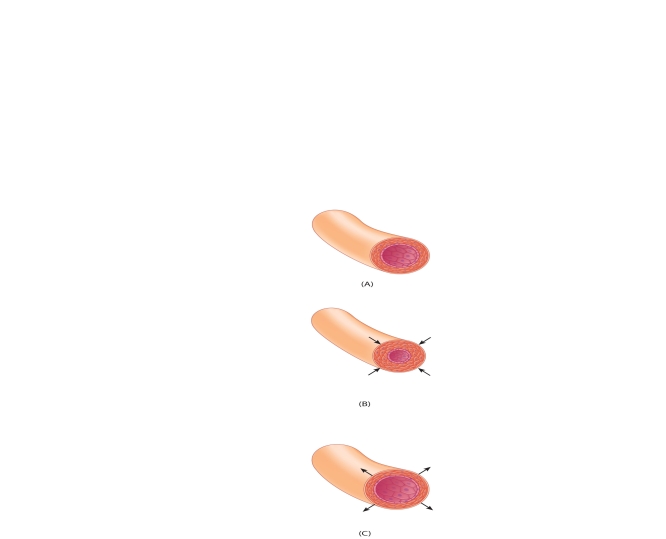 The following questions refer to the accompanying diagram of arteriole vasoconstriction and vasodilation. The diagram shows three state of arteriole tone. The top image labeled "A," shows normal tone. The other two panels labeled "B" and "C" show different state of arteriole tone. Match the statements below with the correct arteriole using A, B, and C.
-Caused by decreased oxygen level
The following questions refer to the accompanying diagram of arteriole vasoconstriction and vasodilation. The diagram shows three state of arteriole tone. The top image labeled "A," shows normal tone. The other two panels labeled "B" and "C" show different state of arteriole tone. Match the statements below with the correct arteriole using A, B, and C.
-Caused by decreased oxygen level (Short Answer)
4.7/5 (86)
(86) MATCHING
Indicate which type of the vessel performs the function listed by writing the appropriate letter in the blank using the answer code below.
-Vessels that pick up fluid that is filtered but not reabsorbed.
(Multiple Choice)
4.8/5 (69)
(69) The extra fluid filtered but not reabsorbed at the capillary level is picked up by the lymphatics.
(True/False)
4.8/5 (85)
(85) Two functions of arteries are ____________________ and ____________________.
(Short Answer)
4.7/5 (76)
(76) The greatest pressure drop in the vascular system occurs within the capillaries due to fluid leaving the capillaries by the process of ultrafiltration.
(True/False)
4.8/5 (76)
(76) Increased respiration within a tissue leads to vasodilation of arterioles because
(Multiple Choice)
4.9/5 (75)
(75) 
Filters
- Essay(0)
- Multiple Choice(0)
- Short Answer(0)
- True False(0)
- Matching(0)