



 Chat with AI
Exam 10: The Blood Vessels and Blood Pressure

Exam 1: Introduction to Physiology and Homeostasis111 Questions
Exam 2: Cell Physiology181 Questions
Exam 3: The Plasma Membrane and Membrane Potential214 Questions
Exam 4: Principles of Neural and Hormonal Communication230 Questions
Exam 5: The Central Nervous System250 Questions
Exam 6: The Peripheral Nervous System: Afferent Division and Special Senses244 Questions
Exam 7: The Peripheral Nervous System: Efferent Division150 Questions
Exam 8: Muscle Physiology333 Questions
Exam 9: Cardiac Physiology284 Questions
Exam 10: The Blood Vessels and Blood Pressure204 Questions
Exam 11: The Blood and Body Defenses247 Questions
Exam 12: The Respiratory System203 Questions
Exam 13: The Urinary System258 Questions
Exam 14: Fluid and Acid-Base Balance182 Questions
Exam 15: The Digestive System304 Questions
Exam 16: Energy Balance and Temperature Regulation168 Questions
Exam 17: The Endocrine System335 Questions
Exam 18: The Reproductive System302 Questions
Select questions type


Water soluble substances such as glucose and amino acids can readily pass through capillary pores during exchange processes.
(True/False)
4.8/5  (80)
(80) The major site of sympathetic blood flow control (resistance changes) is at the
(Multiple Choice)
4.9/5 (80)
(80) When blood pressure falls below normal, indicate what happens to each of the following factors to restore the blood pressure back toward normal.
A. When the blood pressure falls below normal, the rate of firing in the afferent nerves originating from the carotid-sinus and aortic-arch baroreceptors
a. increases.
b. decreases.
c. does not change.
B. As a result of A, the medullary cardiovascular center responds by _____________ the rate of firing in the sympathetic cardiac nerve.
a. increasing
b. decreasing
c. not changing
C. Also as a result of A, the cardiovascular center __________ the rate of firing in the parasympathetic nerve supply to the heart.
a. increases
b. decreases
c. does not alter
D. Also as a result of A, the rate of firing in the sympathetic vasoconstrictor nerve __________ by the cardiovascular center.
a. is increased
b. is decreased
c. is not altered
E. As a result of B and C, the rate of firing of the SA node
a. increases.
b. decreases.
c. remains unchanged.
F. As a result of E, the heart rate
a. increases.
b. decreases.
c. remains unchanged.
G. As a result of D,
a. arteriolar vasoconstriction occurs.
b. arteriolar vasodilation occurs.
c. there is no change in arteriolar radius.
H. As a result of G, total peripheral resistance
a. increases.
b. decreases.
c. remains unchanged.
I. Also as a result of D,
a. venous vasoconstriction occurs.
b. venous vasodilation occurs.
c. there is no change in venous radius.
J. As a result of I, venous return
a. increases.
b. decreases.
c. remains unchanged.
K. As a result of J, end-diastolic volume
a. increases.
b. decreases.
c. remains unchanged.
L. As a result of B and K, stroke volume
a. increases.
b. decreases.
c. remains unchanged.
M. As a result of F and L, cardiac output
a. increases.
b. decreases.
c. remains unchanged.
N. As a result of H and M, blood pressure
a. increases to normal.
b. decreases to normal.
c. remains unchanged.
(Essay)
4.9/5 (81)
(81) Each of the following factors promotes the function of the capillaries except
(Multiple Choice)
4.9/5 (70)
(70) If the pressure gradient in a vessel is constant, flow will double when the radius decreases by two-fold.
(True/False)
4.9/5 (75)
(75) MATCHING
Indicate which type of the vessel performs the function listed by writing the appropriate letter in the blank using the answer code below.
-Serve as a blood reservoir to accommodate variations in blood volume.
(Multiple Choice)
4.8/5 (69)
(69) During circulatory shock, compensatory measures immediately attempt to maintain adequate blood flow to the brain by increasing blood pressure toward normal.
(True/False)
4.9/5 (84)
(84) The primary mechanism for exchange of individual solutes across the capillary wall is ____________________.
(Essay)
4.7/5 (85)
(85) Indicate whether arteriolar vasoconstriction or vasodilation would occur in the tissue in question by using the following answer code:
-a hyperemic response in the heart
(Multiple Choice)
4.8/5 (78)
(78) 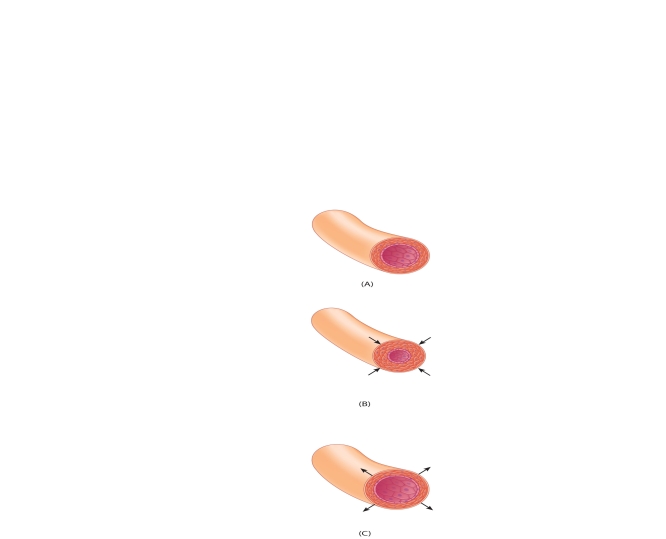 The following questions refer to the accompanying diagram of arteriole vasoconstriction and vasodilation. The diagram shows three state of arteriole tone. The top image labeled "A," shows normal tone. The other two panels labeled "B" and "C" show different state of arteriole tone. Match the statements below with the correct arteriole using A, B, and C.
-Decreased diameter
The following questions refer to the accompanying diagram of arteriole vasoconstriction and vasodilation. The diagram shows three state of arteriole tone. The top image labeled "A," shows normal tone. The other two panels labeled "B" and "C" show different state of arteriole tone. Match the statements below with the correct arteriole using A, B, and C.
-Decreased diameter (Short Answer)
4.9/5 (81)
(81) Indicate what effect the change in question would have on bulk flow using the answer code below:
-expanded plasma volume due to excessive fluid intake
(Multiple Choice)
4.9/5 (72)
(72) Because the arteries have large radii, they serve as excellent rapid-transit passageways for blood. Their second function, related to their elasticity, is to act as a(n) ____ for maintaining blood flow during diastole.
(Multiple Choice)
4.8/5 (81)
(81) What are the roles of the lymphatic system in relation to the cardiovascular system?
(Essay)
4.8/5 (73)
(73) The following local chemical changes occur during a period of increased cell activity except
(Multiple Choice)
4.8/5 (90)
(90) 
Filters
- Essay(0)
- Multiple Choice(0)
- Short Answer(0)
- True False(0)
- Matching(0)