



 Chat with AI
Exam 10: The Blood Vessels and Blood Pressure

Exam 1: Introduction to Physiology and Homeostasis111 Questions
Exam 2: Cell Physiology181 Questions
Exam 3: The Plasma Membrane and Membrane Potential214 Questions
Exam 4: Principles of Neural and Hormonal Communication230 Questions
Exam 5: The Central Nervous System250 Questions
Exam 6: The Peripheral Nervous System: Afferent Division and Special Senses244 Questions
Exam 7: The Peripheral Nervous System: Efferent Division150 Questions
Exam 8: Muscle Physiology333 Questions
Exam 9: Cardiac Physiology284 Questions
Exam 10: The Blood Vessels and Blood Pressure204 Questions
Exam 11: The Blood and Body Defenses247 Questions
Exam 12: The Respiratory System203 Questions
Exam 13: The Urinary System258 Questions
Exam 14: Fluid and Acid-Base Balance182 Questions
Exam 15: The Digestive System304 Questions
Exam 16: Energy Balance and Temperature Regulation168 Questions
Exam 17: The Endocrine System335 Questions
Exam 18: The Reproductive System302 Questions
Select questions type


Indicate what effect the change in question would have on bulk flow using the answer code below:
-reduced synthesis of plasma proteins due to liver disease
(Multiple Choice)
4.8/5  (73)
(73) Which of the following factors would produce the greatest change in blood flow?
(Multiple Choice)
4.7/5 (87)
(87) A major function of the arteries is to serve as a blood reservoir.
(True/False)
4.9/5 (88)
(88) Arterioles to this organ do not normally show vasoconstriction:
(Multiple Choice)
4.7/5 (91)
(91) Mean arterial pressure = ____________________ x ____________________.
(Essay)
5.0/5 (75)
(75) The pressure measured in the arteries just before the next ventricular ejection of blood is
(Multiple Choice)
4.7/5 (68)
(68) 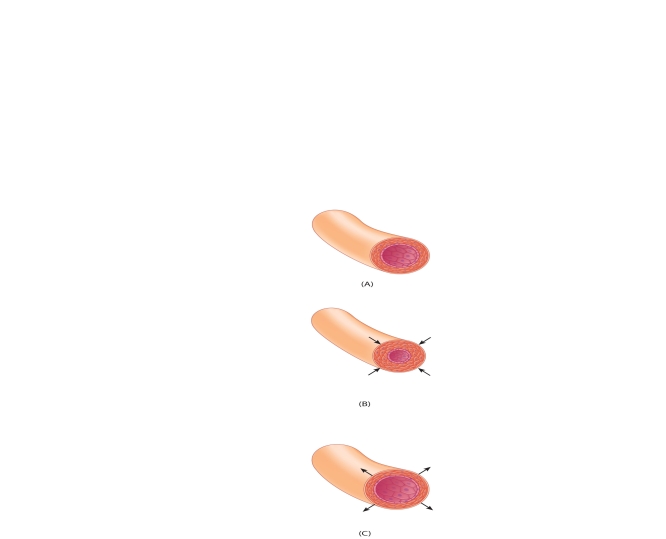 The following questions refer to the accompanying diagram of arteriole vasoconstriction and vasodilation. The diagram shows three state of arteriole tone. The top image labeled "A," shows normal tone. The other two panels labeled "B" and "C" show different state of arteriole tone. Match the statements below with the correct arteriole using A, B, and C.
-Caused by sympathetic stimulation
The following questions refer to the accompanying diagram of arteriole vasoconstriction and vasodilation. The diagram shows three state of arteriole tone. The top image labeled "A," shows normal tone. The other two panels labeled "B" and "C" show different state of arteriole tone. Match the statements below with the correct arteriole using A, B, and C.
-Caused by sympathetic stimulation (Short Answer)
4.8/5 (67)
(67) Indicate whether arteriolar vasoconstriction or vasodilation would occur in the tissue in question by using the following answer code:
-sympathetic stimulation of kidney arterioles
(Multiple Choice)
4.8/5 (86)
(86) Indicate whether arteriolar vasoconstriction or vasodilation would occur in the tissue in question by using the following answer code:
-application of ice to a sprained ankle
(Multiple Choice)
4.9/5 (72)
(72) Fluid return to a capillary bed is driven by plasma colloid osmotic pressure.
(True/False)
4.8/5 (79)
(79)
The following questions refer to the accompanying diagram of arteriole vasoconstriction and vasodilation. The diagram shows three state of arteriole tone. The top image labeled "A," shows normal tone. The other two panels labeled "B" and "C" show different state of arteriole tone. Match the statements below with the correct arteriole using A, B, and C.
-Small amount of NE constantly released onto arteriole
The following questions refer to the accompanying diagram of arteriole vasoconstriction and vasodilation. The diagram shows three state of arteriole tone. The top image labeled "A," shows normal tone. The other two panels labeled "B" and "C" show different state of arteriole tone. Match the statements below with the correct arteriole using A, B, and C.
-Small amount of NE constantly released onto arteriole (Short Answer)
4.8/5 (97)
(97)
The following questions refer to the accompanying diagram of arteriole vasoconstriction and vasodilation. The diagram shows three state of arteriole tone. The top image labeled "A," shows normal tone. The other two panels labeled "B" and "C" show different state of arteriole tone. Match the statements below with the correct arteriole using A, B, and C.
-Caused by application of cold
The following questions refer to the accompanying diagram of arteriole vasoconstriction and vasodilation. The diagram shows three state of arteriole tone. The top image labeled "A," shows normal tone. The other two panels labeled "B" and "C" show different state of arteriole tone. Match the statements below with the correct arteriole using A, B, and C.
-Caused by application of cold (Short Answer)
4.9/5 (92)
(92) Hypertension that occurs because of a known problem of an organ or gland is called _____________.
(Short Answer)
4.7/5 (94)
(94) Venous capacity depends on the ____________________ of the vein walls.
(Short Answer)
4.7/5 (84)
(84) 
Filters
- Essay(0)
- Multiple Choice(0)
- Short Answer(0)
- True False(0)
- Matching(0)