



 Chat with AI
Exam 9: Cardiac Physiology

Exam 1: Introduction to Physiology and Homeostasis111 Questions
Exam 2: Cell Physiology181 Questions
Exam 3: The Plasma Membrane and Membrane Potential214 Questions
Exam 4: Principles of Neural and Hormonal Communication230 Questions
Exam 5: The Central Nervous System250 Questions
Exam 6: The Peripheral Nervous System: Afferent Division and Special Senses244 Questions
Exam 7: The Peripheral Nervous System: Efferent Division150 Questions
Exam 8: Muscle Physiology333 Questions
Exam 9: Cardiac Physiology284 Questions
Exam 10: The Blood Vessels and Blood Pressure204 Questions
Exam 11: The Blood and Body Defenses247 Questions
Exam 12: The Respiratory System203 Questions
Exam 13: The Urinary System258 Questions
Exam 14: Fluid and Acid-Base Balance182 Questions
Exam 15: The Digestive System304 Questions
Exam 16: Energy Balance and Temperature Regulation168 Questions
Exam 17: The Endocrine System335 Questions
Exam 18: The Reproductive System302 Questions
Select questions type


Use the following answer code to compare the magnitude of the items in question.
-A. Stroke volume of right ventricle
B. Stroke volume of left ventricle
(Multiple Choice)
5.0/5  (85)
(85) MATCHING
Match term with correct characteristic.
-Volume of blood in the ventricle before it contracts
(Multiple Choice)
4.8/5 (76)
(76) The rate of appearance of the QRS and T waves is unaffected if the heart develops a complete heart block.
(True/False)
4.9/5 (79)
(79) Using the following answer code, indicate which pressure relationship exists during the time in question.
-when the aortic valve closes
(Multiple Choice)
4.8/5 (86)
(86) The tricuspid prevents regurgitation of blood from the right ventricle back into the right atrium.
(True/False)
4.8/5 (82)
(82) The plateau phase of the action potential in a contractile cardiac muscle cell occurs as a result of activation of slow Ca²? channels.
(True/False)
4.8/5 (63)
(63) The average resting heart rate is normally established by the rhythm of the AV node.
(True/False)
4.9/5 (80)
(80) Indicate the effects of sympathetic and parasympathetic stimulation on the heart using the following answer code:
-decreases the contractility of the atrial muscle
(Multiple Choice)
4.8/5 (86)
(86) Which number on the diagram represents the ECG wave immediately after the SA node fires? 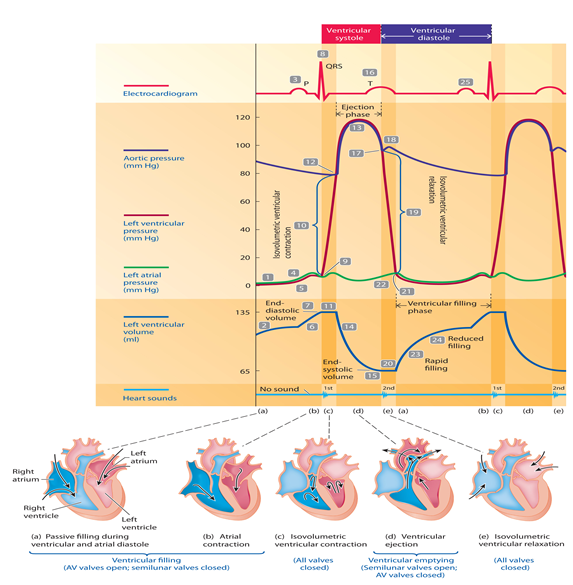
(Multiple Choice)
4.8/5 (70)
(70) An increase in cardiac sympathetic activity ____________________ the rate of depolarization of the SA node.
(Short Answer)
4.7/5 (73)
(73) MATCHING: ART
 The following questions refer to the accompanying diagram of the heart. Eight structures (vessels or chambers) labels have been removed and replaced with letters A-H. Match the letter with list of missing terms below to complete the diagram.
-left ventricle
The following questions refer to the accompanying diagram of the heart. Eight structures (vessels or chambers) labels have been removed and replaced with letters A-H. Match the letter with list of missing terms below to complete the diagram.
-left ventricle (Short Answer)
4.9/5 (61)
(61) An increase in parasympathetic activity ____________________ the stroke volume.
(Short Answer)
4.8/5 (75)
(75) If the cardiac output is 4,800 ml/min and the heart rate is 60 beats per minute, the stroke volume averages ____ ml.
(Multiple Choice)
4.8/5 (86)
(86) Use the following answer code to compare the magnitude of the items in question.
-A. Duration of the refractory period in cardiac muscle
B. Duration of the refractory period in skeletal muscle
(Multiple Choice)
4.7/5 (73)
(73) All of the blood within the ventricles is ejected during ventricular systole.
(True/False)
4.9/5 (78)
(78) Match EKG feature with correct characteristic.
-Time during which ventricles are contracting and emptying.
(Multiple Choice)
4.7/5 (81)
(81) Indicate which ion is involved in each event being described by using the following answer code.
-Changes in cytosolic _____ concentration bring about changes in the strength of cardiac contraction.
(Multiple Choice)
4.8/5 (72)
(72) An increase in heart rate ____________________ the cardiac output.
(Short Answer)
4.8/5 (86)
(86) Use the answer code below to complete the following statements.
-Stroke volume can be increased by increasing _____ and _____.
(Multiple Choice)
4.9/5 (81)
(81) 
Filters
- Essay(0)
- Multiple Choice(0)
- Short Answer(0)
- True False(0)
- Matching(0)