



 Chat with AI
Exam 9: Cardiac Physiology

Exam 1: Introduction to Physiology and Homeostasis111 Questions
Exam 2: Cell Physiology181 Questions
Exam 3: The Plasma Membrane and Membrane Potential214 Questions
Exam 4: Principles of Neural and Hormonal Communication230 Questions
Exam 5: The Central Nervous System250 Questions
Exam 6: The Peripheral Nervous System: Afferent Division and Special Senses244 Questions
Exam 7: The Peripheral Nervous System: Efferent Division150 Questions
Exam 8: Muscle Physiology333 Questions
Exam 9: Cardiac Physiology284 Questions
Exam 10: The Blood Vessels and Blood Pressure204 Questions
Exam 11: The Blood and Body Defenses247 Questions
Exam 12: The Respiratory System203 Questions
Exam 13: The Urinary System258 Questions
Exam 14: Fluid and Acid-Base Balance182 Questions
Exam 15: The Digestive System304 Questions
Exam 16: Energy Balance and Temperature Regulation168 Questions
Exam 17: The Endocrine System335 Questions
Exam 18: The Reproductive System302 Questions
Select questions type


Up to 40% of the cell volume of cardiac muscle cells is occupied by mitochondria.
(True/False)
4.8/5  (90)
(90) Which number on the diagram represents maximal blood pressure recorded in the aorta?
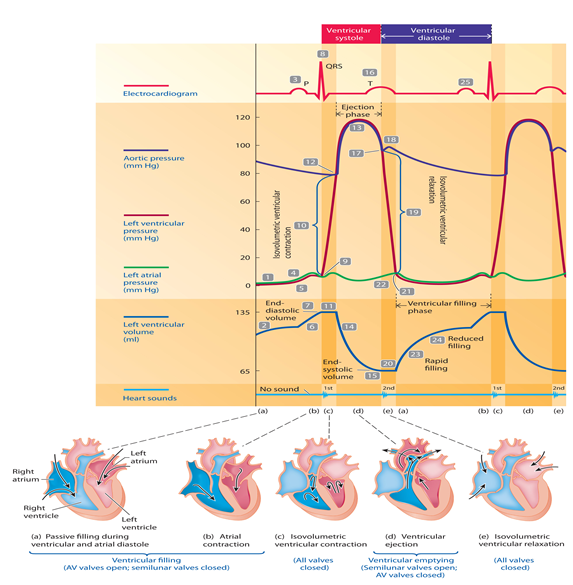
(Multiple Choice)
5.0/5 (72)
(72) Use the answer code below to complete the following statements.
-The minimum volume of blood that the ventricle contains after emptying is complete is the _____.
(Multiple Choice)
4.9/5 (76)
(76) ____________ and ____________ muscles are associated with AV valves and prevent the valves from everting.
(Short Answer)
4.9/5 (68)
(68) Match heart characteristic with correct anatomical structure. Choices may be used more than once or not at all.
-contraction of this generates blood pressure
(Multiple Choice)
4.8/5 (89)
(89) Contraction of the spirally arranged cardiac muscle fibers produces a wringing effect for efficient pumping.
(True/False)
4.8/5 (86)
(86) The ____________________ is the normal pacemaker of the heart.
(Short Answer)
4.9/5 (90)
(90) Use the following answer code to indicate which factor involved in the initiation and spread of cardiac excitation is being identified.
-Rapidly conducts the impulse down the ventricular septum and throughout much of the ventricular musculature.
(Multiple Choice)
5.0/5 (78)
(78) Match heart characteristic with correct anatomical structure. Choices may be used more than once or not at all.
-its fast Ca²+ channels help initiate
(Multiple Choice)
4.9/5 (76)
(76) Indicate which ion is involved in each event being described by using the following answer code.
-Ion which passes through funny channels.
(Multiple Choice)
4.8/5 (79)
(79) Use the following answer code to compare the magnitude of the items in question.
-A. volume of blood in the ventricles at the onset of isovolumetric ventricular contraction
B. volume of blood in the ventricles at the end of isovolumetric ventricular contraction
(Multiple Choice)
4.8/5 (73)
(73) Which molecule(s) induce vasodilation of coronary arteries?
(Multiple Choice)
4.9/5 (81)
(81) The heart muscle receives its oxygen and nutrients directly from the blood within its chambers during ventricular diastole.
(True/False)
5.0/5 (69)
(69) The heart undergoes tetanic contraction during sympathetic stimulation to squeeze out more blood.
(True/False)
4.8/5 (88)
(88) The ____________________ is the volume of blood pumped by each ventricle/minute.
(Short Answer)
4.9/5 (79)
(79) 
Filters
- Essay(0)
- Multiple Choice(0)
- Short Answer(0)
- True False(0)
- Matching(0)