



 Chat with AI
Exam 9: Cardiac Physiology

Exam 1: Introduction to Physiology and Homeostasis111 Questions
Exam 2: Cell Physiology181 Questions
Exam 3: The Plasma Membrane and Membrane Potential214 Questions
Exam 4: Principles of Neural and Hormonal Communication230 Questions
Exam 5: The Central Nervous System250 Questions
Exam 6: The Peripheral Nervous System: Afferent Division and Special Senses244 Questions
Exam 7: The Peripheral Nervous System: Efferent Division150 Questions
Exam 8: Muscle Physiology333 Questions
Exam 9: Cardiac Physiology284 Questions
Exam 10: The Blood Vessels and Blood Pressure204 Questions
Exam 11: The Blood and Body Defenses247 Questions
Exam 12: The Respiratory System203 Questions
Exam 13: The Urinary System258 Questions
Exam 14: Fluid and Acid-Base Balance182 Questions
Exam 15: The Digestive System304 Questions
Exam 16: Energy Balance and Temperature Regulation168 Questions
Exam 17: The Endocrine System335 Questions
Exam 18: The Reproductive System302 Questions
Select questions type


What component of the cardiac conduction system distributes electrical signals through the papillary muscles directly?
(Multiple Choice)
4.9/5  (76)
(76) The sinoatrial node is the heart's normal pacemaker because
(Multiple Choice)
4.9/5 (86)
(86) Use the following answer code to compare the magnitude of the items in question.
-A. duration of diastole at resting heart rate
B. duration of diastole at rapid heart rate during exercise
(Multiple Choice)
4.9/5 (99)
(99) MATCHING: ART
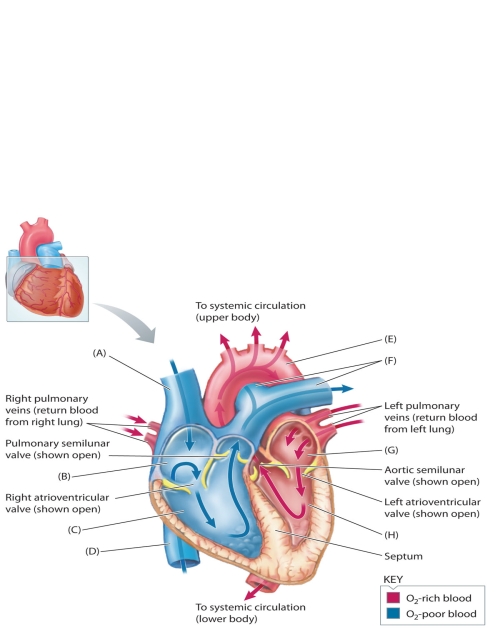 The following questions refer to the accompanying diagram of the heart. Eight structures (vessels or chambers) labels have been removed and replaced with letters A-H. Match the letter with list of missing terms below to complete the diagram.
-pulmonary arteries
The following questions refer to the accompanying diagram of the heart. Eight structures (vessels or chambers) labels have been removed and replaced with letters A-H. Match the letter with list of missing terms below to complete the diagram.
-pulmonary arteries (Short Answer)
4.8/5 (75)
(75) Indicate the effects of sympathetic and parasympathetic stimulation on the heart using the following answer code:
-increases cardiac output
(Multiple Choice)
4.9/5 (73)
(73) Use the following answer code to compare the magnitude of the items in question.
-A. volume of blood pumped out by the left side of the heart
B. volume of blood pumped out by the right side of the heart
(Multiple Choice)
4.7/5 (87)
(87) The heart utilizes glucose almost exclusively for energy production.
(True/False)
4.9/5 (74)
(74) Stroke volume can vary by alterations in both intrinsic and extrinsic control mechanisms.
(True/False)
4.9/5 (75)
(75) The cardiac output is the same as the cardiac reserve of the heart.
(True/False)
4.8/5 (81)
(81) Use the following answer code to compare the magnitude of the items in question.
-A. duration of systole at resting heart rate
B. duration of systole at rapid heart rate during exercise
(Multiple Choice)
4.9/5 (88)
(88) The functional syncytia of the myocardium is offered by the intercalated discs.
(True/False)
4.9/5 (79)
(79) Indicate which is the proper sequence of blood flow through the circulatory system. 1. right atrium
2. left atrium
3. right ventricle
4. left ventricle
5. pulmonary artery
6. pulmonary vein
7. lungs
8. systemic tissues
9. aorta
10. vena cava
(Multiple Choice)
4.8/5 (66)
(66) Match heart characteristic with correct anatomical structure. Choices may be used more than once or not at all.
-the ventricles' left is much thicker
(Multiple Choice)
4.9/5 (78)
(78) Forward failure is when the heart fails to pump an adequate amount of blood forward to the tissues because the stroke volume becomes progressively smaller.
(True/False)
4.9/5 (82)
(82) What percentage of ventricular filling is normally accomplished before atrial contraction begins?
(Multiple Choice)
4.9/5 (81)
(81) The ventricles always depolarize at the same rate as the SA node depolarizes.
(True/False)
4.7/5 (80)
(80) 
Filters
- Essay(0)
- Multiple Choice(0)
- Short Answer(0)
- True False(0)
- Matching(0)