



 Chat with AI
Exam 6: Elasticity: the Responsiveness of Demand and Supply

Exam 1: Economics: Foundations and Models444 Questions
Exam 2: Trade-Offs, Comparative Advantage, and the Market System498 Questions
Exam 3: Where Prices Come From: the Interaction of Demand and Supply475 Questions
Exam 4: Economic Efficiency, Government Price Setting, and Taxes419 Questions
Exam 5: Externalities, Environmental Policy, and Public Goods266 Questions
Exam 6: Elasticity: the Responsiveness of Demand and Supply295 Questions
Exam 7: The Economics of Health Care334 Questions
Exam 8: Firms, the Stock Market, and Corporate Governance278 Questions
Exam 9: Comparative Advantage and the Gains From International Trade379 Questions
Exam 10: Consumer Choice and Behavioral Economics302 Questions
Exam 11: Technology, Production, and Costs330 Questions
Exam 12: Firms in Perfectly Competitive Markets298 Questions
Exam 13: Monopolistic Competition: the Competitive Model in a More Realistic Setting276 Questions
Exam 14: Oligopoly: Firms in Less Competitive Markets262 Questions
Exam 15: Monopoly and Antitrust Policy271 Questions
Exam 16: Pricing Strategy263 Questions
Exam 17: The Markets for Labor and Other Factors of Production286 Questions
Exam 18: Public Choice, Taxes, and the Distribution of Income258 Questions
Exam 19: GDP: Measuring Total Production and Income266 Questions
Exam 20: Unemployment and Inflation292 Questions
Exam 21: Economic Growth, the Financial System, and Business Cycles257 Questions
Exam 22: Long-Run Economic Growth: Sources and Policies268 Questions
Exam 23: Aggregate Expenditure and Output in the Short Run306 Questions
Exam 24: Aggregate Demand and Aggregate Supply Analysis284 Questions
Exam 25: Money, Banks, and the Federal Reserve System280 Questions
Exam 26: Monetary Policy277 Questions
Exam 27: Fiscal Policy303 Questions
Exam 28: Inflation, Unemployment, and Federal Reserve Policy257 Questions
Exam 29: Macroeconomics in an Open Economy278 Questions
Exam 30: The International Financial System262 Questions
Select questions type


Suppose you are considering buying stock in the stock market, and your objective is to maximize your net worth. Furthermore, your study of the market reveals that the economy will be slowing down over the next several months. Under these conditions, it would be best to purchase stock in companies that produce
(Multiple Choice)
4.8/5  (83)
(83) If at a price of $10, a vendor sells 5 units of a product and at a price of $8, 6 units are sold, then, using the midpoint formula, the demand for this good is inelastic.
(True/False)
4.8/5 (76)
(76) Last year, Joan bought 50 pounds of hamburger when her household income was $40,000. This year, her household income was only $30,000 and Joan bought 60 pounds of hamburger. Holding everything else constant, Joan's income elasticity of demand for hamburger is
(Multiple Choice)
4.9/5 (66)
(66) In September 2012, the average price of gasoline in the United States was $3.91 per gallon, and consumers purchased nearly 5 percent less gasoline than they had during September 2011, when the average price of gasoline was $3.66 per gallon. Based on these figures, from September 2011 to September 2012, the demand for gasoline was
(Multiple Choice)
4.8/5 (81)
(81) An increase in the demand for green tea raises the price of apples from $16 a pound to $20 a pound. As a result, quantity supplied increases by 30 percent. Using the midpoint formula, calculate the value of the price elasticity of supply?
(Multiple Choice)
4.8/5 (76)
(76) Suppose the California Nurses Union successfully secured a 12 percent increase in the wages of registered nurses. If a hospital responds by reducing the quantity of registered nurses hired and increasing the quantity of physician's assistants hired, what conclusion can you draw?
(Multiple Choice)
4.8/5 (83)
(83) The price elasticity of the supply of teenage labor services is approximately 1.36. Suppose the minimum wage rises from $7.25 per hour to $8.75. Using the midpoint formula, calculate the approximately change in the quantity supplied of teenage labor.
(Multiple Choice)
4.8/5 (84)
(84) Figure 6-12 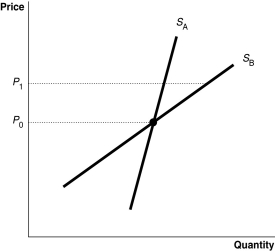 -Suppose the demand curve for a product is represented by a typical downward-sloping curve. Now suppose the demand for this product increases. Which of the following statements accurately predicts the resulting increase in price?
 (Multiple Choice)
4.8/5 (90)
(90) The price elasticity of demand for Stork ice cream is -4. Suppose you're told that following a price increase, quantity demanded fell by 10 percent. What was the percentage change in price that brought about this change in quantity demanded?
(Multiple Choice)
4.9/5 (74)
(74) Explain the economic concept of price elasticity of supply. How is price elasticity of supply calculated?
(Essay)
5.0/5 (75)
(75) Figure 6-3 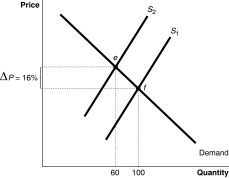 -Which of the following statements about price elasticity of demand is false?
 (Multiple Choice)
4.9/5 (70)
(70) Holding everything else constant, the demand for a good tends to be more elastic
(Multiple Choice)
4.9/5 (76)
(76) If the percentage increase in price is 15 percent and the value of the price elasticity of demand is -3, then quantity demanded
(Multiple Choice)
5.0/5 (92)
(92) If a firm wanted to know whether the demand for its product was elastic, unit-elastic, or inelastic, then the firm could
(Multiple Choice)
4.9/5 (79)
(79) If at a price of $24, Octavia sells 36 home-grown orchids and at $30 she sells 24 home-grown orchids, the demand for her orchids is
(Multiple Choice)
4.9/5 (83)
(83) Suppose the absolute value of the price elasticity of demand for basketball game tickets on your campus is greater than 1. Increasing ticket prices will increase the total revenue from ticket sales.
(True/False)
4.9/5 (81)
(81) The price elasticity of demand for canned soup is estimated at -1.62. What happens to sales revenue if the price of canned soup rises?
(Multiple Choice)
4.8/5 (71)
(71) When the price of tortilla chips rose by 10 percent, the quantity of tortilla chips sold fell 4 percent. This indicates that the demand for tortilla chips is
(Multiple Choice)
5.0/5 (96)
(96) Since 1950 there has been a substantial increase in wheat production. The increase in production has led to a decrease in the price of wheat because of which of the following factors?
(Multiple Choice)
5.0/5 (80)
(80) 
Filters
- Essay(0)
- Multiple Choice(0)
- Short Answer(0)
- True False(0)
- Matching(0)