



 Chat with AI
Exam 2: Thinking Like an Economist

Exam 1: Ten Principles of Economics216 Questions
Exam 2: Thinking Like an Economist234 Questions
Exam 3: Interdependence and the Gains From Trade206 Questions
Exam 4: The Market Forces of Supply and Demand349 Questions
Exam 5: Measuring a Nations Income169 Questions
Exam 6: Measuring the Cost of Living181 Questions
Exam 7: Production and Growth191 Questions
Exam 8: Saving, investment, and the Financial System213 Questions
Exam 9: Unemployment and Its Natural Rate197 Questions
Exam 10: The Monetary System204 Questions
Exam 11: Money Growth and Inflation195 Questions
Exam 12: Open-Economy Macroeconomics: Basic Concepts220 Questions
Exam 13: A Macroeconomic Theory of the Small Open Economy196 Questions
Exam 14: Aggregate Demand and Aggregate Supply257 Questions
Exam 15: The Influence of Monetary and Fiscal Policy on Aggregate Demand222 Questions
Exam 16: The Short-Run Tradeoff Between Inflation and Unemployment207 Questions
Exam 17: Five Debates Over Macroeconomic Policy119 Questions
Select questions type


Figure 2-11 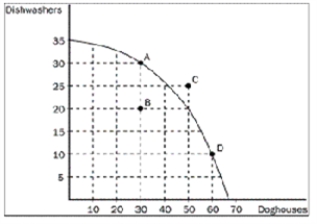 -Refer to Figure 2-11.Points A,B,and D represent feasible or attainable outcomes for society.
 (True/False)
4.7/5  (86)
(86) What are the two basic reasons why economists often appear to give conflicting advice to policymakers?
(Multiple Choice)
4.7/5 (90)
(90) Figure 2-10  -Refer to Figure 2-10.What is the movement from point A to point B?
 (Multiple Choice)
4.9/5 (80)
(80) Which statement best describes the way economists study the economy?
(Multiple Choice)
4.9/5 (67)
(67) What is a common thread between economics and other sciences,such as physics?
(Multiple Choice)
4.9/5 (74)
(74) This exercise will show you how different theories (models)can lead to very different courses of action.Suppose we ask the following question: Does income inequality promote economic growth and society's overall prosperity? Suppose two economists come up with the following theories (models):
Economist A believes that wealth accumulation in just a few hands increases savings because consumption is necessarily limited.Higher savings,in turn,allow investing in new production facilities that increase the country's overall income and everybody is better off.So,Economist A advocates a non-equalitarian society.
Economist B thinks that a very unequal distribution of wealth will increase capacities of production beyond the purchasing power of an essentially poor mass of consumers.For a while,consumers will increase their consumption,and prosperity,by borrowing from the rich,but eventually they will not be able to repay their debts and the economy will collapse for lack of demand.At that point,investing in new production facilities becomes unnecessary.In conclusion,Economist B thinks that extreme income inequality is counterproductive.
a.What are the policy implications of the two theories? (In other words,does it matter which theory is correct?)
b.How would a scientist determine which theory is correct?
c.Under what conditions would each of the two models be correct? Could one use both models under different circumstances?
(Essay)
4.9/5 (87)
(87) What are the four sectors in a more complex circular-flow diagram?
(Multiple Choice)
4.9/5 (99)
(99) What is a type of graph that can be used to display the relationship between two variables?
(Multiple Choice)
4.9/5 (78)
(78) Figure 2-4 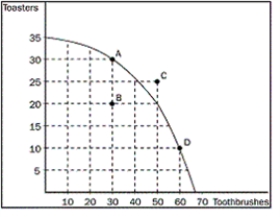 -Refer to Figure 2-4.Suppose the economy is at point A.What is the opportunity cost of increasing the production of toothbrushes by 20 units?
 (Multiple Choice)
4.8/5 (78)
(78) What are economists who try to improve the world considered?
(Multiple Choice)
4.8/5 (84)
(84) Figure 2-3  -Refer to Figure 2-3.At which point or points can the economy NOT produce?
 (Multiple Choice)
5.0/5 (83)
(83) What do economists at Foreign Affairs Canada and International Trade Canada do?
(Multiple Choice)
4.8/5 (81)
(81) According to a simple circular-flow diagram,how many markets do households and firms interact in?
(Multiple Choice)
4.7/5 (103)
(103) 
Filters
- Essay(0)
- Multiple Choice(0)
- Short Answer(0)
- True False(0)
- Matching(0)