



 Chat with AI
Exam 2: Thinking Like an Economist

Exam 1: Ten Principles of Economics216 Questions
Exam 2: Thinking Like an Economist234 Questions
Exam 3: Interdependence and the Gains From Trade206 Questions
Exam 4: The Market Forces of Supply and Demand349 Questions
Exam 5: Measuring a Nations Income169 Questions
Exam 6: Measuring the Cost of Living181 Questions
Exam 7: Production and Growth191 Questions
Exam 8: Saving, investment, and the Financial System213 Questions
Exam 9: Unemployment and Its Natural Rate197 Questions
Exam 10: The Monetary System204 Questions
Exam 11: Money Growth and Inflation195 Questions
Exam 12: Open-Economy Macroeconomics: Basic Concepts220 Questions
Exam 13: A Macroeconomic Theory of the Small Open Economy196 Questions
Exam 14: Aggregate Demand and Aggregate Supply257 Questions
Exam 15: The Influence of Monetary and Fiscal Policy on Aggregate Demand222 Questions
Exam 16: The Short-Run Tradeoff Between Inflation and Unemployment207 Questions
Exam 17: Five Debates Over Macroeconomic Policy119 Questions
Select questions type


Figure 2-9  -Refer to Figure 2-9.What would you say about the relationship between coffee and hours without sleep?
 (Multiple Choice)
4.9/5  (69)
(69) An economy can produce at any point on or outside the production possibilities frontier,but it cannot produce at points inside the frontier.
(True/False)
4.8/5 (86)
(86) Figure 2-11 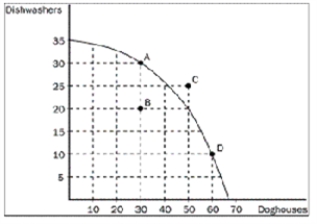 -Refer to Figure 2-11.The opportunity cost to the economy of moving from point A to point B is 10 dishwashers.
 (True/False)
4.9/5 (80)
(80) Suppose there are two countries,Freedonia and Sylvania,which have identical amounts of resources,identical technologies,and identical populations.Both produce two types of goods,consumer goods and capital goods,and they both always operate on their production possibilities frontiers.The only difference is that this year Sylvania chooses to produce relatively more capital goods than Freedonia. What will happen as a result?
(Multiple Choice)
4.9/5 (76)
(76) What do almost all economists agree on about rent control?
(Multiple Choice)
4.8/5 (89)
(89) What happens when two variables have a negative correlation?
(Multiple Choice)
4.9/5 (87)
(87) Figure 2-11
-Refer to Figure 2-11.The opportunity cost of more doghouses increases as more doghouses are produced.
-Refer to Figure 2-11.The opportunity cost of more doghouses increases as more doghouses are produced. (True/False)
4.8/5 (75)
(75) What do the duties of the economists employed by Human Resources and Skill Development Canada include?
(Multiple Choice)
4.8/5 (87)
(87) Figure 2-3  -Refer to Figure 2-3.At which point or points can the economy produce?
 (Multiple Choice)
4.8/5 (69)
(69) In the simple circular-flow diagram,who are the decision makers?
(Multiple Choice)
4.8/5 (76)
(76) When a production possibilities frontier is linear,what does it show?
(Multiple Choice)
4.9/5 (77)
(77) Figure 2-2 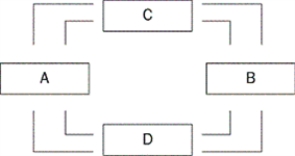 -Refer to Figure 2-2.What does the inner loop represent?
 (Multiple Choice)
4.8/5 (84)
(84) When economists are speaking as policy advisors,which statements are they more likely to use?
(Multiple Choice)
4.9/5 (92)
(92) Table 2-1
Production Possibilities for Toyland  -Refer to Table 2-1.What is the opportunity cost to Toyland of increasing the production of dolls from 0 to 100?
 (Multiple Choice)
4.8/5 (66)
(66) Figure 2-10  -Refer to Figure 2-10.What is the slope of the curve between point A and point B?
 (Multiple Choice)
4.9/5 (85)
(85) "Society would be better if the welfare system were abolished" is a normative statement,not a positive statement.
(True/False)
4.7/5 (76)
(76) Suppose there are two countries,Freedonia and Sylvania,which have identical amounts of resources,identical technologies,and identical populations.Both produce two types of goods,consumer goods and capital goods,and they both always operate on their production possibilities frontiers.The only difference is that this year Freedonia chooses to produce relatively more consumer goods than Sylvania. What will happen as a result?
(Multiple Choice)
4.7/5 (74)
(74) 
Filters
- Essay(0)
- Multiple Choice(0)
- Short Answer(0)
- True False(0)
- Matching(0)