



 Chat with AI
Exam 16: The Short-Run Tradeoff Between Inflation and Unemployment

Exam 1: Ten Principles of Economics216 Questions
Exam 2: Thinking Like an Economist234 Questions
Exam 3: Interdependence and the Gains From Trade206 Questions
Exam 4: The Market Forces of Supply and Demand349 Questions
Exam 5: Measuring a Nations Income169 Questions
Exam 6: Measuring the Cost of Living181 Questions
Exam 7: Production and Growth191 Questions
Exam 8: Saving, investment, and the Financial System213 Questions
Exam 9: Unemployment and Its Natural Rate197 Questions
Exam 10: The Monetary System204 Questions
Exam 11: Money Growth and Inflation195 Questions
Exam 12: Open-Economy Macroeconomics: Basic Concepts220 Questions
Exam 13: A Macroeconomic Theory of the Small Open Economy196 Questions
Exam 14: Aggregate Demand and Aggregate Supply257 Questions
Exam 15: The Influence of Monetary and Fiscal Policy on Aggregate Demand222 Questions
Exam 16: The Short-Run Tradeoff Between Inflation and Unemployment207 Questions
Exam 17: Five Debates Over Macroeconomic Policy119 Questions
Select questions type


If the short-run Phillips curve were stable,what would be unusual?

Free
(Multiple Choice)
4.9/5  (76)
(76) Correct Answer: Verified
B
Which hypothesis is supported by the economic experience of Canada during the late 1960s and early 1970s?
Free
(Multiple Choice)
4.8/5 (79)
(79) Correct Answer:Verified
VerifiedB
What is the effect of an adverse supply shock?
Free
(Multiple Choice)
4.7/5 (71)
(71) Correct Answer:Verified
VerifiedD
Figure 16-4 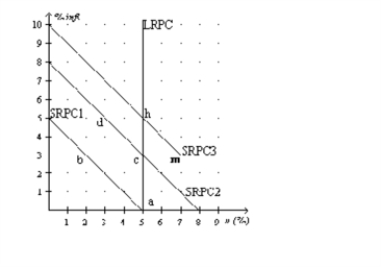 -Refer to the Figure 16-4.If the economy is at point c and the Bank of Canada pursues an expansionary monetary policy,then the economy will move to which point in the short and long run?
 (Multiple Choice)
4.8/5 (77)
(77) Friedman and Phelps believed that the natural rate of unemployment was constant.
(True/False)
4.9/5 (75)
(75) What did Friedman and Phelps argue about the effectiveness of monetary policies?
(Multiple Choice)
4.9/5 (83)
(83) If efficiency wages became more common,where would the long-run Phillips curve and the long-run aggregate-supply curve shift?
(Multiple Choice)
4.9/5 (70)
(70) According to Friedman and Phelps,no matter what a central bank does to the money supply,what will happen in the long run?
(Multiple Choice)
4.7/5 (77)
(77) In the long run,how does an increase in the rate of growth of the money supply shift the Phillips curves?
(Multiple Choice)
4.8/5 (98)
(98) If technological change shifts the long-run aggregate-supply curve to the right,it will also do which of the following?
(Multiple Choice)
4.9/5 (88)
(88) What did Samuelson and Solow believe about the Phillips curve?
(Multiple Choice)
4.9/5 (84)
(84) Suppose that weather around the world is especially good next year,so farmers have unusually good crops.What might we expect that this will do to the short-run and long-run Phillips curves?
(Multiple Choice)
4.8/5 (73)
(73) In 1980,how did the Canadian misery index compare to the average?
(Multiple Choice)
4.9/5 (72)
(72) Figure 16-1 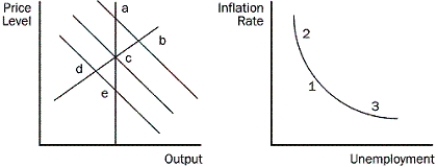 -Refer to the Figure 16-1.If the economy starts at c and 1,then in the short run,where does a decrease in aggregate demand move the economy?
 (Multiple Choice)
4.9/5 (71)
(71) Suppose the natural rate of unemployment is 6 percent,the expected inflation is 2 percent,and the constant "a" in the short-run Phillips curve equation is 0.8.Draw the long-run and short-run Phillips curves.What is the inflation rate corresponding to the intersection of the two curves?
(Essay)
4.9/5 (76)
(76) How will a favourable supply shock shift the short-run Phillips curve,and how does unemployment change?
(Multiple Choice)
4.8/5 (85)
(85) According to the Friedman-Phelps analysis,in the long run,actual inflation equals expected inflation,and unemployment is at its natural rate.
(True/False)
4.8/5 (79)
(79) Figure 16-2 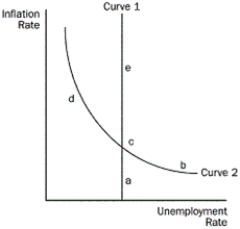 -Refer to the Figure 16-2.If the economy starts at c and the money supply growth rate increases,where does the economy move to in the long run?
 (Multiple Choice)
4.9/5 (84)
(84) In the late 1960s,which of the following was published by economist Edmund Phelps?
(Multiple Choice)
4.8/5 (71)
(71) 
Filters
- Essay(0)
- Multiple Choice(0)
- Short Answer(0)
- True False(0)
- Matching(0)