



 Chat with AI
Exam 11: Long-Run Economic Growth: Sources and Policies

Exam 1: Economics: Foundations and Models211 Questions
Exam 2: Trade-Offs,comparative Advantage,and the Market System239 Questions
Exam 3: Where Prices Come From: the Interaction of Demand and Supply233 Questions
Exam 4: Economic Efficiency, government Price Setting, and Taxes211 Questions
Exam 5: The Economics of Health Care164 Questions
Exam 6: Firms,the Stock Market,and Corporate Governance276 Questions
Exam 7: Comparative Advantage and the Gains From International Trade190 Questions
Exam 8: GDP: Measuring Total Production and Income266 Questions
Exam 9: Unemployment and Inflation292 Questions
Exam 10: Economic Growth, the Financial System, and Business Cycles257 Questions
Exam 11: Long-Run Economic Growth: Sources and Policies268 Questions
Exam 12: Aggregate Expenditure and Output in the Short Run306 Questions
Exam 13: Aggregate Demand and Aggregate Supply Analysis284 Questions
Exam 14: Money, banks, and the Federal Reserve System280 Questions
Exam 15: Monetary Policy277 Questions
Exam 16: Fiscal Policy303 Questions
Exam 17: Inflation, unemployment, and Federal Reserve Policy257 Questions
Exam 18: Macroeconomics in an Open Economy278 Questions
Exam 19: The International Financial System262 Questions
Select questions type


The productivity slowdown experience in the United States from the mid-1970s to the mid-1990s was actually a global phenomenon.
(True/False)
4.7/5  (88)
(88) Empirical evidence from 1960 to 2010 shows that convergence in economic growth is occurring in which of the following cases?
(Multiple Choice)
4.8/5 (85)
(85) Because firms can free ride on the research and development of other firms,
(Multiple Choice)
5.0/5 (98)
(98) Explain three reasons why the productivity slowdown of 1974-1995 occurred.
(Essay)
4.9/5 (86)
(86) Figure 11-2  -Refer to Figure 11-2.Assuming no technological change,if the United States increases capital per hour worked by $40,000 every year between 2010 and 2014,we would expect to see
 (Multiple Choice)
4.8/5 (77)
(77) When additions of input to a fixed quantity of another input lead to progressively smaller increases in output,we say we are facing
(Multiple Choice)
4.8/5 (76)
(76) In a small European country,it is estimated that changing the level of capital from $8 million to $10 million will increase real GDP from $2 million to $3 million.What level of GDP would you expect the economy to be able to reach if spending on capital continued to rise to $12 million,assuming no technological change and no change in the hours of work?
(Multiple Choice)
4.8/5 (69)
(69) The owner of a firm wants some advice on how to increase productivity.Suggest three ways the entrepreneur could increase labor productivity through improving technology.
(Essay)
4.9/5 (86)
(86) Which of the following is an example of foreign direct investment?
(Multiple Choice)
5.0/5 (89)
(89) Starting at point B in the diagram below,identify which combinations of points illustrate technological change.Give a brief explanation to support your answer. 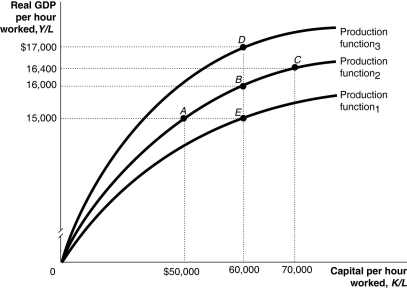
(Essay)
4.9/5 (78)
(78) Because knowledge capital is nonexcludable and nonrival,firms have an incentive to ________ the research and development of other firms.
(Multiple Choice)
4.8/5 (82)
(82) Some economists argue that the apparent slowdown in economic growth in the United States during the mid-1970s may not really have reduced the standard of living because
(Multiple Choice)
4.8/5 (85)
(85) Which of the following is an example of the way the financial markets in the United States can encourage technological progress more efficiently than other countries?
(Multiple Choice)
5.0/5 (85)
(85) The per-worker production function has a ________ slope,indicating that increases in capital per hour worked ________ real GDP.
(Multiple Choice)
4.9/5 (86)
(86) According to Joseph Schumpeter,economic growth is achieved through
(Multiple Choice)
4.9/5 (75)
(75) If real GDP per capita in the United States is $8,000 in 2013,and if real GDP per capita is $12,000 in 2023,what is the total percent change in the growth rate of GDP per capita between 2013 and 2023?
(Multiple Choice)
4.9/5 (81)
(81) In the United States,the annual growth rate of real GDP per hour worked between 1996 and 2012 averaged
(Multiple Choice)
5.0/5 (69)
(69) 
Filters
- Essay(0)
- Multiple Choice(0)
- Short Answer(0)
- True False(0)
- Matching(0)