



 Chat with AI
Exam 11: Long-Run Economic Growth: Sources and Policies

Exam 1: Economics: Foundations and Models211 Questions
Exam 2: Trade-Offs,comparative Advantage,and the Market System239 Questions
Exam 3: Where Prices Come From: the Interaction of Demand and Supply233 Questions
Exam 4: Economic Efficiency, government Price Setting, and Taxes211 Questions
Exam 5: The Economics of Health Care164 Questions
Exam 6: Firms,the Stock Market,and Corporate Governance276 Questions
Exam 7: Comparative Advantage and the Gains From International Trade190 Questions
Exam 8: GDP: Measuring Total Production and Income266 Questions
Exam 9: Unemployment and Inflation292 Questions
Exam 10: Economic Growth, the Financial System, and Business Cycles257 Questions
Exam 11: Long-Run Economic Growth: Sources and Policies268 Questions
Exam 12: Aggregate Expenditure and Output in the Short Run306 Questions
Exam 13: Aggregate Demand and Aggregate Supply Analysis284 Questions
Exam 14: Money, banks, and the Federal Reserve System280 Questions
Exam 15: Monetary Policy277 Questions
Exam 16: Fiscal Policy303 Questions
Exam 17: Inflation, unemployment, and Federal Reserve Policy257 Questions
Exam 18: Macroeconomics in an Open Economy278 Questions
Exam 19: The International Financial System262 Questions
Select questions type


Robert Lucas,a Nobel laureate in economics,argues that there are increasing returns to
(Multiple Choice)
4.8/5  (74)
(74) During which of the following periods was growth in GDP per capita the strongest?
(Multiple Choice)
4.8/5 (82)
(82) To what do economists attribute the rapid growth of labor productivity in the United States relative to other countries?
(Multiple Choice)
4.8/5 (83)
(83) Figure 11-4  -Refer to Figure 11-4.Which of the following combinations of points illustrates changes in the Soviet Union's economy from 1950 to 1980?
 (Multiple Choice)
4.8/5 (65)
(65) Figure 11-4
-Refer to Figure 11-4.Within a country,the impact of wars and revolutions and their subsequent destruction of capital is reflected in the per-worker production function in the figure above by a movement from
-Refer to Figure 11-4.Within a country,the impact of wars and revolutions and their subsequent destruction of capital is reflected in the per-worker production function in the figure above by a movement from (Multiple Choice)
4.7/5 (82)
(82) The Soviet Union consistently increased the amount of capital available to its workers,but found that increases in capital resulted in progressively smaller and smaller increases in GDP per worker.This phenomenon is referred to as
(Multiple Choice)
4.8/5 (74)
(74) Robert Lucas argues that there are ________ returns to human capital,and these productivity increases are not completely captured by individuals as they decide how much education to purchase.As a result,the market produces ________ education and training.
(Multiple Choice)
4.9/5 (73)
(73) The Soviet Union's economic growth rate slowed despite rapid increases in capital per hour worked.
(True/False)
4.9/5 (73)
(73) Foreign direct investment declined worldwide during the recession of 2007-2009.The decline in foreign direct investment in developing countries can make it more difficult for these countries to break out of the vicious cycle of low economic growth and
(Multiple Choice)
4.9/5 (71)
(71) According to the World Bank,GDP per capita ________ in the least corrupt countries than in the most corrupt countries.
(Multiple Choice)
4.9/5 (82)
(82) Describe the process of "creative destruction" using a specific example.
(Essay)
5.0/5 (83)
(83) Policies to promote growth by increasing saving and investment work through
(Multiple Choice)
4.7/5 (73)
(73) Table 11-2
 -Refer to Table 11-2.Calculate the GDP per capita for each country in the table.Which country has the highest standard of living? Why?
 (Essay)
4.8/5 (75)
(75) Figure 11-3 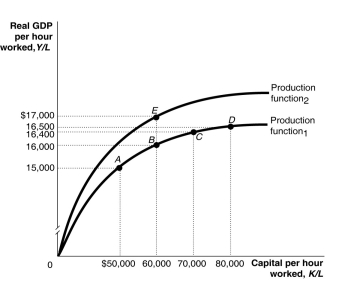 -Refer to Figure 11-3.Technological change is shown in the figure above by the movement from
 (Multiple Choice)
4.9/5 (84)
(84) 
Filters
- Essay(0)
- Multiple Choice(0)
- Short Answer(0)
- True False(0)
- Matching(0)