



 Chat with AI
Exam 16: Fiscal Policy

Exam 1: Economics: Foundations and Models211 Questions
Exam 2: Trade-Offs,comparative Advantage,and the Market System239 Questions
Exam 3: Where Prices Come From: the Interaction of Demand and Supply233 Questions
Exam 4: Economic Efficiency, government Price Setting, and Taxes211 Questions
Exam 5: The Economics of Health Care164 Questions
Exam 6: Firms,the Stock Market,and Corporate Governance276 Questions
Exam 7: Comparative Advantage and the Gains From International Trade190 Questions
Exam 8: GDP: Measuring Total Production and Income266 Questions
Exam 9: Unemployment and Inflation292 Questions
Exam 10: Economic Growth, the Financial System, and Business Cycles257 Questions
Exam 11: Long-Run Economic Growth: Sources and Policies268 Questions
Exam 12: Aggregate Expenditure and Output in the Short Run306 Questions
Exam 13: Aggregate Demand and Aggregate Supply Analysis284 Questions
Exam 14: Money, banks, and the Federal Reserve System280 Questions
Exam 15: Monetary Policy277 Questions
Exam 16: Fiscal Policy303 Questions
Exam 17: Inflation, unemployment, and Federal Reserve Policy257 Questions
Exam 18: Macroeconomics in an Open Economy278 Questions
Exam 19: The International Financial System262 Questions
Select questions type


Why will there be less crowding out of private spending by government spending the less sensitive consumption,investment,and net exports are to changes in interest rates?
(Essay)
5.0/5  (87)
(87) Part of the spending on the Caldecott Tunnel project in northern California came from the American Reinvestment and Recovery Act,which is an example of discretionary fiscal policy aimed at increasing
(Multiple Choice)
4.7/5 (86)
(86) Table 16-5
 -Refer to Table 16-5.The economy is in the state described by the table above.Draw the dynamic aggregate demand and aggregate supply diagram to illustrate the state of the economy in year 1 and year 2,assuming that no policy is pursued.Then illustrate and explain the appropriate fiscal policy to use in this situation.Assume that the policy results in the economy producing potential GDP.
 (Essay)
4.8/5 (75)
(75) A study by Edward Prescott found that the ________ marginal tax rates in the United States relative to Europe resulted in a ________ quantity of labor supplied in the United States.
(Multiple Choice)
4.8/5 (77)
(77) Decreasing government spending ________ the price level and ________ equilibrium real GDP.
(Multiple Choice)
5.0/5 (94)
(94) Figure 16-5
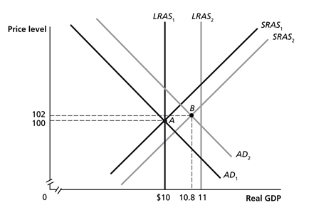 -Refer to Figure 16-5.In the dynamic model of AD-AS in the figure above,if the economy is at point A in year 1 and is expected to go to point B in year 2,Congress and the president would most likely pursue
 (Multiple Choice)
4.9/5 (82)
(82) Table 16-6
 -Refer to Table 16-6.Suppose the economy is in the state described by the table above.What problem will occur in the economy if no policy is pursued? What fiscal policy tools could be used to combat the problem? Draw a dynamic aggregate demand and aggregate supply diagram to illustrate the appropriate fiscal policy to use in this situation.
 (Essay)
4.9/5 (73)
(73) The aggregate demand curve will shift to the right ________ the initial increase in government purchases.
(Multiple Choice)
4.8/5 (72)
(72) A one-time tax rebate,which is not expected to be extended in future years,will
(Multiple Choice)
4.8/5 (76)
(76) Which of the following is considered contractionary fiscal policy?
(Multiple Choice)
5.0/5 (86)
(86) If the federal budget goes from a budget deficit in Year 1 to a budget surplus in Year 2,does it follow that the federal government acted to raise taxes or cut government spending in Year 2?
(Essay)
4.8/5 (88)
(88) Suppose real GDP is $14 trillion and potential real GDP is $14.4 trillion.An increase in government purchases of $400 billion would cause real GDP to ________ potential real GDP (assuming a constant price level).
(Multiple Choice)
4.8/5 (77)
(77) In an open economy,the government purchases multiplier will be
(Multiple Choice)
4.9/5 (77)
(77) Figure 16-6  -Refer to Figure 16-6.In the dynamic model of AD-AS in the figure above,if the economy is at point A in year 1 and is expected to go to point B in year 2,and no fiscal or monetary policy is pursued,then at point B
 (Multiple Choice)
4.7/5 (78)
(78) In recent economic history,the U.S.federal budget was in surplus during
(Multiple Choice)
4.8/5 (74)
(74) A recession tends to cause the federal budget deficit to ________ because tax revenues ________ and government spending on transfer payments ________.
(Multiple Choice)
4.8/5 (66)
(66) An increase in individual income taxes ________ disposable income,which ________ consumption spending.
(Multiple Choice)
4.8/5 (92)
(92) 
Filters
- Essay(0)
- Multiple Choice(0)
- Short Answer(0)
- True False(0)
- Matching(0)