



 Chat with AI
Exam 16: Fiscal Policy

Exam 1: Economics: Foundations and Models211 Questions
Exam 2: Trade-Offs,comparative Advantage,and the Market System239 Questions
Exam 3: Where Prices Come From: the Interaction of Demand and Supply233 Questions
Exam 4: Economic Efficiency, government Price Setting, and Taxes211 Questions
Exam 5: The Economics of Health Care164 Questions
Exam 6: Firms,the Stock Market,and Corporate Governance276 Questions
Exam 7: Comparative Advantage and the Gains From International Trade190 Questions
Exam 8: GDP: Measuring Total Production and Income266 Questions
Exam 9: Unemployment and Inflation292 Questions
Exam 10: Economic Growth, the Financial System, and Business Cycles257 Questions
Exam 11: Long-Run Economic Growth: Sources and Policies268 Questions
Exam 12: Aggregate Expenditure and Output in the Short Run306 Questions
Exam 13: Aggregate Demand and Aggregate Supply Analysis284 Questions
Exam 14: Money, banks, and the Federal Reserve System280 Questions
Exam 15: Monetary Policy277 Questions
Exam 16: Fiscal Policy303 Questions
Exam 17: Inflation, unemployment, and Federal Reserve Policy257 Questions
Exam 18: Macroeconomics in an Open Economy278 Questions
Exam 19: The International Financial System262 Questions
Select questions type


A decrease in the marginal income tax rate is a fiscal policy which will increase aggregate demand.
(True/False)
4.9/5  (78)
(78) Social Security began as a "pay-as-you-go" system,meaning that payments to current retirees were paid
(Multiple Choice)
4.7/5 (70)
(70) In an open economy,the government purchases multiplier will be smaller the
(Multiple Choice)
4.8/5 (72)
(72) Figure 16-5
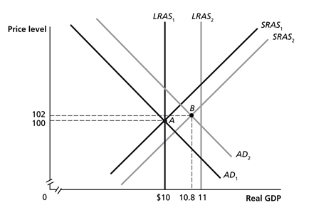 -Refer to Figure 16-5.In the dynamic model of AD-AS in the figure above,if the economy is at point A in year 1 and is expected to go to point B in year 2,Congress and the president would most likely
 (Multiple Choice)
4.8/5 (84)
(84) A(n)________ in private expenditures as a result of a(n)________ in government purchases is called crowding out.
(Multiple Choice)
4.8/5 (86)
(86) Table 16-1
 -Refer to Table 16-1.Consider the hypothetical information in the table above for potential real GDP,real GDP and the price level in 2013 and in 2014 if the Congress and the president do not use fiscal policy.If the Congress and the president want to keep real GDP at its potential level in 2014,they should
 (Multiple Choice)
4.8/5 (86)
(86) Suppose real GDP is $12.6 trillion and potential GDP is $12.4 trillion.To move the economy back to potential GDP,Congress should
(Multiple Choice)
4.8/5 (75)
(75) The use of fiscal policy to stabilize the economy is limited because
(Multiple Choice)
4.9/5 (86)
(86) Suppose real GDP is $13 trillion,potential real GDP is $13.5 trillion,and Congress and the president plan to use fiscal policy to restore the economy to potential real GDP.Assuming a constant price level,Congress and the president would need to increase government purchases by
(Multiple Choice)
4.8/5 (85)
(85) From an initial long-run equilibrium,if aggregate demand grows more slowly than long-run and short-run aggregate supply,then Congress and the president would most likely
(Multiple Choice)
4.9/5 (73)
(73) Calculate the government purchases multiplier if the marginal propensity to consume equals 0.75,the tax rate is 0.2,and the marginal propensity to import equals 0.3.
(Multiple Choice)
4.9/5 (81)
(81) In early 2008,the housing crisis and rising oil prices increased the risk of recession in the United States.What fiscal policy action was taken by Congress and the president to counter these events?
(Multiple Choice)
4.9/5 (86)
(86) Which of the following best describes supply-side economics?
(Multiple Choice)
4.8/5 (72)
(72) Which of the following provides health-care coverage to people age 65 and over?
(Multiple Choice)
4.8/5 (82)
(82) An increase in the sensitivity of private spending (consumption,investment,and net exports)to changes in the interest rate ________ the government purchases multiplier.
(Multiple Choice)
4.9/5 (81)
(81) How could the existence of an unemployment insurance system or other transfer programs have reduced the severity of the Great Depression?
(Essay)
4.9/5 (84)
(84) Figure 16-5
-Refer to Figure 16-5.In the dynamic model of AD-AS in the figure above,if the economy is at point A in year 1 and is expected to go to point B in year 2,and no fiscal or monetary policy is pursued,then at point B
-Refer to Figure 16-5.In the dynamic model of AD-AS in the figure above,if the economy is at point A in year 1 and is expected to go to point B in year 2,and no fiscal or monetary policy is pursued,then at point B (Multiple Choice)
4.7/5 (92)
(92) 
Filters
- Essay(0)
- Multiple Choice(0)
- Short Answer(0)
- True False(0)
- Matching(0)