



 Chat with AI
Exam 17: Inflation, unemployment, and Federal Reserve Policy

Exam 1: Economics: Foundations and Models211 Questions
Exam 2: Trade-Offs,comparative Advantage,and the Market System239 Questions
Exam 3: Where Prices Come From: the Interaction of Demand and Supply233 Questions
Exam 4: Economic Efficiency, government Price Setting, and Taxes211 Questions
Exam 5: The Economics of Health Care164 Questions
Exam 6: Firms,the Stock Market,and Corporate Governance276 Questions
Exam 7: Comparative Advantage and the Gains From International Trade190 Questions
Exam 8: GDP: Measuring Total Production and Income266 Questions
Exam 9: Unemployment and Inflation292 Questions
Exam 10: Economic Growth, the Financial System, and Business Cycles257 Questions
Exam 11: Long-Run Economic Growth: Sources and Policies268 Questions
Exam 12: Aggregate Expenditure and Output in the Short Run306 Questions
Exam 13: Aggregate Demand and Aggregate Supply Analysis284 Questions
Exam 14: Money, banks, and the Federal Reserve System280 Questions
Exam 15: Monetary Policy277 Questions
Exam 16: Fiscal Policy303 Questions
Exam 17: Inflation, unemployment, and Federal Reserve Policy257 Questions
Exam 18: Macroeconomics in an Open Economy278 Questions
Exam 19: The International Financial System262 Questions
Select questions type


Which of the following could decrease unemployment and inflation simultaneously?
(Multiple Choice)
4.8/5  (79)
(79) If firms and workers have adaptive expectations,what impact will expansionary monetary policy have on inflation,unemployment,and the Phillips curve?
(Essay)
4.8/5 (71)
(71) If strong aggregate demand is pushing the economy beyond potential real GDP,which of the following must be true?
(Multiple Choice)
5.0/5 (84)
(84) Figure 17-6 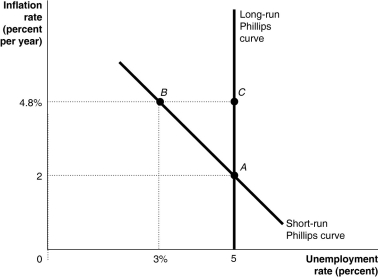 -Refer to Figure 17-6.If firms and workers have adaptive expectations,an expansionary monetary policy will cause the short-run equilibrium to move from
 (Multiple Choice)
4.8/5 (75)
(75) The experience of Paul Volcker's fight against inflation during the late 1970s and early 1980s indicates that firms and workers may have
(Multiple Choice)
4.8/5 (76)
(76) Article Summary
In a September 2013 speech to the Independent Bankers Association of Texas, Federal Reserve Bank of Dallas president Richard Fisher stated that the Fed's credibility was harmed when it announced the previous week that it would continue its large bond purchasing program. In June, Fed Chairman Ben Bernanke had stated that that the program could begin to be cut back later in the year, and several other Fed officials expressed being open to the announced timing of this policy. Bernanke's change in his announced timeline of the Fed's intentions regarding the bond purchasing program brought criticism that the Fed had misled investors. In his speech, Fisher stated "I disagreed with the decision of the committee and argued against it. Doing nothing at this meeting would increase uncertainty about the future conduct of policy and call the credibility of our communications into question. I believe that is exactly what has occurred, though I take no pleasure in saying so." Fisher has been a long-time opponent of the Fed's bond purchasing program, claiming it is ineffective and may well lead to future inflation, and had been calling for the Fed to begin phasing out this program in September.
Source: "Fisher: Standing pat on policy hurt Fed's credibility," Reuters, September 23, 2013.
-Refer to the Article Summary.Richard Fisher brought the Fed's credibility into question when it decided to continue with its bond purchasing program despite leading many to believe that the program would begin to be phased out.Prior to this,over the past two decades whenever a change in Fed policy had been announced,the change has ________ taken place,leading to ________ credibility.
(Multiple Choice)
4.9/5 (74)
(74) The expansionary monetary and fiscal policies of the 1960s resulted in ________ inflation rates and ________ rates of unemployment.
(Multiple Choice)
4.7/5 (72)
(72) Where does the short-run Phillips curve intersect the long-run Phillips curve?
(Multiple Choice)
4.8/5 (76)
(76) In face of a negative supply shock,the Fed may avoid a rise in unemployment only if it is willing to increase the rate of inflation.
(True/False)
4.7/5 (84)
(84) All other factors held constant,increased growth in aggregate demand will
(Multiple Choice)
4.9/5 (89)
(89) Which of the following would be the source of a "real" business cycle?
(Multiple Choice)
4.8/5 (74)
(74) If weak aggregate demand is pushing the economy into recession,which of the following must be true?
(Multiple Choice)
4.9/5 (79)
(79) What actions could the Federal Reserve take to achieve consistent growth in real GDP at 4 percent per year?
(Multiple Choice)
4.9/5 (78)
(78) In the long run,the Phillips curve is a ________ at ________.
(Multiple Choice)
4.9/5 (87)
(87) Figure 17-2  -Refer to Figure 17-2.Suppose the economy is at point B in the figure above.Which of the following is true?
 (Multiple Choice)
4.8/5 (78)
(78) Under Alan Greenspan,the Fed strived to hit its goals of price stability and high employment through
(Multiple Choice)
4.9/5 (83)
(83) If the economy is producing ________,unemployment is at its natural rate.
(Multiple Choice)
4.8/5 (82)
(82) A study conducted by Robert Shiller,a Yale Economist,found that a large majority of the public thinks that increases in inflation will not quickly lead to an increase in wages.
(True/False)
4.9/5 (87)
(87) A "long-run exploitable Phillips curve" refers to a Phillips curve that in the long run is ________ rather than ________.
(Multiple Choice)
4.7/5 (82)
(82) Which of the following would increase the natural rate of unemployment?
(Multiple Choice)
4.7/5 (72)
(72) 
Filters
- Essay(0)
- Multiple Choice(0)
- Short Answer(0)
- True False(0)
- Matching(0)