



 Chat with AI
Exam 17: Inflation, unemployment, and Federal Reserve Policy

Exam 1: Economics: Foundations and Models211 Questions
Exam 2: Trade-Offs,comparative Advantage,and the Market System239 Questions
Exam 3: Where Prices Come From: the Interaction of Demand and Supply233 Questions
Exam 4: Economic Efficiency, government Price Setting, and Taxes211 Questions
Exam 5: The Economics of Health Care164 Questions
Exam 6: Firms,the Stock Market,and Corporate Governance276 Questions
Exam 7: Comparative Advantage and the Gains From International Trade190 Questions
Exam 8: GDP: Measuring Total Production and Income266 Questions
Exam 9: Unemployment and Inflation292 Questions
Exam 10: Economic Growth, the Financial System, and Business Cycles257 Questions
Exam 11: Long-Run Economic Growth: Sources and Policies268 Questions
Exam 12: Aggregate Expenditure and Output in the Short Run306 Questions
Exam 13: Aggregate Demand and Aggregate Supply Analysis284 Questions
Exam 14: Money, banks, and the Federal Reserve System280 Questions
Exam 15: Monetary Policy277 Questions
Exam 16: Fiscal Policy303 Questions
Exam 17: Inflation, unemployment, and Federal Reserve Policy257 Questions
Exam 18: Macroeconomics in an Open Economy278 Questions
Exam 19: The International Financial System262 Questions
Select questions type


The short-run Phillips curve is ________ than the long-run Phillips curve.
(Multiple Choice)
4.8/5  (67)
(67) In which of the following situations might you expect expansionary monetary policy to reduce the unemployment rate?
(Multiple Choice)
4.7/5 (63)
(63) If the Federal Reserve chooses to fight high inflation with contractionary monetary policy and firms and consumers expect this policy to reduce inflation,which of the following would you expect to see?
(Multiple Choice)
4.8/5 (80)
(80) Figure 17-1  -Refer to Figure 17-1.Suppose that the economy is currently at point A.If the Federal Reserve engaged in expansionary monetary policy,where would the economy end up in the short run?
 (Multiple Choice)
4.7/5 (93)
(93) If the actual rate of inflation exceeds the expected rate of inflation,the actual real wage is greater than the expected real wage and unemployment falls.
(True/False)
5.0/5 (62)
(62) Which of the following could increase unemployment and inflation simultaneously?
(Multiple Choice)
4.8/5 (77)
(77) If expected inflation falls,the long-run Phillips curve will
(Multiple Choice)
4.9/5 (92)
(92) A relationship that depends on the basic behavior of consumers and firms and remains unchanged over long periods is called a ________ relationship.
(Multiple Choice)
4.8/5 (96)
(96) An increase in the level of structural unemployment will shift the long-run Phillips curve.
(True/False)
5.0/5 (75)
(75) A study conducted by Alberto Alesina and Lawrence Summers concluded that countries with highly independent central banks had ________ than countries whose central banks had little independence.
(Multiple Choice)
5.0/5 (80)
(80) Figure 17-2  -Refer to Figure 17-2.At which point is the unemployment rate equal to the natural rate of unemployment?
 (Multiple Choice)
4.7/5 (64)
(64) Matt's real wage in 2014 is $26.80.If the price level is 104,what is Matt's nominal wage?
(Multiple Choice)
4.7/5 (67)
(67) Suppose a presidential candidate makes a statement in a debate whereby he promises that he would encourage the Fed to permanently lower the unemployment rate to 3%.His opponent claims that this type of policy idea is mired in the 1960s and would only cause inflation.Explain what the opponent means.
(Essay)
4.8/5 (79)
(79) A decrease in the level of cyclical unemployment will shift the long-run Phillips curve.
(True/False)
4.9/5 (91)
(91) Figure 17-3 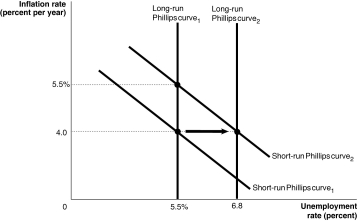 -Refer to Figure 17-3.The shifts shown in the short-run and long-run Phillips curves between period 1 and period 2 could be explained by
 (Multiple Choice)
4.7/5 (78)
(78) 
Filters
- Essay(0)
- Multiple Choice(0)
- Short Answer(0)
- True False(0)
- Matching(0)