



 Chat with AI
Exam 11: Technology, production, and Costs

Exam 1: Economics: Foundations and Models146 Questions
Exam 2: Trade-Offs, comparative Advantage, and the Market System153 Questions
Exam 3: Where Prices Come From: the Interaction of Demand and Supply147 Questions
Exam 4: Economic Efficiency, government Price Setting, and Taxes138 Questions
Exam 5: Externalities, environmental Policy, and Public Goods133 Questions
Exam 6: Elasticity: the Responsiveness of Demand and Supply150 Questions
Exam 7: The Economics of Health Care115 Questions
Exam 8: Firms, the Stock Market, and Corporate Governance141 Questions
Exam 9: Comparative Advantage and the Gains From International Trade123 Questions
Exam 10: Consumer Choice and Behavioral Economics154 Questions
Exam 11: Technology, production, and Costs165 Questions
Exam 12: Firms in Perfectly Competitive Markets151 Questions
Exam 13: Monopolistic Competition: the Competitive Model in a More Realistic Setting143 Questions
Exam 14: Oligopoly: Firms in Less Competitive Markets135 Questions
Exam 15: Monopoly and Antitrust Policy134 Questions
Exam 16: Pricing Strategy134 Questions
Exam 17: The Markets for Labor and Other Factors of Production147 Questions
Exam 18: Public Choice, taxes, and the Distribution of Income139 Questions
Select questions type


If marginal product is equal to average product,then total product is at a maximum.
(True/False)
4.8/5  (84)
(84) When a firm experiences negative technological change it can produce the same output with fewer inputs.
(True/False)
4.7/5 (78)
(78) Bill owns "Bill's Home of Blues" a store that specializes in selling CDs and DVDs of blues musicians of the 1960s and 1970s.Bill took out a loan from his bank to pay for his store and its initial inventory.Bill pays the bank $900 per week for his loan.The $900 bank payment
(Multiple Choice)
4.9/5 (72)
(72) Are the costs of utilities always fixed,always variable,or can they be both? Briefly explain.
(Essay)
4.8/5 (68)
(68) Figure 11-1  Fancy Footwear manufactures shoes.Figure 11-1 shows Fancy Footwear's marginal product of labor and average product of labor curves in the short run.
-Refer to Figure 11-1.For what quantity of labor does production display diminishing returns?
Fancy Footwear manufactures shoes.Figure 11-1 shows Fancy Footwear's marginal product of labor and average product of labor curves in the short run.
-Refer to Figure 11-1.For what quantity of labor does production display diminishing returns? (Multiple Choice)
4.8/5 (62)
(62) When a firm produces more output using the same inputs or the same output using fewer inputs we say that the firm
(Multiple Choice)
4.9/5 (82)
(82) Figure 11-6  Figure 11-6 illustrates the long-run average cost curve for a firm that produces picture frames.The graph also includes short-run average cost curves for three firm sizes: ATCa,ATCb and ATCc.
-Refer to Figure 11-6.For output rates greater than 20,000 picture frames per month
Figure 11-6 illustrates the long-run average cost curve for a firm that produces picture frames.The graph also includes short-run average cost curves for three firm sizes: ATCa,ATCb and ATCc.
-Refer to Figure 11-6.For output rates greater than 20,000 picture frames per month (Multiple Choice)
5.0/5 (81)
(81) Suppose a firm uses labor and capital to produce output.The last unit of labor hired has a marginal product of 12 units of output,and the last unit of capital employed has a marginal product of 20 units.Use the optimal combination of inputs rule to calculate the price of capital if the price of labor is $6 per unit.The price of capital is
(Multiple Choice)
4.8/5 (81)
(81) The slope of a typical isoquant is negative because to produce a given output,a producer
(Multiple Choice)
4.9/5 (81)
(81) The shape of the average total cost curve is determined by the shape of
(Multiple Choice)
4.9/5 (81)
(81) The rate at which a firm is able to substitute one input for another while keeping the level of output constant is called the
(Multiple Choice)
4.8/5 (83)
(83) Marginal cost is calculated for a particular increase in output by
(Multiple Choice)
4.8/5 (72)
(72) Table 11-6
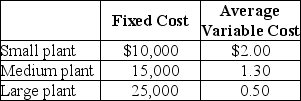 -Refer to Table 11-6.Clock It To Me manufactures clock radios.The table above shows estimates of fixed cost per period and average variable cost for three possible plant sizes.
a.You are employed as the company's cost accountant and have been asked to prepare cost estimates for various output levels for each of the three possible plant sizes.Record your calculations in the table below.
Average Cost of Production
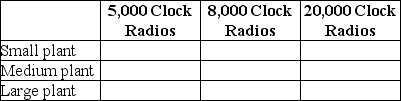 b.For each of the three output levels,which plant size will generate the lowest average total cost of production?
c.Suppose the firm currently sells 8,000 clock radios per period (using the optimal plant size for this output level).Now,however,it has just secured a long-term contract to supply 20,000 clock radios per period.In the short run,what is the average total cost of producing 20,000 clock radios? Provide a numerical value based on your answer in part a.
d.What happens to average total cost of production in the long run? Provide a numerical value based on your answer in part a.
-Refer to Table 11-6.Clock It To Me manufactures clock radios.The table above shows estimates of fixed cost per period and average variable cost for three possible plant sizes.
a.You are employed as the company's cost accountant and have been asked to prepare cost estimates for various output levels for each of the three possible plant sizes.Record your calculations in the table below.
Average Cost of Production
b.For each of the three output levels,which plant size will generate the lowest average total cost of production?
c.Suppose the firm currently sells 8,000 clock radios per period (using the optimal plant size for this output level).Now,however,it has just secured a long-term contract to supply 20,000 clock radios per period.In the short run,what is the average total cost of producing 20,000 clock radios? Provide a numerical value based on your answer in part a.
d.What happens to average total cost of production in the long run? Provide a numerical value based on your answer in part a. (Essay)
4.7/5 (72)
(72) 
Filters
- Essay(0)
- Multiple Choice(0)
- Short Answer(0)
- True False(0)
- Matching(0)