



 Chat with AI
Exam 9: Comparative Advantage and the Gains From International Trade


In 1930,the U.S.government attempted to help domestic firms that were harmed by the Great Depression by passing the Smoot-Hawley Tariff.In response to this tariff,other countries ________ and international trade ________.

 (82)
 Verified
B
Table 9-1
 Rob Crusoe and Bill Friday spent their week-long vacation on a desert island where they had to find and make their own food.Rob and Bill spent one day each fishing and picking berries.The following table lists the pounds of output Rob and Bill produced.
-Refer to Table 9-1.Use the table above to select the statement that accurately interprets the data in the table.
Rob Crusoe and Bill Friday spent their week-long vacation on a desert island where they had to find and make their own food.Rob and Bill spent one day each fishing and picking berries.The following table lists the pounds of output Rob and Bill produced.
-Refer to Table 9-1.Use the table above to select the statement that accurately interprets the data in the table. (76) VerifiedD
a.Distinguish between a tariff and a quota.
b.In what ways are tariffs and quotas similar?
c.In what ways are tariffs and quotas different?
d.Why might a foreign producer prefer a quota rather than a tariff?
(84) Verifieda.A tariff is a tax imposed by a government on imports while a quota is a numerical limit imposed by the government on the quantity of a good that can be imported into a country. b.Compared to unrestricted trade,both a tariff and a quota result in: (1)a higher domestic price for the protected good; (2)a lower quantity consumed; (3)a decrease in consumer surplus; (4)an increase in producer surplus; (5)an inefficient allocation of resources (a deadweight loss). c.One important difference between a tariff and a quota is that a tariff generates revenue for the government.Part of the decrease in consumer surplus is redistributed to the government in the form of tariff revenue.A quota generates no revenue for the government.Part of the decrease in consumer surplus is redistributed to the foreign producers who are allowed to sell the good in the domestic market. d.A foreign producer might prefer a quota to a tariff because the producer is able to sell the product at a higher price and also to capture part of the decrease in consumer surplus.
Figure 9-3  Since 1953 the United States has imposed a quota to limit the imports of peanuts.Figure 9-3 illustrates the impact of the quota.
-Refer to Figure 9-3.If there was no quota,how many pounds of peanuts would be imported?
Since 1953 the United States has imposed a quota to limit the imports of peanuts.Figure 9-3 illustrates the impact of the quota.
-Refer to Figure 9-3.If there was no quota,how many pounds of peanuts would be imported? (78) How does the U.S.federal government assist workers who have lost their jobs due to international trade?
(77) Governments sometimes erect barriers to trade other than tariffs and quotas.Which of the following is not an example of this type of trade barrier?
(71) A voluntary export restraint is an agreement negotiated by two countries that places ________ that can be imported by one country from another country.
(81) Your roommate Hansen argues that American producers cannot compete with foreign producers because wages are lower in foreign countries than in the United States.Hansen
(72) Figure 9-2  Suppose the U.S.government imposes a $0.75 per pound tariff on coffee imports.Figure 9-2 shows the impact of this tariff.
-Refer to Figure 9-2.The tariff causes domestic consumption of coffee
Suppose the U.S.government imposes a $0.75 per pound tariff on coffee imports.Figure 9-2 shows the impact of this tariff.
-Refer to Figure 9-2.The tariff causes domestic consumption of coffee (70) The United States would gain from the elimination of tariffs and quotas even if other countries do not reduce their tariffs and quotas.
(90) Table 9-2
Output Per Hour of Work
 Table 9-2 shows the output per hour of work for light bulbs and flash drives in Mexico and in Canada.
-Refer to Table 9-2.Fill in the following table with the opportunity costs of producing light bulbs and flash drives for Mexico and Canada.

Table 9-2 shows the output per hour of work for light bulbs and flash drives in Mexico and in Canada.
-Refer to Table 9-2.Fill in the following table with the opportunity costs of producing light bulbs and flash drives for Mexico and Canada.
(75) Figure 9-5 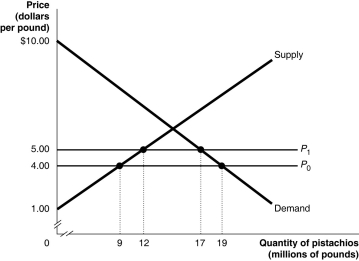 -Refer to Figure 9-5.Fenwick currently both produces and imports pistachios.The government of Fenwick decides to restrict international trade in pistachios by imposing a quota that allows imports of only 5 million pounds each year.Figure 9-5 shows the estimated demand and supply curves for pistachios in Fenwick and the results of imposing the quota.Answer questions a-j using the figure.
a.If there is no quota what is the domestic price of pistachios and what is the quantity of pistachios demanded by consumers?
b.If there is no quota how many pounds of pistachios would domestic producers supply and what quantity would be imported?
c.If there is no quota what is the dollar value of consumer surplus?
d.If there is no quota what is the dollar value of producer surplus received by producers in Fenwick?
e.If there is no quota what is the revenue received by foreign producers who supply pistachios to Fenwick?
f.With a quota in place what is the price that consumers of Fenwick must now pay and what is the quantity demanded?
g.With a quota in place what is the dollar value of consumer surplus? Are consumers better off?
h.With a quota in place what is the dollar value of producer surplus received by producers in Fenwick? Are domestic producers better off?
i.Calculate the revenue to foreign producers who are granted permission to sell in Fenwick after the imposition of the quota.
j.Calculate the deadweight loss as a result of the quota.
-Refer to Figure 9-5.Fenwick currently both produces and imports pistachios.The government of Fenwick decides to restrict international trade in pistachios by imposing a quota that allows imports of only 5 million pounds each year.Figure 9-5 shows the estimated demand and supply curves for pistachios in Fenwick and the results of imposing the quota.Answer questions a-j using the figure.
a.If there is no quota what is the domestic price of pistachios and what is the quantity of pistachios demanded by consumers?
b.If there is no quota how many pounds of pistachios would domestic producers supply and what quantity would be imported?
c.If there is no quota what is the dollar value of consumer surplus?
d.If there is no quota what is the dollar value of producer surplus received by producers in Fenwick?
e.If there is no quota what is the revenue received by foreign producers who supply pistachios to Fenwick?
f.With a quota in place what is the price that consumers of Fenwick must now pay and what is the quantity demanded?
g.With a quota in place what is the dollar value of consumer surplus? Are consumers better off?
h.With a quota in place what is the dollar value of producer surplus received by producers in Fenwick? Are domestic producers better off?
i.Calculate the revenue to foreign producers who are granted permission to sell in Fenwick after the imposition of the quota.
j.Calculate the deadweight loss as a result of the quota. (86) Figure 9-2 Suppose the U.S.government imposes a $0.75 per pound tariff on coffee imports.Figure 9-2 shows the impact of this tariff.
-Refer to Figure 9-2.The increase in domestic producer surplus as a result of the tariff is equal to
Suppose the U.S.government imposes a $0.75 per pound tariff on coffee imports.Figure 9-2 shows the impact of this tariff.
-Refer to Figure 9-2.The increase in domestic producer surplus as a result of the tariff is equal to (89) An economic principle that explains why people pursue different occupations is
(74) Figure 9-2 Suppose the U.S.government imposes a $0.75 per pound tariff on coffee imports.Figure 9-2 shows the impact of this tariff.
-Refer to Figure 9-2.With the tariff in place,the United States
Suppose the U.S.government imposes a $0.75 per pound tariff on coffee imports.Figure 9-2 shows the impact of this tariff.
-Refer to Figure 9-2.With the tariff in place,the United States (77) Once an industry becomes established in a certain area firms that locate in that area gain advantages over firms located elsewhere,leading to lower costs of production.Economists refer to the lower costs that result from increases in the size of an industry in a certain area as
(83) If Finland has an absolute advantage in the production of two goods compared to Latvia,Finland can still benefit from trade with Latvia.
(82) 
Filters
- Essay(0)
- Multiple Choice(0)
- Short Answer(0)
- True False(0)
- Matching(0)