



 Chat with AI
Exam 9: Comparative Advantage and the Gains From International Trade

Exam 1: Economics: Foundations and Models146 Questions
Exam 2: Trade-Offs, comparative Advantage, and the Market System153 Questions
Exam 3: Where Prices Come From: the Interaction of Demand and Supply147 Questions
Exam 4: Economic Efficiency, government Price Setting, and Taxes138 Questions
Exam 5: Externalities, environmental Policy, and Public Goods133 Questions
Exam 6: Elasticity: the Responsiveness of Demand and Supply150 Questions
Exam 7: The Economics of Health Care115 Questions
Exam 8: Firms, the Stock Market, and Corporate Governance141 Questions
Exam 9: Comparative Advantage and the Gains From International Trade123 Questions
Exam 10: Consumer Choice and Behavioral Economics154 Questions
Exam 11: Technology, production, and Costs165 Questions
Exam 12: Firms in Perfectly Competitive Markets151 Questions
Exam 13: Monopolistic Competition: the Competitive Model in a More Realistic Setting143 Questions
Exam 14: Oligopoly: Firms in Less Competitive Markets135 Questions
Exam 15: Monopoly and Antitrust Policy134 Questions
Exam 16: Pricing Strategy134 Questions
Exam 17: The Markets for Labor and Other Factors of Production147 Questions
Exam 18: Public Choice, taxes, and the Distribution of Income139 Questions
Select questions type


Figure 9-3 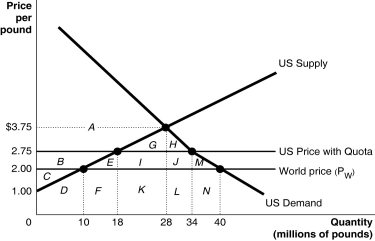 Since 1953 the United States has imposed a quota to limit the imports of peanuts.Figure 9-3 illustrates the impact of the quota.
-Refer to Figure 9-3.What is the value of revenue to foreign producers who are granted permission to sell in the U.S.market when there is a quota?
Since 1953 the United States has imposed a quota to limit the imports of peanuts.Figure 9-3 illustrates the impact of the quota.
-Refer to Figure 9-3.What is the value of revenue to foreign producers who are granted permission to sell in the U.S.market when there is a quota? (Multiple Choice)
4.9/5  (88)
(88) Protectionism is the use of ________ to protect domestic firms from foreign competition.
(Multiple Choice)
4.9/5 (78)
(78) Many economists ________ protectionism because it ________ consumers and ________ jobs in domestic industries that use protected products.
(Multiple Choice)
4.7/5 (81)
(81) Automobiles and many other products are differentiated.As a result
(Multiple Choice)
4.9/5 (82)
(82) In the 1930s the United States charged an average tariff rate
(Multiple Choice)
4.8/5 (86)
(86) Economists believe the most persuasive argument for protectionism is to
(Multiple Choice)
4.8/5 (68)
(68) It is difficult to determine if foreign companies are selling their products for prices below their costs of production because
(Multiple Choice)
4.8/5 (92)
(92) The first discussion of comparative advantage appears in a book written by
(Multiple Choice)
4.8/5 (72)
(72) A tax imposed by a government on imports of a good into a country is called
(Multiple Choice)
4.9/5 (75)
(75) One of the main sources of comparative advantage is natural resources.
(True/False)
4.9/5 (78)
(78) If Brazil has a comparative advantage relative to Cuba in the production of sugar cane,then
(Multiple Choice)
4.8/5 (82)
(82) In the past two decades the United States lost its comparative advantage in automobiles to Japan.What factor was most responsible for the development of Japan's comparative advantage in automobiles?
(Multiple Choice)
4.9/5 (69)
(69) Textbook examples of trade between two nations are simplified in order to show how two nations both benefit from trade.These examples are misleading because
(Multiple Choice)
4.8/5 (68)
(68) A "Buy American" provision in the 2009 stimulus bill would ________ consumer surplus and ________ producer surplus for industries that produce protected products in the United States.
(Multiple Choice)
4.8/5 (69)
(69) Which of the following statements about the importance of trade to the U.S.economy is false?
(Multiple Choice)
4.8/5 (88)
(88) ________ is the ability to produce more of a good or service than competitors when using the same amount of resources.
(Multiple Choice)
4.9/5 (84)
(84) 
Filters
- Essay(0)
- Multiple Choice(0)
- Short Answer(0)
- True False(0)
- Matching(0)