



 Chat with AI
Exam 9: Comparative Advantage and the Gains From International Trade

Exam 1: Economics: Foundations and Models146 Questions
Exam 2: Trade-Offs, comparative Advantage, and the Market System153 Questions
Exam 3: Where Prices Come From: the Interaction of Demand and Supply147 Questions
Exam 4: Economic Efficiency, government Price Setting, and Taxes138 Questions
Exam 5: Externalities, environmental Policy, and Public Goods133 Questions
Exam 6: Elasticity: the Responsiveness of Demand and Supply150 Questions
Exam 7: The Economics of Health Care115 Questions
Exam 8: Firms, the Stock Market, and Corporate Governance141 Questions
Exam 9: Comparative Advantage and the Gains From International Trade123 Questions
Exam 10: Consumer Choice and Behavioral Economics154 Questions
Exam 11: Technology, production, and Costs165 Questions
Exam 12: Firms in Perfectly Competitive Markets151 Questions
Exam 13: Monopolistic Competition: the Competitive Model in a More Realistic Setting143 Questions
Exam 14: Oligopoly: Firms in Less Competitive Markets135 Questions
Exam 15: Monopoly and Antitrust Policy134 Questions
Exam 16: Pricing Strategy134 Questions
Exam 17: The Markets for Labor and Other Factors of Production147 Questions
Exam 18: Public Choice, taxes, and the Distribution of Income139 Questions
Select questions type


Figure 9-3 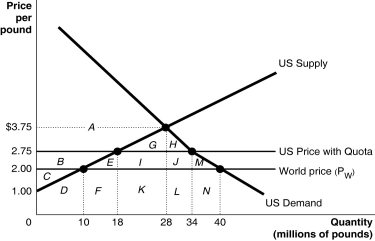 Since 1953 the United States has imposed a quota to limit the imports of peanuts.Figure 9-3 illustrates the impact of the quota.
-Refer to Figure 9-3.What is the value of the deadweight loss as a result of the quota?
Since 1953 the United States has imposed a quota to limit the imports of peanuts.Figure 9-3 illustrates the impact of the quota.
-Refer to Figure 9-3.What is the value of the deadweight loss as a result of the quota? (Multiple Choice)
4.8/5  (90)
(90) In early versions of the 2009 stimulus bill,a "Buy American" provision required
(Multiple Choice)
4.9/5 (72)
(72) Figure 9-2 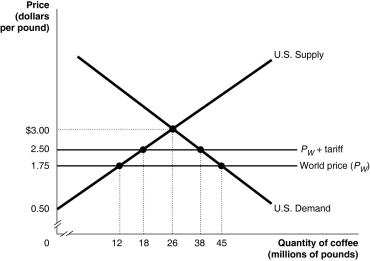 Suppose the U.S.government imposes a $0.75 per pound tariff on coffee imports.Figure 9-2 shows the impact of this tariff.
-Refer to Figure 9-2.The tariff revenue collected by the government equals
Suppose the U.S.government imposes a $0.75 per pound tariff on coffee imports.Figure 9-2 shows the impact of this tariff.
-Refer to Figure 9-2.The tariff revenue collected by the government equals (Multiple Choice)
4.7/5 (86)
(86) The textbook referred to the following quotation from a Federal Reserve publication: "Trade is a win-win situation for all countries that participate." But many firms and workers oppose free trade policies and protests against globalization have become a regular occurrence at meetings of the World Trade Organization.If trade is a "win-win" situation,why is there strong opposition to free trade and globalization?
(Essay)
4.9/5 (81)
(81) a.Define the term "globalization."
b.Describe the benefits of globalization.
c.Who is likely to oppose globalization and why?
(Essay)
4.7/5 (98)
(98) Figure 9-3 Since 1953 the United States has imposed a quota to limit the imports of peanuts.Figure 9-3 illustrates the impact of the quota.
-Refer to Figure 9-3.What is the value of domestic producer surplus without a quota?
Since 1953 the United States has imposed a quota to limit the imports of peanuts.Figure 9-3 illustrates the impact of the quota.
-Refer to Figure 9-3.What is the value of domestic producer surplus without a quota? (Multiple Choice)
4.9/5 (90)
(90) Over the past several decades there has been a rapid growth in international trade.This growth has been due to all except one of the following factors.Which factor has not contributed to the growth of international trade?
(Multiple Choice)
4.8/5 (77)
(77) Suppose in Vietnam a worker can produce either 16 units of cloth or 2 bicycles while in China a worker can produce either 20 units of cloth or 5 bicycles.
a.Which country has an absolute advantage in cloth production? In bicycle production?
b.What is the opportunity cost of 1 unit of cloth in Vietnam? In China?
c.What is the opportunity cost of 1 bicycle in Vietnam? In China?
d.Which country has a comparative advantage in cloth production? In bicycle production?
e.Suppose each country has 1,000 workers.Currently,each country devotes 40 percent of its labor force to cloth production and 60 percent to bicycle production.What is the output of cloth and bicycles for each country and what is the total output of cloth and bicycles between the two countries?
f.Suppose each country specializes in the production of the good in which it has a comparative advantage.What is the total output of cloth and bicycles in the two countries?
g.Provide a numerical example to show how Vietnam and China can both gain from trade.Assume that the terms of trade are established at 6 units of cloth for 1 bicycle.
(Essay)
4.9/5 (88)
(88) In order to avoid the imposition of other types of trade barriers,foreign producers will sometimes agree to limit their exports to a country.What are these types of agreements called?
(Multiple Choice)
4.9/5 (78)
(78) A quota is a numerical limit on the quantity of a good that can be imported.
(True/False)
4.9/5 (81)
(81) If the ________ cost of production for two goods is different between two countries then mutually beneficial trade is possible.
(Multiple Choice)
4.8/5 (78)
(78) Twenty-seven countries in Europe have formed the European Union (EU).After the EU was formed it
(Multiple Choice)
4.7/5 (84)
(84) If Norwegian workers are more productive than Albanian workers,then trade between Norway and Albania
(Multiple Choice)
4.8/5 (89)
(89) Table 9-1
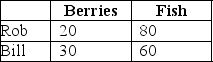 Rob Crusoe and Bill Friday spent their week-long vacation on a desert island where they had to find and make their own food.Rob and Bill spent one day each fishing and picking berries.The following table lists the pounds of output Rob and Bill produced.
-Refer to Table 9-1.Use the table above to select the statement that accurately interprets the data in the table.
Rob Crusoe and Bill Friday spent their week-long vacation on a desert island where they had to find and make their own food.Rob and Bill spent one day each fishing and picking berries.The following table lists the pounds of output Rob and Bill produced.
-Refer to Table 9-1.Use the table above to select the statement that accurately interprets the data in the table. (Multiple Choice)
4.8/5 (64)
(64) In 2010,________ of Caterpillar's sales were inside the United States.
(Multiple Choice)
4.8/5 (78)
(78) Countries gain from specializing in producing goods in which they have ________ and trading for goods in which other countries have ________.
(Multiple Choice)
4.9/5 (83)
(83) The quota on imported sugar costs U.S.consumers more than $2 billion annually and protects very few jobs.Why does Congress maintain a sugar quota that protects only a few thousand workers while forcing millions of people to pay higher prices for sugar products?
(Multiple Choice)
4.7/5 (91)
(91) Costa Rica is a leading exporter of bananas.What explains the comparative advantage of this country in banana production?
(Multiple Choice)
4.9/5 (84)
(84) 
Filters
- Essay(0)
- Multiple Choice(0)
- Short Answer(0)
- True False(0)
- Matching(0)