



 Chat with AI
Exam 14: Oligopoly: Firms in Less Competitive Markets

Exam 1: Economics: Foundations and Models146 Questions
Exam 2: Trade-Offs, comparative Advantage, and the Market System153 Questions
Exam 3: Where Prices Come From: the Interaction of Demand and Supply147 Questions
Exam 4: Economic Efficiency, government Price Setting, and Taxes138 Questions
Exam 5: Externalities, environmental Policy, and Public Goods133 Questions
Exam 6: Elasticity: the Responsiveness of Demand and Supply150 Questions
Exam 7: The Economics of Health Care115 Questions
Exam 8: Firms, the Stock Market, and Corporate Governance141 Questions
Exam 9: Comparative Advantage and the Gains From International Trade123 Questions
Exam 10: Consumer Choice and Behavioral Economics154 Questions
Exam 11: Technology, production, and Costs165 Questions
Exam 12: Firms in Perfectly Competitive Markets151 Questions
Exam 13: Monopolistic Competition: the Competitive Model in a More Realistic Setting143 Questions
Exam 14: Oligopoly: Firms in Less Competitive Markets135 Questions
Exam 15: Monopoly and Antitrust Policy134 Questions
Exam 16: Pricing Strategy134 Questions
Exam 17: The Markets for Labor and Other Factors of Production147 Questions
Exam 18: Public Choice, taxes, and the Distribution of Income139 Questions
Select questions type


Why does a prisoner's dilemma lead to a noncooperative equilibrium?
(Multiple Choice)
4.9/5  (85)
(85) Collusion makes firms better off because if they act as a single entity (a cartel)they can reduce output and increase their prices and profits.But some cartels have failed and others are unstable.Which of the following is a reason why cartels often break down?
(Multiple Choice)
4.8/5 (87)
(87) A game in which pursuing dominant strategies results in noncooperation that leaves all parties worse off is a
(Multiple Choice)
4.9/5 (89)
(89) If economies of scale are relatively unimportant in an industry,the typical firm's long-run average total cost curve will reach a minimum at a level of output that is a ________ fraction of total industry sales.The industry will be ________.
(Multiple Choice)
4.7/5 (78)
(78) Because many business situations are repeated games,firms may be able to avoid the prisoner's dilemma and implicitly collude to keep prices high.
(True/False)
4.8/5 (84)
(84) A baseball hat worn by the Boston Red Sox Hall of Fame outfielder Ted Williams was auctioned on eBay.The three highest bidders and their bids were: Roger Bulava $5,000
Tony Millasiti $4,900
Joe Albano $4,200
What price did Roger have to pay for the Ted Williams hat?
(Multiple Choice)
4.9/5 (86)
(86) Doctors and lawyers in every state need a license to practice.This is an example of
(Multiple Choice)
4.7/5 (84)
(84) Natural resource cartels such as OPEC are inherently unstable because their members operate with excess capacity and have an incentive to cheat on their output quotas.
(True/False)
4.8/5 (87)
(87) Table 14-1  Alistair Luggage and Baine Baggage are the only firms selling luggage in the upscale town of Montecito.Each firm must decide on whether to increase its advertising spending to compete for customers.If one firm increases its advertising budget but the other does not,then the firm with the higher advertising budget will increase its profit.Table 14-1 shows the payoff matrix for this advertising game.
-Refer to Table 14-1.What is the Nash equilibrium in this game?
Alistair Luggage and Baine Baggage are the only firms selling luggage in the upscale town of Montecito.Each firm must decide on whether to increase its advertising spending to compete for customers.If one firm increases its advertising budget but the other does not,then the firm with the higher advertising budget will increase its profit.Table 14-1 shows the payoff matrix for this advertising game.
-Refer to Table 14-1.What is the Nash equilibrium in this game? (Multiple Choice)
4.9/5 (91)
(91) Table 14-6 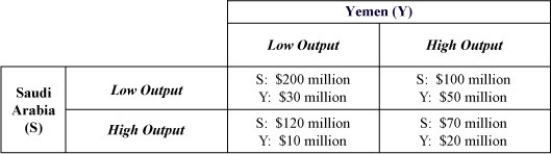 -Refer to Table 14-6.Saudi Arabia and Yemen must decide how much oil to produce.Since the demand for oil is inelastic,relatively low production rates drive up prices and profits.Saudi Arabia,the world's largest and lowest cost producer,is able to influence market price; it has an incentive to keep output low.Yemen,on the other hand,is a relatively high cost producer with much smaller reserves.Use the payoff matrix in Table 14-6 to answer the following questions.
a.What is the dominant strategy for Saudi Arabia?
b.What is the dominant strategy for Yemen?
c.What is the Nash equilibrium?
-Refer to Table 14-6.Saudi Arabia and Yemen must decide how much oil to produce.Since the demand for oil is inelastic,relatively low production rates drive up prices and profits.Saudi Arabia,the world's largest and lowest cost producer,is able to influence market price; it has an incentive to keep output low.Yemen,on the other hand,is a relatively high cost producer with much smaller reserves.Use the payoff matrix in Table 14-6 to answer the following questions.
a.What is the dominant strategy for Saudi Arabia?
b.What is the dominant strategy for Yemen?
c.What is the Nash equilibrium? (Essay)
4.9/5 (99)
(99) When Wal-Mart decides to build a new retail store in a town,it will decide to build a large store rather than a small store if the large store is expected to earn a greater economic profit.What other motive would Wal-Mart have for choosing to build a large store?
(Multiple Choice)
5.0/5 (62)
(62) Decision trees are commonly used to illustrate how firms make business decisions that depend on the actions of rival firms.A decision tree has boxes that contain points that represent when firms must make the decisions contained in the boxes.What are these points called?
(Multiple Choice)
4.9/5 (89)
(89) Table 14-4
 The payoff matrix shown above assumes that Pepsi and Coca-Cola must decide whether to advertise their products.The matrix shows how much profit each firm will earn if it does or does not advertise.The amount of profit for one firm depends on whether the other firm advertises.
-Refer to Table 14-4.Which of the following statements is true?
The payoff matrix shown above assumes that Pepsi and Coca-Cola must decide whether to advertise their products.The matrix shows how much profit each firm will earn if it does or does not advertise.The amount of profit for one firm depends on whether the other firm advertises.
-Refer to Table 14-4.Which of the following statements is true? (Multiple Choice)
4.8/5 (78)
(78) 
Filters
- Essay(0)
- Multiple Choice(0)
- Short Answer(0)
- True False(0)
- Matching(0)