



 Chat with AI
Exam 4: Economic Efficiency, government Price Setting, and Taxes

Exam 1: Economics: Foundations and Models146 Questions
Exam 2: Trade-Offs, comparative Advantage, and the Market System153 Questions
Exam 3: Where Prices Come From: the Interaction of Demand and Supply147 Questions
Exam 4: Economic Efficiency, government Price Setting, and Taxes138 Questions
Exam 5: Externalities, environmental Policy, and Public Goods133 Questions
Exam 6: Elasticity: the Responsiveness of Demand and Supply150 Questions
Exam 7: The Economics of Health Care115 Questions
Exam 8: Firms, the Stock Market, and Corporate Governance141 Questions
Exam 9: Comparative Advantage and the Gains From International Trade123 Questions
Exam 10: Consumer Choice and Behavioral Economics154 Questions
Exam 11: Technology, production, and Costs165 Questions
Exam 12: Firms in Perfectly Competitive Markets151 Questions
Exam 13: Monopolistic Competition: the Competitive Model in a More Realistic Setting143 Questions
Exam 14: Oligopoly: Firms in Less Competitive Markets135 Questions
Exam 15: Monopoly and Antitrust Policy134 Questions
Exam 16: Pricing Strategy134 Questions
Exam 17: The Markets for Labor and Other Factors of Production147 Questions
Exam 18: Public Choice, taxes, and the Distribution of Income139 Questions
Select questions type


The willingness of consumers to buy a product at different prices is shown on a
(Multiple Choice)
4.8/5  (87)
(87) If,in a competitive market,marginal benefit is greater than marginal cost
(Multiple Choice)
4.7/5 (87)
(87) Table 4-3
 Table 4-3 shows the demand and supply schedules for the low-skilled labor market in the city of Westover.
-Refer to Table 4-3.If a minimum wage of $9.50 an hour is mandated,what is the quantity of labor supplied?
Table 4-3 shows the demand and supply schedules for the low-skilled labor market in the city of Westover.
-Refer to Table 4-3.If a minimum wage of $9.50 an hour is mandated,what is the quantity of labor supplied? (Multiple Choice)
4.9/5 (84)
(84) In a competitive market equilibrium the ________ equals the ________ of the last unit sold.
(Multiple Choice)
4.7/5 (84)
(84) Table 4-5
 -Refer to Table 4-5.The equations above describe the demand and supply for Aunt Maud's Premium Hand Lotion.What are the equilibrium price and quantity (in thousands)for Aunt Maud's Lotion?
 (Multiple Choice)
4.8/5 (79)
(79) Table 4-3
Table 4-3 shows the demand and supply schedules for the low-skilled labor market in the city of Westover.
-Refer to Table 4-3.Suppose that the quantity of labor demanded increases by 40,000 at each wage level.What are the new free market equilibrium hourly wage and the new equilibrium quantity of labor?
Table 4-3 shows the demand and supply schedules for the low-skilled labor market in the city of Westover.
-Refer to Table 4-3.Suppose that the quantity of labor demanded increases by 40,000 at each wage level.What are the new free market equilibrium hourly wage and the new equilibrium quantity of labor? (Multiple Choice)
4.7/5 (85)
(85) Suppose there are two cities that have rent controlled apartments.In one city (Albany)all apartments are subject to rent control; in the other city (Halftrack)one-half of the apartments are rent controlled.Which of the following is most likely to be true?
(Multiple Choice)
4.8/5 (77)
(77) Figure 4-2  -Refer to Figure 4-2.What area represents the decrease in producer surplus when the market price falls from P2 to P1?
 (Multiple Choice)
4.9/5 (57)
(57) Which of the follow is a result of imposing a rent ceiling?
(Multiple Choice)
4.7/5 (86)
(86) Figure 4-2
-Refer to Figure 4-2.What area represents producer surplus at a price of P1?
-Refer to Figure 4-2.What area represents producer surplus at a price of P1? (Multiple Choice)
4.8/5 (89)
(89) Is there a difference between the "true burden" of a tax and who is legally required to pay a tax? Briefly explain.
(Essay)
5.0/5 (83)
(83) Figure 4-9  Figure 4-9 shows the market for cigarettes.The government plans to impose a unit tax in this market.
-Refer to Figure 4-9.For each unit sold,the price sellers receive after the tax (net of tax)is
Figure 4-9 shows the market for cigarettes.The government plans to impose a unit tax in this market.
-Refer to Figure 4-9.For each unit sold,the price sellers receive after the tax (net of tax)is (Multiple Choice)
4.9/5 (80)
(80) Figure 4-8 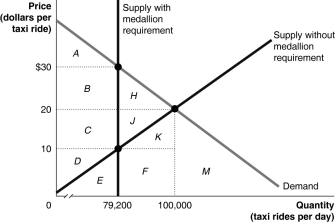 Figure 4-8 shows the market for taxi rides.The following question(s)are based on this figure.
-Refer to Figure 4-8.To legally drive a taxicab in New York City,you must have a medallion issued by the city government.Assume that only 13,200 medallions have been issued.Let's also assume this puts an absolute limit on the number of taxi rides that can be supplied in New York City on any day,because no one breaks the law by driving a taxi without a medallion.Assume as well that each taxi provides 6 trips per day.In that case,the quantity supplied of taxi rides is 79,200 (or 6 rides per taxi × 13,200 taxis).This is shown in the diagram with a vertical line at this quantity.Assume that there are no government controls on the prices that drivers can charge for rides.
a.What would the equilibrium price and quantity be in this market if there were no medallion requirement?
b.If there were no medallion requirement,indicate the area that represents consumer surplus.
c.If there were no medallion requirement,indicate the area that represents producer surplus.
d.If there were no medallion requirement,indicate the area that represents economic surplus.
e.What are the price and quantity with the medallion requirement?
f.With a medallion requirement in place,what area represents consumer surplus?
g.With a medallion requirement in place,what area represents producer surplus?
h.With a medallion requirement in place,what area represents the deadweight loss?
i.Based on your answers to parts (c)and (g),are taxicab drivers better off with the medallion requirement for taxicabs than without?
j.Are consumers better off with or without the medallion requirement for taxicabs?
Figure 4-8 shows the market for taxi rides.The following question(s)are based on this figure.
-Refer to Figure 4-8.To legally drive a taxicab in New York City,you must have a medallion issued by the city government.Assume that only 13,200 medallions have been issued.Let's also assume this puts an absolute limit on the number of taxi rides that can be supplied in New York City on any day,because no one breaks the law by driving a taxi without a medallion.Assume as well that each taxi provides 6 trips per day.In that case,the quantity supplied of taxi rides is 79,200 (or 6 rides per taxi × 13,200 taxis).This is shown in the diagram with a vertical line at this quantity.Assume that there are no government controls on the prices that drivers can charge for rides.
a.What would the equilibrium price and quantity be in this market if there were no medallion requirement?
b.If there were no medallion requirement,indicate the area that represents consumer surplus.
c.If there were no medallion requirement,indicate the area that represents producer surplus.
d.If there were no medallion requirement,indicate the area that represents economic surplus.
e.What are the price and quantity with the medallion requirement?
f.With a medallion requirement in place,what area represents consumer surplus?
g.With a medallion requirement in place,what area represents producer surplus?
h.With a medallion requirement in place,what area represents the deadweight loss?
i.Based on your answers to parts (c)and (g),are taxicab drivers better off with the medallion requirement for taxicabs than without?
j.Are consumers better off with or without the medallion requirement for taxicabs? (Essay)
4.8/5 (93)
(93) Figure 4-9 Figure 4-9 shows the market for cigarettes.The government plans to impose a unit tax in this market.
-Refer to Figure 4-9.How much of the tax is paid by buyers?
Figure 4-9 shows the market for cigarettes.The government plans to impose a unit tax in this market.
-Refer to Figure 4-9.How much of the tax is paid by buyers? (Multiple Choice)
4.8/5 (71)
(71) The maximum price that a buyer is willing to pay for a good measures his
(Multiple Choice)
4.9/5 (78)
(78) Figure 4-3  Figure 4-3 shows the market for granola.The market is initially in equilibrium at a price of P1 and a quantity of Q1.Now suppose producers decide to cut output to Q2 in order to raise the price to P2.
-Refer to Figure 4-3.At the price P2 consumers are willing to buy the Q2 pounds of granola.Is this an economically efficient quantity?
Figure 4-3 shows the market for granola.The market is initially in equilibrium at a price of P1 and a quantity of Q1.Now suppose producers decide to cut output to Q2 in order to raise the price to P2.
-Refer to Figure 4-3.At the price P2 consumers are willing to buy the Q2 pounds of granola.Is this an economically efficient quantity? (Multiple Choice)
4.8/5 (63)
(63) 
Filters
- Essay(0)
- Multiple Choice(0)
- Short Answer(0)
- True False(0)
- Matching(0)