



 Chat with AI
Exam 22: Capital Budgeting: a Closer Look

Exam 1: The Accountants Vital Role in Decision Making141 Questions
Exam 2: An Introduction to Cost Terms and Purposes165 Questions
Exam 3: Cost-Volume-Profit Analysis139 Questions
Exam 4: Job Costing138 Questions
Exam 5: Activity-Based Costing and Management133 Questions
Exam 6: Master Budget and Responsibility Accounting150 Questions
Exam 7: Flexible Budgets, Variances, and Management Control: I146 Questions
Exam 8: Flexible Budgets, Variances, and Management Control: II137 Questions
Exam 9: Income Effects of Denominator Level on Inventory Valuation154 Questions
Exam 10: Quantitative Analyses of Cost Functions114 Questions
Exam 11: Decision Making and Relevant Information146 Questions
Exam 12: Pricing Decisions, Product Profitability Decisions, and Cost Management135 Questions
Exam 13: Strategy, Balanced Scorecard, and Profitability Analysis140 Questions
Exam 14: Period Cost Allocation153 Questions
Exam 15: Cost Allocation: Joint Products and Byproducts149 Questions
Exam 16: Revenue and Customer Profitability Analysis137 Questions
Exam 17: Process Costing128 Questions
Exam 18: Spoilage, Rework, and Scrap121 Questions
Exam 19: Cost Management: Quality, Time, and the Theory of Constraints158 Questions
Exam 20: Inventory Cost Management Strategies136 Questions
Exam 21: Capital Budgeting: Methods of Investment Analysis128 Questions
Exam 22: Capital Budgeting: a Closer Look120 Questions
Exam 23: Transfer Pricing and Multinational Management Control Systems141 Questions
Exam 24: Multinational Performance Measurement and Compensation139 Questions
Select questions type


Which of the following statements about non-profit organizations and capital budgeting is true?
(Multiple Choice)
4.8/5  (78)
(78) Adjusting the Required Rate of Return Approach involves examining the consequences of changing key assumptions underlying a capital budgeting project.
(True/False)
4.8/5 (68)
(68) Tex Corporation trades in a Class 10 (30%) asset during the current year. The opening UCC balance in the Class 10 pool is $420,000. Tex trades in an asset for $25,000, which is deducted from the $125,000 price of the new machine (also Class 10). The appropriate tax rate is 35% and the nominal after-tax rate of return is 10%.
Required: Calculate the UCC at the end of the year for class 10.
(Essay)
4.9/5 (87)
(87) When making capital-budgeting decisions, the inflation rate
(Multiple Choice)
4.9/5 (81)
(81) The disposal of a machine (or any depreciable asset) results in a lost tax shield.
(True/False)
4.8/5 (91)
(91) Based on the above data only, what are the tax savings from the CCA of class 8 for year 2?
(Multiple Choice)
4.9/5 (72)
(72) Headwaters Ltd. is considering purchasing a new asset. It has a cost of $1,350,000, an expected 6 year life and a salvage value of $90,000. The equipment would qualify as a class 8 (20% CCA) asset and Headwaters has a required rate of return of 11% and an effective tax rate of 32%.
Required:
Assume that this asset is the only asset in the pool. Assuming the asset is disposed of at its estimated salvage value, what is the tax effect on the disposition of the asset? Assume the asset will be disposed of on day 1 of year 7 so the asset is eligible for CCA claims in year 6.
(Essay)
4.8/5 (82)
(82) What is the balance in the Class 10 pool after the addition of the new equipment?
(Multiple Choice)
4.8/5 (70)
(70) A Canadian corporation can deduct a full year's worth of CCA on any asset acquired in the year.
(True/False)
4.9/5 (78)
(78) The use of an accelerated method of depreciation for tax purposes would usually increase the present value of the investment.
(True/False)
4.8/5 (82)
(82) Canada, like most taxing authorities, uses different methods for calculating depreciation for tax purposes. The Income Tax Act uses which of the following methods?
(Multiple Choice)
4.8/5 (87)
(87) In the net present value (NPV) method, after-tax cash flows should be used instead of pre-tax cash flows when taxes are a consideration.
(True/False)
4.8/5 (88)
(88) Which of the following is not a relevant cash flow in capital budgeting?
(Multiple Choice)
4.9/5 (82)
(82) For Years 1 through 6 Better Products Ltd. had annual net income of $20,000, CCA of $40,000 each year, a 40 percent tax rate, a discount rate of 10 percent and annual cash sales of $200,000. The depreciable assets of Better Products belong in several different classes under the Income tax Act, have a salvage value of zero at the end of six years, and were all bought new at the beginning of Year 1. The present value factors, in simplified form, for 10 percent are:
 -What is the annual expense deduction for CCA?
 (Multiple Choice)
4.8/5 (89)
(89) The Income Tax Act does not permit a company to deduct depreciation in the calculation of taxable income.
(True/False)
4.7/5 (79)
(79) Broughton Ltd. manufactures and sells one product with a projected contribution margin of $17.00 for year 1. The total budgeted fixed costs are $925,000. Selling prices and variable costs are projected to increase by 8% per year, while fixed costs are forecast to grow at a rate of 5% per year. Existing production capacity is 105,000 units.
The probability distribution on its forecasted demand is as follows:
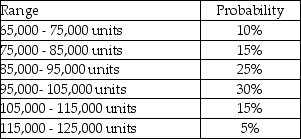 The company is considering purchasing a new machine which will increase its production capacity by 30,000 units. The machine costs $175,000 with a residual value of $40,000 after its useful life of 5 years. The applicable Capital Cost Allowance rate is 20%. The company's tax rate is 40% and it requires an after-tax rate of return on capital of 10% (including provision for inflation).
Required:
Should Broughton purchase the new machine based on NPV analysis? Assume the machine will be sold on January 1 of year 6 for tax purposes.
The company is considering purchasing a new machine which will increase its production capacity by 30,000 units. The machine costs $175,000 with a residual value of $40,000 after its useful life of 5 years. The applicable Capital Cost Allowance rate is 20%. The company's tax rate is 40% and it requires an after-tax rate of return on capital of 10% (including provision for inflation).
Required:
Should Broughton purchase the new machine based on NPV analysis? Assume the machine will be sold on January 1 of year 6 for tax purposes. (Essay)
4.9/5 (85)
(85) Declines in the general purchasing power of the dollar will inflate future cash flows above what they would have been without inflation.
(True/False)
4.8/5 (83)
(83) Use the information below to answer the following question(s).
Barry operates a shop in a resort in an area known for its high inflation rate. The inflation rate for the last few years has been averaging 3 percent a month. His long-term real rate of return is 12 percent, or 1 percent a month. On April 1 he anticipates that real dollar sales during the summer will be as follows:
 -What is the nominal rate of return on a monthly basis for Barry's shop during the summer?
 (Multiple Choice)
4.8/5 (87)
(87) Morrison Limited has an opportunity to purchase new, more efficient production equipment to replace existing machinery. The new machine will cost $850,000 and has an expected 8 year life and a salvage value of $125,000.
The existing machine can be sold for $255,000. It is estimated that 8 years from now the salvage value of the old equipment will be zero.
Annual cash flows to be generated by the new machine through productivity improvements are estimated at $198,000 per year (before tax).
The equipment is in Class 8 and Morrison's tax rate is 40%. Morrison uses a cost of capital of 15%.
Required:
Using NPV analysis, should the new equipment be purchased? Assume the asset will be disposed of on January 1 of year 9 for tax purposes and there will be assets remaining in the pool.
(Essay)
4.7/5 (77)
(77) 
Filters
- Essay(0)
- Multiple Choice(0)
- Short Answer(0)
- True False(0)
- Matching(0)