



 Chat with AI
Exam 21: Capital Budgeting and Cost Analysis

Exam 1: The Accountants Role in the Organization195 Questions
Exam 2: An Introduction to Cost Terms and Purposes224 Questions
Exam 3: Cost-Volume-Profit Analysis207 Questions
Exam 4: Job Costing199 Questions
Exam 5: Activity-Based Costing and Activity-Based Management175 Questions
Exam 6: Master Budget and Responsibility Accounting229 Questions
Exam 7: Flexible Budgets, Direct-Cost Variances, and Management Control180 Questions
Exam 8: Flexible Budgets, Overhead Cost Variances, and Management Control171 Questions
Exam 9: Inventory Costing and Capacity Analysis208 Questions
Exam 10: Determining How Costs Behave182 Questions
Exam 11: Decision Making and Relevant Information220 Questions
Exam 12: Pricing Decisions and Cost Management210 Questions
Exam 13: Strategy, Balanced Scorecard, and Strategic Profitability Analysis171 Questions
Exam 14: Cost Allocation, Customer-Profitability Analysis, and Sales-Variance Analysis170 Questions
Exam 15: Allocation of Support-Department Costs, Common Costs, and Revenues144 Questions
Exam 16: Cost Allocation: Joint Products and Byproducts125 Questions
Exam 17: Process Costing126 Questions
Exam 18: Spoilage, Rework, and Scrap125 Questions
Exam 19: Balanced Scorecard: Quality, Time, and the Theory of Constraints124 Questions
Exam 20: Inventory Management, Just-In-Time, and Simplified Costing Methods125 Questions
Exam 21: Capital Budgeting and Cost Analysis130 Questions
Exam 22: Management Control Systems, Transfer Pricing, and Multinational Considerations123 Questions
Exam 23: Performance Measurement, Compensation, and Multinational Considerations139 Questions
Select questions type


The phenol Corporation has an annual cash inflow from operations from its investment in a capital asset of $25,000 each year for five years. The corporation's income tax rate is 40%. Calculate the five years total after-tax cash inflow from operations.
(Multiple Choice)
4.8/5  (71)
(71) A capital budgeting tool that management can use to summarize the difference in the future net cash inflows from an intangible asset at two different points in time is referred to as:
(Multiple Choice)
4.8/5 (78)
(78) A "what-if" technique that examines how a result will change if the original predicted data are NOT achieved or if an underlying assumption changes is called:
(Multiple Choice)
5.0/5 (66)
(66) A manager who uses discounted cash flow methods to make capital budgeting decisions does NOT face goal-congruence issues if the accrual accounting rate of return is used for performance evaluation.
(True/False)
4.9/5 (80)
(80) Answer the following questions using the information below:
Jonesville Hospital has been considering the purchase of a new x-ray machine. The existing machine is operable for five more years and will have a zero disposal price. If the machine is disposed now, it may be sold for $90,000. The new machine will cost $650,000 and an additional cash investment in working capital of $20,000 will be required. The new machine will reduce the average amount of time required to take the x-rays and will allow an additional amount of business to be done at the hospital. The investment is expected to net $60,000 in additional cash inflows during the year of acquisition and $230,000 each additional year of use. The new machine has a five-year life, and zero disposal value. These cash flows will generally occur throughout the year and are recognized at the end of each year. Income taxes are not considered in this problem. The working capital investment will not be recovered at the end of the asset's life.
-What is the net present value of the investment, assuming the required rate of return is 12%? Would the hospital want to purchase the new machine?
(Multiple Choice)
4.9/5 (84)
(84) Capital budgeting is the process of making long-run planning decisions for investments in projects.
(True/False)
4.8/5 (73)
(73) The Silver Shades Corporation disposes a capital asset with an original cost of $230,000 and accumulated depreciation of $125,000 for a salvage price of $36,000. Silver Shades's tax rate is 30%. Calculate the after-tax cash inflow from the disposal of the capital asset.
(Multiple Choice)
4.8/5 (82)
(82) Answer the following questions using the information below:
Hawkeye Cleaners has been considering the purchase of an industrial dry-cleaning machine. The existing machine is operable for three more years and will have a zero disposal price. If the machine is disposed now, it may be sold for $120,000. The new machine will cost $400,000 and an additional cash investment in working capital of $120,000 will be required. The new machine will reduce the average amount of time required to wash clothing and will decrease labor costs. The investment is expected to net $100,000 in additional cash inflows during the year of acquisition and $300,000 each additional year of use. The new machine has a three-year life, and zero disposal value. These cash flows will generally occur throughout the year and are recognized at the end of each year. Income taxes are not considered in this problem. The working capital investment will not be recovered at the end of the asset's life.
-What is the net present value of the investment, assuming the required rate of return is 10%? Would the company want to purchase the new machine?
(Multiple Choice)
4.8/5 (75)
(75) The method that measures the time it will take to recoup, in the form of future cash inflows, the total dollars invested in a project is called:
(Multiple Choice)
4.7/5 (82)
(82) An example of an intangible asset would be a corporation's customer base.
(True/False)
4.9/5 (63)
(63) Comparison of the actual results for a project to the costs and benefits expected at the time the project was selected is referred to as:
(Multiple Choice)
4.8/5 (79)
(79) Maremount Tire Company needs to overhaul its auto lift system or buy a new one. The facts have been gathered, and they are as follows:
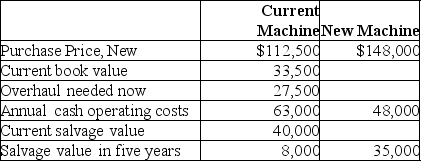 Required:
Which alternative is the most desirable with a current required rate of return of 15%? Show computations, and assume no taxes.
Required:
Which alternative is the most desirable with a current required rate of return of 15%? Show computations, and assume no taxes. (Essay)
4.9/5 (67)
(67) The stage of the capital budgeting process in which a firm obtains funding for the project is the:
(Multiple Choice)
4.8/5 (84)
(84) Upper Darby Park Department is considering a new capital investment. The following information is available on the investment. The cost of the machine will be $72,096. The annual cost savings if the new machine is acquired will be $20,000. The machine will have a 5-year life, at which time the terminal disposal value is expected to be zero. Upper Darby Park is assuming no tax consequences. Upper Darby Park has a 10% required rate of return. What is the payback period on this investment?
(Multiple Choice)
4.9/5 (69)
(69) The stage of the capital budgeting process during which marketing is queried for potential revenue numbers is the:
(Multiple Choice)
4.9/5 (75)
(75) Which capital budgeting technique(s)measure all expected future cash inflows and outflows as if they occurred at a single point in time?
(Multiple Choice)
4.8/5 (76)
(76) In capital budgeting, a project is accepted only if the internal rate of return equals or:
(Multiple Choice)
5.0/5 (84)
(84) The capital budgeting method which calculates the expected monetary gain or loss from a project by discounting all expected future cash inflows and outflows to the present point in time using the required rate of return is the:
(Multiple Choice)
4.8/5 (99)
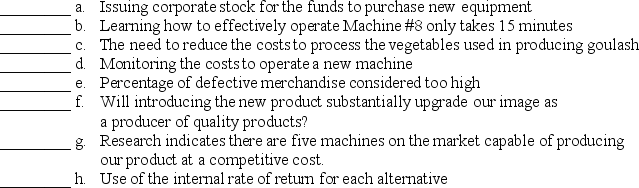
(99) Match each one of the examples below with one of the stages of the capital budgeting decision model.
Stages:
1. Identify Projects
2. Obtain Information
3. Make Predictions
4. Make Decisions by Choosing Among Alternatives
5. Implement the Decision, Evaluate Performance, and Learn
(Essay)
4.7/5 (73)
(73) Assume your goal in life is to retire with two million dollars. How much would you need to save at the end of each year if interest rates average 6% and you have a 20-year work life?
(Multiple Choice)
5.0/5 (84)
(84) 
Filters
- Essay(0)
- Multiple Choice(0)
- Short Answer(0)
- True False(0)
- Matching(0)