



 Chat with AI
Exam 21: Capital Budgeting and Cost Analysis

Exam 1: The Accountants Role in the Organization195 Questions
Exam 2: An Introduction to Cost Terms and Purposes224 Questions
Exam 3: Cost-Volume-Profit Analysis207 Questions
Exam 4: Job Costing199 Questions
Exam 5: Activity-Based Costing and Activity-Based Management175 Questions
Exam 6: Master Budget and Responsibility Accounting229 Questions
Exam 7: Flexible Budgets, Direct-Cost Variances, and Management Control180 Questions
Exam 8: Flexible Budgets, Overhead Cost Variances, and Management Control171 Questions
Exam 9: Inventory Costing and Capacity Analysis208 Questions
Exam 10: Determining How Costs Behave182 Questions
Exam 11: Decision Making and Relevant Information220 Questions
Exam 12: Pricing Decisions and Cost Management210 Questions
Exam 13: Strategy, Balanced Scorecard, and Strategic Profitability Analysis171 Questions
Exam 14: Cost Allocation, Customer-Profitability Analysis, and Sales-Variance Analysis170 Questions
Exam 15: Allocation of Support-Department Costs, Common Costs, and Revenues144 Questions
Exam 16: Cost Allocation: Joint Products and Byproducts125 Questions
Exam 17: Process Costing126 Questions
Exam 18: Spoilage, Rework, and Scrap125 Questions
Exam 19: Balanced Scorecard: Quality, Time, and the Theory of Constraints124 Questions
Exam 20: Inventory Management, Just-In-Time, and Simplified Costing Methods125 Questions
Exam 21: Capital Budgeting and Cost Analysis130 Questions
Exam 22: Management Control Systems, Transfer Pricing, and Multinational Considerations123 Questions
Exam 23: Performance Measurement, Compensation, and Multinational Considerations139 Questions
Select questions type


What are the four alternative methods for evaluating capital budgeting projects? What is an advantage and disadvantage of each method?
(Essay)
4.8/5  (76)
(76) In using the net present value method, only projects with a zero or positive net present value are acceptable because:
(Multiple Choice)
4.8/5 (83)
(83) The payback method of capital budgeting approach to the investment decision highlights:
(Multiple Choice)
4.8/5 (74)
(74) Depreciation is usually NOT considered an operating cash flow in capital budgeting because:
(Multiple Choice)
4.9/5 (85)
(85) Deducting depreciation from operating cash flows would result in counting the initial investment twice in a discounted cash flow analysis.
(True/False)
4.8/5 (74)
(74) Using capital budgeting techniques to track and (based on success to date)modify resource levels committed to staged R&D investments is called timed options.
(True/False)
4.8/5 (74)
(74) All of the following are methods that aid management in analyzing the expected results of capital budgeting decisions EXCEPT:
(Multiple Choice)
4.7/5 (89)
(89) All of the following are major categories of cash flows in capital investment decisions EXCEPT:
(Multiple Choice)
4.8/5 (100)
(100) Investment A requires a net investment of $1,600,000. The required rate of return is 12% for the four-year annuity. What are the annual cash inflows if the net present value equals 0? (rounded)
(Multiple Choice)
4.9/5 (72)
(72) The stage of the capital budgeting process that distinguishes which types of capital expenditure projects are necessary to accomplish organization objectives is the:
(Multiple Choice)
4.9/5 (82)
(82) The Zeron Corporation recently purchased a new machine for its factory operations at a cost of $921,250. The investment is expected to generate $250,000 in annual cash flows for a period of six years. The required rate of return is 14%. The old machine has a remaining life of six years. The new machine is expected to have zero value at the end of the six-year period. The disposal value of the old machine at the time of replacement is zero. What is the internal rate of return?
(Multiple Choice)
4.8/5 (72)
(72) Explain why the term tax shield is used in conjunction with depreciation.
(Essay)
4.8/5 (76)
(76) In calculating the net initial investment cash flows, any increase in working capital required for the project should be included.
(True/False)
4.9/5 (77)
(77) What conflicts can arise between using discounted cash flow methods for capital budgeting decisions and accrual accounting for performance evaluation? How can these conflicts be reduced?
(Essay)
4.9/5 (75)
(75) The make predictions stage of the capital budgeting process consists of forecasting all potential net income additions that are attributable to the alternative projects.
(True/False)
4.8/5 (78)
(78) Soda Manufacturing Company provides vending machines for soft-drink manufacturers. The company has been investigating a new piece of machinery for its production department. The old equipment has a remaining life of three years and the new equipment has a value of $52,650 with a three-year life. The expected additional cash inflows are $25,000 per year. What is the internal rate of return?
(Multiple Choice)
4.9/5 (77)
(77) Bock Construction Company is considering four proposals for the construction of new loading facilities that will include the latest in ship loading/unloading equipment. After careful analysis, the company's accountant has developed the following information about the four proposals:
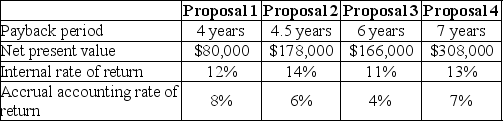 Required:
How can this information be used in the decision-making process for the new loading facilities? Does it cause any confusion?
Required:
How can this information be used in the decision-making process for the new loading facilities? Does it cause any confusion? (Essay)
4.8/5 (67)
(67) A capital budgeting project is accepted if the required rate of return equals or exceeds the internal rate of return.
(True/False)
4.9/5 (73)
(73) 
Filters
- Essay(0)
- Multiple Choice(0)
- Short Answer(0)
- True False(0)
- Matching(0)