



 Chat with AI
Exam 4: Job Costing

Exam 1: The Accountants Role in the Organization195 Questions
Exam 2: An Introduction to Cost Terms and Purposes224 Questions
Exam 3: Cost-Volume-Profit Analysis207 Questions
Exam 4: Job Costing199 Questions
Exam 5: Activity-Based Costing and Activity-Based Management175 Questions
Exam 6: Master Budget and Responsibility Accounting229 Questions
Exam 7: Flexible Budgets, Direct-Cost Variances, and Management Control180 Questions
Exam 8: Flexible Budgets, Overhead Cost Variances, and Management Control171 Questions
Exam 9: Inventory Costing and Capacity Analysis208 Questions
Exam 10: Determining How Costs Behave182 Questions
Exam 11: Decision Making and Relevant Information220 Questions
Exam 12: Pricing Decisions and Cost Management210 Questions
Exam 13: Strategy, Balanced Scorecard, and Strategic Profitability Analysis171 Questions
Exam 14: Cost Allocation, Customer-Profitability Analysis, and Sales-Variance Analysis170 Questions
Exam 15: Allocation of Support-Department Costs, Common Costs, and Revenues144 Questions
Exam 16: Cost Allocation: Joint Products and Byproducts125 Questions
Exam 17: Process Costing126 Questions
Exam 18: Spoilage, Rework, and Scrap125 Questions
Exam 19: Balanced Scorecard: Quality, Time, and the Theory of Constraints124 Questions
Exam 20: Inventory Management, Just-In-Time, and Simplified Costing Methods125 Questions
Exam 21: Capital Budgeting and Cost Analysis130 Questions
Exam 22: Management Control Systems, Transfer Pricing, and Multinational Considerations123 Questions
Exam 23: Performance Measurement, Compensation, and Multinational Considerations139 Questions
Select questions type


Answer the following questions using the information below:
Bauer Manufacturing uses departmental cost driver rates to allocate manufacturing overhead costs to products. Manufacturing overhead costs are allocated on the basis of machine-hours in the Machining Department and on the basis of direct labor-hours in the Assembly Department. At the beginning of 20X3, the following estimates were provided for the coming year:
 The accounting records of the company show the following data for Job #316:
 -What amount of manufacturing overhead costs will be allocated to Job #316?
The accounting records of the company show the following data for Job #316:
-What amount of manufacturing overhead costs will be allocated to Job #316? (Multiple Choice)
4.9/5  (86)
(86) Moira Company has just finished its first year of operations and must decide which method to use for adjusting cost of goods sold. Because the company used a budgeted indirect-cost rate for its manufacturing operations, the amount that was allocated ($435,000)to cost of goods sold was different from the actual amount incurred ($425,000).
Ending balances in the relevant accounts were:
 Required:
a. Prepare a journal entry to write off the difference between allocated and actual overhead directly to Cost of Goods Sold. Be sure your journal entry closes the related overhead accounts.
b. Prepare a journal entry that prorates the write-off of the difference between allocated and actual overhead using ending account balances. Be sure your journal entry closes the related overhead accounts.
Required:
a. Prepare a journal entry to write off the difference between allocated and actual overhead directly to Cost of Goods Sold. Be sure your journal entry closes the related overhead accounts.
b. Prepare a journal entry that prorates the write-off of the difference between allocated and actual overhead using ending account balances. Be sure your journal entry closes the related overhead accounts. (Essay)
4.8/5 (77)
(77) The actual costs of all individual overhead categories are recorded in the Manufacturing Overhead Control account.
(True/False)
4.8/5 (95)
(95) The Dougherty Furniture Company manufactures tables. In March, the two production departments had budgeted allocation bases of 4,000 machine-hours in Department 100 and 8,000 direct manufacturing labor-hours in Department 200. The budgeted manufacturing overheads for the month were $57,500 and $62,500, respectively. For Job A, the actual costs incurred in the two departments were as follows:
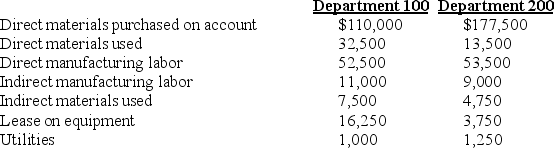 Job A incurred 800 machine-hours in Department 100 and 300 manufacturing labor-hours in Department 200. The company uses a budgeted overhead rate for applying overhead to production.
Required:
a. Determine the budgeted manufacturing overhead rate for each department.
b. Prepare the necessary journal entries to summarize the March transactions for Department 100.
c. What is the total cost of Job A?
Job A incurred 800 machine-hours in Department 100 and 300 manufacturing labor-hours in Department 200. The company uses a budgeted overhead rate for applying overhead to production.
Required:
a. Determine the budgeted manufacturing overhead rate for each department.
b. Prepare the necessary journal entries to summarize the March transactions for Department 100.
c. What is the total cost of Job A? (Essay)
4.9/5 (87)
(87) A local engineering firm is bidding on a design project for a new client. The total budgeted direct-labor costs for the firm are $400,000. The total budgeted indirect costs are $600,000. It is estimated that there are 8,000 billable hours in total.
Required:
a. What is the budgeted direct-labor cost rate?
b. What is the budgeted indirect-cost rate assuming direct-labor cost is the allocation base?
c. What should be the engineering firm bid on the project if the direct labor hours are estimated

(Essay)
4.8/5 (82)
(82) ________ costing is used by a business to price homogeneous products.
(Multiple Choice)
4.8/5 (78)
(78) In a job-costing system, explain why it is necessary to apply indirect costs to production through the use of a manufacturing overhead cost allocation rate.
(Essay)
5.0/5 (84)
(84) Luke employs 25 professional cleaners. Budgeted costs total $1,800,000 of which $1,050,000 is direct costs. Budgeted indirect costs are $750,000 and actual indirect costs were $793,800. Budgeted professional labor-hours are 1,000,000 and actual hours were 1,008,000. What is the budgeted direct cost-allocation rate?
(Multiple Choice)
4.8/5 (79)
(79) The ending balance in Work-in-Process Control represents the total costs of all jobs that have NOT yet been completed.
(True/False)
4.7/5 (75)
(75) Answer the following questions using the information below:
A local accounting firm employs 20 full-time professionals. The budgeted annual compensation per employee is $40,500. The average chargeable time is 500 hours per client annually. All professional labor costs are included in a single direct-cost category and are allocated to jobs on a per-hour basis.
Other costs are included in a single indirect-cost pool, allocated according to professional labor-hours. Budgeted indirect costs for the year are $787,500, and the firm expects to have 90 clients during the coming year.
-What is the budgeted indirect-cost rate per hour?
(Multiple Choice)
4.9/5 (78)
(78) What would be the appropriate journal entry if the following labor wages were incurred in a furniture manufacturing company? 
(Multiple Choice)
4.7/5 (95)
(95) Actual costing is a costing system that traces direct costs to a cost object by
(Multiple Choice)
4.8/5 (67)
(67) Answer the following questions using the information below:
For 2010, Jake's Dog Supply Manufacturing uses machine-hours as the only overhead cost-allocation base. The accounting records contain the following information:
 -Using job costing, the 2010 budgeted manufacturing overhead rate is:
 (Multiple Choice)
4.8/5 (89)
(89) Answer the following questions using the information below:
A local accounting firm employs 20 full-time professionals. The budgeted annual compensation per employee is $40,500. The average chargeable time is 500 hours per client annually. All professional labor costs are included in a single direct-cost category and are allocated to jobs on a per-hour basis.
Other costs are included in a single indirect-cost pool, allocated according to professional labor-hours. Budgeted indirect costs for the year are $787,500, and the firm expects to have 90 clients during the coming year.
-What is the budgeted direct labor cost rate per hour?
(Multiple Choice)
4.9/5 (70)
(70) In a job-costing system, a manufacturing firm typically uses an indirect-cost rate to estimate the ________ allocated to a job.
(Multiple Choice)
4.9/5 (81)
(81) Answer the following questions using the information below:
Wayland Manufacturing uses a normal cost system and had the following data available for 2010:


 -The ending balance of work-in-process inventory is:
 (Multiple Choice)
4.9/5 (74)
(74) In each period, job costing divides the total cost of producing an identical or similar product by the total number of units produced to obtain a per-unit cost.
(True/False)
4.7/5 (80)
(80) Answer the following questions using the information below:
Apple Valley Corporation uses a job cost system and has two production departments, A and B. Budgeted manufacturing costs for the year are:
 The actual material and labor costs charged to Job #432 were as follows:
 Apple Valley applies manufacturing overhead costs to jobs on the basis of direct manufacturing labor cost using departmental rates determined at the beginning of the year.
-For Department A, the manufacturing overhead allocation rate is:
The actual material and labor costs charged to Job #432 were as follows:
Apple Valley applies manufacturing overhead costs to jobs on the basis of direct manufacturing labor cost using departmental rates determined at the beginning of the year.
-For Department A, the manufacturing overhead allocation rate is: (Multiple Choice)
4.9/5 (83)
(83) 
Filters
- Essay(0)
- Multiple Choice(0)
- Short Answer(0)
- True False(0)
- Matching(0)