



 Chat with AI
Exam 4: Job Costing

Exam 1: The Accountants Role in the Organization195 Questions
Exam 2: An Introduction to Cost Terms and Purposes224 Questions
Exam 3: Cost-Volume-Profit Analysis207 Questions
Exam 4: Job Costing199 Questions
Exam 5: Activity-Based Costing and Activity-Based Management175 Questions
Exam 6: Master Budget and Responsibility Accounting229 Questions
Exam 7: Flexible Budgets, Direct-Cost Variances, and Management Control180 Questions
Exam 8: Flexible Budgets, Overhead Cost Variances, and Management Control171 Questions
Exam 9: Inventory Costing and Capacity Analysis208 Questions
Exam 10: Determining How Costs Behave182 Questions
Exam 11: Decision Making and Relevant Information220 Questions
Exam 12: Pricing Decisions and Cost Management210 Questions
Exam 13: Strategy, Balanced Scorecard, and Strategic Profitability Analysis171 Questions
Exam 14: Cost Allocation, Customer-Profitability Analysis, and Sales-Variance Analysis170 Questions
Exam 15: Allocation of Support-Department Costs, Common Costs, and Revenues144 Questions
Exam 16: Cost Allocation: Joint Products and Byproducts125 Questions
Exam 17: Process Costing126 Questions
Exam 18: Spoilage, Rework, and Scrap125 Questions
Exam 19: Balanced Scorecard: Quality, Time, and the Theory of Constraints124 Questions
Exam 20: Inventory Management, Just-In-Time, and Simplified Costing Methods125 Questions
Exam 21: Capital Budgeting and Cost Analysis130 Questions
Exam 22: Management Control Systems, Transfer Pricing, and Multinational Considerations123 Questions
Exam 23: Performance Measurement, Compensation, and Multinational Considerations139 Questions
Select questions type


Which of the following are reasons for using longer periods, such as a year, to calculate indirect cost rates.
(Multiple Choice)
4.8/5  (83)
(83) A company may use job costing to assign costs to different product lines and then use process costing to calculate unit costs within each product line.
(True/False)
5.0/5 (70)
(70) If indirect-cost rates were based on actual short-term usage, periods of lower demand would result in lower costs per unit.
(True/False)
4.8/5 (90)
(90) What is the difference between an actual cost system and a normal cost system?
(Essay)
4.8/5 (91)
(91) Answer the following questions using the information below:
Because the Abernathy Company used a budgeted indirect-cost rate for its manufacturing operations, the amount allocated ($200,000)was different from the actual amount incurred ($225,000).
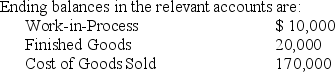 -What is the journal entry used to write off the difference between allocated and actual overhead using the proration approach?
(Multiple Choice)
4.9/5 (75)
(75) Which of the following companies is most likely to use a process costing system.
(Multiple Choice)
4.8/5 (85)
(85) The budgeted indirect cost rate is the budgeted indirect costs divided by budgeted quantity of the cost allocation base.
(True/False)
4.7/5 (85)
(85) If ten clients are lost and the workforce stays at 20 employees, then the direct labor cost rate per hour:
(Multiple Choice)
5.0/5 (73)
(73) The spreading of underallocated or overallocated overhead among ending work-in-process, finished goods, and cost of goods sold is called:
(Multiple Choice)
4.8/5 (83)
(83) Answer the following questions using the information below:
Wayland Manufacturing uses a normal cost system and had the following data available for 2010:


 -The journal entry to record the materials placed into production would include a:
 (Multiple Choice)
4.9/5 (56)
(56) Jacobs Company manufactures refrigerators. The company uses a budgeted indirect-cost rate for its manufacturing operations and during 20X5 allocated $1,000,000 to work-in-process inventory. Actual overhead incurred was $1,100,000.
Ending balances in the following accounts are:
 Required:
a. Prepare a journal entry to write off the difference between allocated and actual overhead directly to Cost of Goods Sold. Be sure your journal entry closes the related overhead accounts.
b. Prepare a journal entry that prorates the write-off of the difference between allocated and actual overhead using ending account balances. Be sure your journal entry closes the related overhead accounts.
Required:
a. Prepare a journal entry to write off the difference between allocated and actual overhead directly to Cost of Goods Sold. Be sure your journal entry closes the related overhead accounts.
b. Prepare a journal entry that prorates the write-off of the difference between allocated and actual overhead using ending account balances. Be sure your journal entry closes the related overhead accounts. (Essay)
4.9/5 (74)
(74) What is the appropriate journal entry if $100,000 of materials were purchased on account for the month of August?
(Multiple Choice)
4.9/5 (80)
(80) Place the following steps in the order suggested by the seven steps used to assign costs to individual jobs: 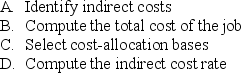
(Multiple Choice)
4.7/5 (83)
(83) Hill Manufacturing uses departmental cost driver rates to apply manufacturing overhead costs to products. Manufacturing overhead costs are applied on the basis of machine-hours in the Machining Department and on the basis of direct labor-hours in the Assembly Department. At the beginning of 20X5, the following estimates were provided for the coming year:
 The accounting records of the company show the following data for Job #846:
 Required:
a. Compute the manufacturing overhead allocation rate for each department.
b. Compute the total cost of Job #846.
c. Provide possible reasons why Hill Manufacturing uses two different cost allocation rates.
The accounting records of the company show the following data for Job #846:
Required:
a. Compute the manufacturing overhead allocation rate for each department.
b. Compute the total cost of Job #846.
c. Provide possible reasons why Hill Manufacturing uses two different cost allocation rates. (Essay)
4.8/5 (69)
(69) Describe job-costing and process-costing systems. Explain when it would be appropriate to use each.
(Essay)
4.9/5 (86)
(86) The ending balance in the Work-in-Process Control account represents the costs of all jobs that:
(Multiple Choice)
4.9/5 (68)
(68) 
Filters
- Essay(0)
- Multiple Choice(0)
- Short Answer(0)
- True False(0)
- Matching(0)