



 Chat with AI
Exam 1: Accounting in Business

Exam 1: Accounting in Business298 Questions
Exam 2: Analyzing and Recording Transactions253 Questions
Exam 3: Adjusting Accounts and Preparing Financial Statements247 Questions
Exam 4: Completing the Accounting Cycle186 Questions
Exam 5: Accounting for Merchandising Operations258 Questions
Exam 6: Inventories and Cost of Sales232 Questions
Exam 7: Accounting Information Systems177 Questions
Exam 8: Cash and Internal Controls220 Questions
Exam 9: Accounting for Receivables217 Questions
Exam 10: Plant Assets Natural Resoures and Intangibles245 Questions
Exam 11: Current Liabilities and Payroll Accounting210 Questions
Exam 12: Accounting for Partnerships172 Questions
Exam 13: Accounting for Corporations228 Questions
Exam 14: Long-Term Liabilities234 Questions
Exam 15: Investments220 Questions
Exam 16: Reporting the Statement of Cash Flows237 Questions
Exam 17: Analysis of Financial Statements235 Questions
Exam 18: Managerial Accounting Concepts and Principles246 Questions
Exam 19: Job Order Costing213 Questions
Exam 20: Process Costing230 Questions
Exam 21: Cost-Volume-Profit Analysis244 Questions
Exam 22: Master Budgets and Planning216 Questions
Exam 23: Flexible Budgets and Standard Costs223 Questions
Exam 24: Performance Measurement and Responsibility Accounting208 Questions
Exam 25: Capital Budgeting and Managerial Decisions190 Questions
Exam 26: Present and Future Values in Accounting84 Questions
Exam 27: Activity-Based Costing70 Questions
Select questions type


Chou Co. has a net income of $43,000, assets at the beginning of the year are $250,000 and assets at the end of the year are $300,000. Compute its return on assets.
(Multiple Choice)
4.9/5  (70)
(70) The statement of cash flows shows the net effect of revenues and expenses for a reporting period.
(True/False)
4.8/5 (81)
(81) The following schedule reflects shows the first month's transactions of the Green Construction Company, owned by Jennifer Green:
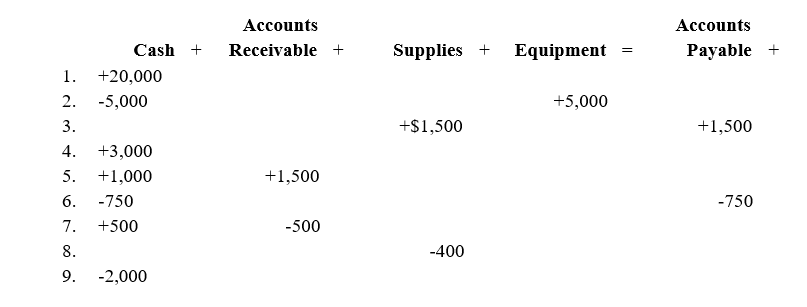 Provide descriptions for each transaction.
 (Essay)
5.0/5 (69)
(69) External users include lenders, shareholders, customers, and regulators.
(True/False)
4.9/5 (85)
(85) Which of the following accounts is not included in the asset section of the balance sheet?
(Multiple Choice)
4.9/5 (75)
(75) The term ________ refers to a liability that promises a future outflow of resources.
(Short Answer)
4.7/5 (73)
(73) Zippy had cash inflows from operations $60,500; cash outflows from investing activities of $47,000; and cash inflows from financing of $25,000. The net change in cash was:
(Multiple Choice)
4.7/5 (76)
(76) The assets of a company total $700,000; the liabilities, $200,000. What are the net assets?
(Multiple Choice)
4.9/5 (83)
(83) The basic financial statements include all of the following except:
(Multiple Choice)
4.9/5 (76)
(76) On May 31 of the current year, the assets and liabilities of Riser, Inc. are as follows: Cash $20,500; Accounts Receivable, $7,250; Supplies, $650; Equipment, $12,000; Accounts Payable, $9,300. What is the amount of owner's equity as of May 31 of the current year?
(Multiple Choice)
4.8/5 (76)
(76) Revenues are increases in equity (via net income) from a company's sales of products and services to customers.
(True/False)
4.7/5 (79)
(79) Internal users include lenders, shareholders, brokers and nonexecutive employees.
(True/False)
4.7/5 (72)
(72) Investing activities are the acquiring and disposing of resources that an organization uses to acquire and sell its products or services.
(True/False)
4.8/5 (68)
(68) Contessa Company collected $42,000 cash on its accounts receivable. The effects of this transaction as reflected in the accounting equation are:
(Multiple Choice)
4.9/5 (89)
(89) In a business decision where there are ethical concerns, the preferred course of action should be one that:
(Multiple Choice)
4.8/5 (72)
(72) Operating activities include long-term borrowing and repaying cash from lenders, and cash investments or withdrawals by the owner.
(True/False)
4.8/5 (76)
(76) Match the following definitions with terms 1 through 8. Place the letter that identifies the best definition in the blank space next to the term.
____ 1. Generally accepted accounting principles
____ 2. Time period assumption
____ 3. Statement of owner's equity.
____ 4. Balance sheet
____ 5. Objectivity principle
____ 6. Measurement (Cost) principle
____ 7. Securities and Exchange Commission
____ 8. IASB
____ 9. Full disclosure principle
____ 10. Statement of cash flows
a. Prescribes that assets and services to be recorded initially on a cash or equal-to-cash basis.
b. A principle that requires the information in financial statements to be supported by independent unbiased evidence.
c. An independent group consisting of individuals from many countries that identify preferred accounting practices.
d. Presumes that the life of a company can be divided into periods for reporting purposes.
e. The concepts and rules that govern financial accounting.
f. A financial statement that reports the changes in equity over the reporting period; including increases such as owner investment and net income and for decreases such as owner withdrawals or net loss.
g. A report that identifies cash receipts and cash payments over a period of time.
h. Prescribes that a company report the details behind financial statements that would impact user decisions.
i. The governmental agency that has the legal authority to establish accounting rules.
j. A report that describes a company's financial position at a point in time.
(Short Answer)
4.8/5 (68)
(68) Match the following terms with the appropriate definition
Correct Answer: Verified
Premises:
Responses:
(Matching)
4.9/5 (81)
(81) 
Filters
- Essay(0)
- Multiple Choice(0)
- Short Answer(0)
- True False(0)
- Matching(0)