



 Chat with AI
Exam 12: Exchange-Rate Determination

Exam 1: The International Economy and Globalization48 Questions
Exam 2: Foundations of Modern Trade Theory: Comparative Advantage166 Questions
Exam 3: Sources of Comparative Advantage108 Questions
Exam 4: Tariffs124 Questions
Exam 5: Nontariff Trade Barriers134 Questions
Exam 6: Trade Regulations and Industrial Policies129 Questions
Exam 7: Trade Policies for the Developing Nations100 Questions
Exam 8: Regional Trading Arrangements130 Questions
Exam 9: International Factor Movements and Multinational Enterprises96 Questions
Exam 10: The Balance of Payments92 Questions
Exam 11: Foreign Exchange121 Questions
Exam 12: Exchange-Rate Determination133 Questions
Exam 13: Mechanisms of International Adjustment107 Questions
Exam 14: Exchange-Rate Adjustments and the Balance of Payments100 Questions
Exam 15: Exchange-Rate Systems and Currency Crises107 Questions
Exam 16: Macroeconomic Policy in an Open Economy72 Questions
Exam 17: International Banking: Reserves, Debt, and Risk96 Questions
Select questions type


The supply of francs,would shift to the right for all of the following reasons except:
(Multiple Choice)
5.0/5  (79)
(79) The appreciation in the value of the dollar in the early 1980s is explained by all of the following except:
(Multiple Choice)
4.8/5 (79)
(79) Given floating exchange rates,assume that the Swiss decrease their import purchases from Italy while at the same time the Italians increase their purchases of Swiss government securities.The first action by itself would lead to a (an)____ of the franc against the lira while the second action by itself would lead to a (an)____ of the franc against the lira.
(Multiple Choice)
4.9/5 (75)
(75) Given a system of floating exchange rates,stronger U.S.preferences for imports would trigger:
(Multiple Choice)
4.9/5 (81)
(81) When deciding between U.S.and British government securities,an American investor typically considers:
(Multiple Choice)
4.8/5 (84)
(84) The asset market theory of exchange rate determination suggests that the most important factor influencing the demand for domestic and foreign securities is:
(Multiple Choice)
4.9/5 (89)
(89) Concerning exchange-rate determination,"market fundamentals" include all of the following except:
(Multiple Choice)
4.8/5 (83)
(83) The figure below illustrates the supply and demand schedules of Swiss francs under a system of floating exchange rates.
Figure 12.2.The Market for Swiss Francs  -Refer to Figure 12.2.If the United States decreases tariffs on imports from Switzerland,there would occur a decrease in the demand for francs and a decrease in the dollar price of the franc.
 (True/False)
4.9/5 (86)
(86) The demand in the United States for yen will increase if,other things remaining equal:
(Multiple Choice)
4.8/5 (72)
(72) The figure below illustrates the supply and demand schedules of Swiss francs in a market of freely-floating exchange rates.
Figure 12.1 The Market for Francs 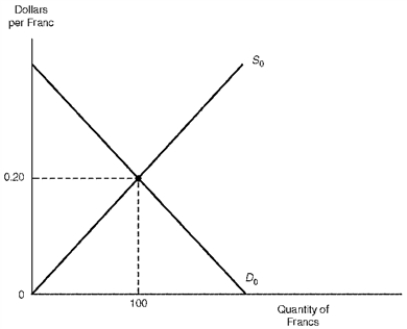 -Refer to Figure 12.1.Should preferences for imports rise in the United States and fall in Switzerland,there would occur a (an):
 (Multiple Choice)
4.9/5 (61)
(61) According to the law of one price,identical goods should cost the same in all nations,assuming there are no shipping costs nor trade barriers.
(True/False)
4.7/5 (81)
(81) Under a system of floating exchange rates,relatively high productivity and low inflation rates in the United States result in:
(Multiple Choice)
4.7/5 (89)
(89) Which of the following is likely to result in long-run depreciation of the U.S.dollar relative to the euro?
(Multiple Choice)
4.8/5 (74)
(74) Long-run determinants of exchange rate include labor productivity levels,inflation rates,consumer preferences for goods and services,and trade barriers.
(True/False)
4.9/5 (70)
(70) For the United States,suppose the annual interest rate on government securities equals 12 percent while the annual inflation rate equals 8 percent.For Japan,suppose the annual interest rate equals 5 percent.These variables would cause investment funds to flow from:
(Multiple Choice)
4.9/5 (88)
(88) What is the purchasing power parity approach to exchange rate determination?
(Essay)
4.8/5 (66)
(66) If consumer tastes in the United States change in favor of goods produced in France,the demand for francs will increase which causes an appreciation of the dollar against the franc under a floating exchange rate system.
(True/False)
4.8/5 (83)
(83) 
Filters
- Essay(0)
- Multiple Choice(0)
- Short Answer(0)
- True False(0)
- Matching(0)