



 Chat with AI
Exam 11: Foreign Exchange

Exam 1: The International Economy and Globalization48 Questions
Exam 2: Foundations of Modern Trade Theory: Comparative Advantage166 Questions
Exam 3: Sources of Comparative Advantage108 Questions
Exam 4: Tariffs124 Questions
Exam 5: Nontariff Trade Barriers134 Questions
Exam 6: Trade Regulations and Industrial Policies129 Questions
Exam 7: Trade Policies for the Developing Nations100 Questions
Exam 8: Regional Trading Arrangements130 Questions
Exam 9: International Factor Movements and Multinational Enterprises96 Questions
Exam 10: The Balance of Payments92 Questions
Exam 11: Foreign Exchange121 Questions
Exam 12: Exchange-Rate Determination133 Questions
Exam 13: Mechanisms of International Adjustment107 Questions
Exam 14: Exchange-Rate Adjustments and the Balance of Payments100 Questions
Exam 15: Exchange-Rate Systems and Currency Crises107 Questions
Exam 16: Macroeconomic Policy in an Open Economy72 Questions
Exam 17: International Banking: Reserves, Debt, and Risk96 Questions
Select questions type


Refer to Exhibit 11.1.If U.S.investors cover their exchange rate risk,the extra return for the 6 months on the U.K.treasury bills is:
(Multiple Choice)
4.9/5  (81)
(81) Figure 11.3 The Market for the Euro 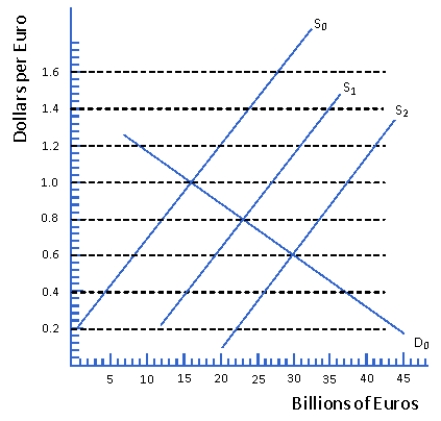 -Refer to Figure 11.3.If the supply curve shifts from S2 to S1
 (Multiple Choice)
4.9/5 (77)
(77) Assume you are an American exporter and expect to receive 50 pounds sterling at the end of 60 days.You can remove the risk of loss due to a devaluation of the pound sterling by:
(Multiple Choice)
4.9/5 (86)
(86) A U.S.export company scheduled to receive 1 million pounds six months from today can hedge its foreign exchange risk by:
(Multiple Choice)
4.9/5 (74)
(74) Most foreign exchange trading is carried out in the forward market.
(True/False)
4.9/5 (89)
(89) An increase in the dollar price of other currencies tends to cause:
(Multiple Choice)
4.9/5 (68)
(68) Given an upward-sloping supply schedule of pounds and a downward-sloping demand schedule for pounds,a decrease in the supply schedule causes an appreciation of the dollar against the pound.
(True/False)
4.8/5 (73)
(73) Given an upward-sloping supply schedule of pounds and a downward-sloping demand schedule for pounds,a decrease in the demand schedule causes an appreciation of the dollar against the pound.
(True/False)
4.9/5 (69)
(69) A person needing foreign exchange immediately would purchase it on the spot market.
(True/False)
4.9/5 (82)
(82) Is it possible to trade foreign exchange in the futures market? How does such trading differ from the forward market?
(Essay)
4.8/5 (76)
(76) A (An)____ is an arrangement by which two parties exchange one currency for another and agree that the exchange will be reversed at a stipulated date in the future:
(Multiple Choice)
4.9/5 (74)
(74) Which of the following would not induce the U.S.demand curve for foreign exchange to shift backward to the left?
(Multiple Choice)
4.9/5 (70)
(70) The demand schedule for Swiss francs is always downsloping while the supply schedule of francs is always upsloping.
(True/False)
4.9/5 (84)
(84) 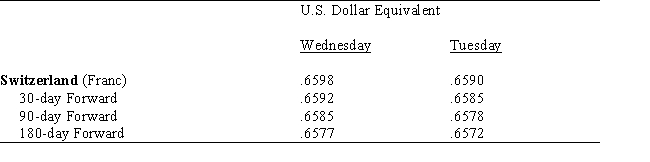 -Refer to Table 11.4.On Wednesday,the 30-day forward franc was selling at a:
 (Multiple Choice)
4.8/5 (73)
(73) The U.S.demand for pounds is derived from U.S.exports to the United Kingdom,U.K.investments in the United States,and U.K.tourist expenditures in the United States.
(True/False)
4.8/5 (72)
(72) If the trade-weighted dollar moves from an index value to 100 to 110,the dollar depreciates by 10 percent against the trade-weighted averages of the exchange rates of the major trading partners of the United States.
(True/False)
5.0/5 (77)
(77) Suppose that a Swiss watch that costs 400 francs in Switzerland costs $200 in the United States.The exchange rate between the franc and the dollar is:
(Multiple Choice)
4.9/5 (94)
(94) Refer to Exhibit 11.1.If the price of the 6-month forward pound were to ____,U.S.investors would no longer earn an extra return by shifting funds to the United Kingdom.
(Multiple Choice)
4.8/5 (83)
(83) 
Filters
- Essay(0)
- Multiple Choice(0)
- Short Answer(0)
- True False(0)
- Matching(0)