



 Chat with AI
Exam 10: The Balance of Payments

Exam 1: The International Economy and Globalization48 Questions
Exam 2: Foundations of Modern Trade Theory: Comparative Advantage166 Questions
Exam 3: Sources of Comparative Advantage108 Questions
Exam 4: Tariffs124 Questions
Exam 5: Nontariff Trade Barriers134 Questions
Exam 6: Trade Regulations and Industrial Policies129 Questions
Exam 7: Trade Policies for the Developing Nations100 Questions
Exam 8: Regional Trading Arrangements130 Questions
Exam 9: International Factor Movements and Multinational Enterprises96 Questions
Exam 10: The Balance of Payments92 Questions
Exam 11: Foreign Exchange121 Questions
Exam 12: Exchange-Rate Determination133 Questions
Exam 13: Mechanisms of International Adjustment107 Questions
Exam 14: Exchange-Rate Adjustments and the Balance of Payments100 Questions
Exam 15: Exchange-Rate Systems and Currency Crises107 Questions
Exam 16: Macroeconomic Policy in an Open Economy72 Questions
Exam 17: International Banking: Reserves, Debt, and Risk96 Questions
Select questions type


If an American receives dividends from the shares of stock she or he owns in Toyota,Inc.,a Japanese firm,the transaction would be recorded on the U.S.balance of payments as a:
(Multiple Choice)
4.9/5  (82)
(82) For the United States,merchandise trade has generally constituted the largest portion of its goods-and-services account.
(True/False)
5.0/5 (71)
(71) Most economists belief that in the 1980s,a massive outflow of capital caused a current account deficit for the United States.
(True/False)
4.8/5 (71)
(71) Which of the following is classified as a credit in the U.S.balance of payments?
(Multiple Choice)
4.9/5 (81)
(81) By the mid-1980s,the United States had evolved from the status of a net-creditor nation to a net-debtor nation in its balance of international indebtedness.
(True/False)
4.9/5 (85)
(85) If a country realizes a current-account deficit in its balance of payments,it becomes a net supplier of funds to the rest of the world.
(True/False)
4.8/5 (74)
(74) Since the 1970s,the merchandise trade account of the U.S.balance of payments has registered deficit.
(True/False)
4.9/5 (80)
(80) For the United States,a consequence of its current account deficit is a growing foreign ownership of the capital stock of the United States and a rising fraction of U.S.income that must be diverted abroad in the form of interest and dividends to foreigners.
(True/False)
5.0/5 (86)
(86) If Bank of America receives repayment for a loan it made to a Mexican firm,the U.S.capital account would register an inflow.
(True/False)
4.8/5 (89)
(89) Unilateral transfers consist of private-sector transfers,such as church contributions to alleviate starvation in Africa,as well as governmental transfers,such as foreign aid.
(True/False)
4.9/5 (87)
(87) Concerning the balance of payments,a current-account deficit results in a worsening of a country's net foreign investment position.
(True/False)
4.8/5 (73)
(73) Concerning the balance of international indebtedness,when is a country a net creditor or a net debtor?
(Essay)
4.9/5 (90)
(90) On the balance-of-payments statement,a capital inflow can be likened to the import of goods and services.
(True/False)
4.8/5 (82)
(82) That German investors collect interest income on their holdings of U.S.Treasury bills constitutes a credit transaction on the U.S.balance of payments.
(True/False)
4.9/5 (79)
(79) Because the balance of payments utilizes double-entry accounting,merchandise exports will always be in balance with merchandise imports.
(True/False)
4.9/5 (68)
(68) Table 10.1.U.S.International Transactions
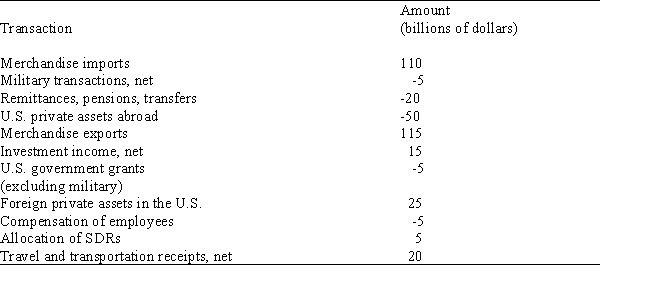 -Referring to Table 10.1,the current account balance equals:
 (Multiple Choice)
4.9/5 (72)
(72) Because a large number of international transactions fail to get recorded,statisticians insert a residual,known as statistical discrepancy,to ensure that total debits equal total credits.
(True/False)
4.7/5 (79)
(79) 
Filters
- Essay(0)
- Multiple Choice(0)
- Short Answer(0)
- True False(0)
- Matching(0)