



 Chat with AI
Exam 9: International Factor Movements and Multinational Enterprises

Exam 1: The International Economy and Globalization48 Questions
Exam 2: Foundations of Modern Trade Theory: Comparative Advantage166 Questions
Exam 3: Sources of Comparative Advantage108 Questions
Exam 4: Tariffs124 Questions
Exam 5: Nontariff Trade Barriers134 Questions
Exam 6: Trade Regulations and Industrial Policies129 Questions
Exam 7: Trade Policies for the Developing Nations100 Questions
Exam 8: Regional Trading Arrangements130 Questions
Exam 9: International Factor Movements and Multinational Enterprises96 Questions
Exam 10: The Balance of Payments92 Questions
Exam 11: Foreign Exchange121 Questions
Exam 12: Exchange-Rate Determination133 Questions
Exam 13: Mechanisms of International Adjustment107 Questions
Exam 14: Exchange-Rate Adjustments and the Balance of Payments100 Questions
Exam 15: Exchange-Rate Systems and Currency Crises107 Questions
Exam 16: Macroeconomic Policy in an Open Economy72 Questions
Exam 17: International Banking: Reserves, Debt, and Risk96 Questions
Select questions type


Multinational corporations sometimes locate manufacturing subsidiaries abroad to avoid tariff barriers which would place their products at a competitive disadvantage in a foreign country.
(True/False)
4.8/5  (86)
(86) Developing countries,such as Mexico and India,often close their borders to foreign companies unless they are willing to take on partner companies in developing countries.
(True/False)
4.8/5 (88)
(88) Labor migration tends to increase output and decrease wages in the country of immigration while decreasing output and increasing wages in the country of emigration.
(True/False)
4.7/5 (79)
(79) American critics of U.S.multinational enterprises contend that they promote
(Multiple Choice)
4.8/5 (75)
(75) Are there any differences between the theory of multinational enterprises and conventional trade theory?
(Essay)
5.0/5 (83)
(83) Critics of multinational corporations maintain that they often abandon domestic workers in order to take advantage of lower wage scales abroad.
(True/False)
4.9/5 (63)
(63) Vertical integration occurs if a parent multinational corporation establishes foreign subsidiaries to produce intermediate goods or inputs that go into the production of a finished good.
(True/False)
4.9/5 (51)
(51) Which type of multinational diversification occurs when the parent firm establishes foreign subsidiaries to produce intermediate goods going into the production of finished goods?
(Multiple Choice)
4.8/5 (75)
(75) If the size of the Canadian market is large enough to permit efficient production in Canada,a U.S.firm would profit by establishing a Canadian manufacturing subsidiary or licensing rights to a Canadian firm to manufacture and sell its product in Canada.
(True/False)
4.9/5 (83)
(83) The market power effect of an international joint venture can lead to welfare losses for the domestic economy unless offset by cost reductions.Which type of cost reduction would not lead to offsetting welfare gains for the overall economy?
(Multiple Choice)
4.8/5 (70)
(70) Joint ventures lead to national welfare gains if the newly established business yields productivity increases that would have been unavailable if each parent performed the same function separately.
(True/False)
5.0/5 (90)
(90) Trade analysis involving multinational enterprises differs from our conventional trade analysis in that multinational enterprise analysis emphasizes:
(Multiple Choice)
4.8/5 (78)
(78) The source (home)location of most of the world's leading multinational enterprises is:
(Multiple Choice)
4.9/5 (78)
(78) Suppose that a steel manufacturer headquartered in Japan sets up a subsidiary in Canada to produce steel.This practice is referred to as:
(Multiple Choice)
4.9/5 (75)
(75) Which business device involves the creation of a new business by two or more companies,often for a limited period of time?
(Multiple Choice)
4.8/5 (80)
(80) Figure 9.1.International Joint Venture 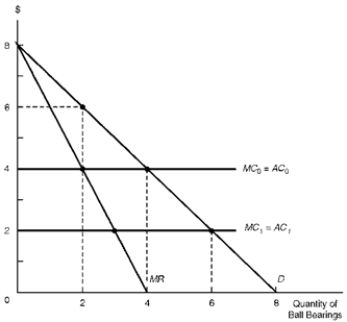 -Consider Figure 9.1.Assume Venture Company's formation yields new cost reductions,indicated by MC1=AC1,which result from technological advances.Realizing that Venture Company results in a deadweight loss of consumer surplus,the net effect of Venture Company's formation on the welfare of the domestic economy is:
 (Multiple Choice)
4.9/5 (95)
(95) 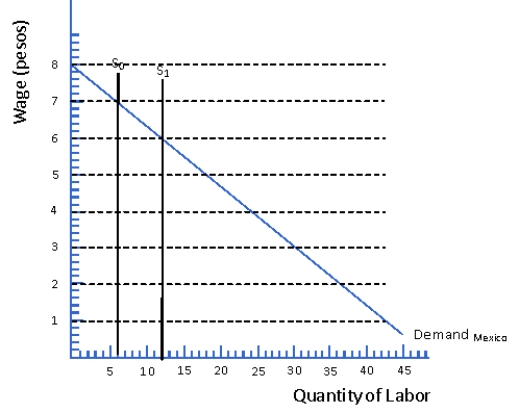 -Consider Figure 9.3.At labor market equilibrium,the payment to Mexican capital owners equals:
 (Multiple Choice)
4.8/5 (74)
(74) The theory of multinational enterprise is totally inconsistent with the principle of comparative advantage.
(True/False)
4.9/5 (77)
(77) Figure 9.1.International Joint Venture
-Consider Figure 9.1.Suppose that Sony Company and American Company jointly form a new firm,Venture Company,whose ball bearings replace the output sold by the parents in the domestic market.Assuming that Venture Company operates as a monopoly and that its costs equal MC0=AC0,the firm's price,output,and total profit would respectively equal:
-Consider Figure 9.1.Suppose that Sony Company and American Company jointly form a new firm,Venture Company,whose ball bearings replace the output sold by the parents in the domestic market.Assuming that Venture Company operates as a monopoly and that its costs equal MC0=AC0,the firm's price,output,and total profit would respectively equal: (Multiple Choice)
4.8/5 (82)
(82) 
Filters
- Essay(0)
- Multiple Choice(0)
- Short Answer(0)
- True False(0)
- Matching(0)