



 Chat with AI
Exam 16: The Electric Field

Exam 1: Introduction32 Questions
Exam 2: Kinematics: Motion in One Dimension162 Questions
Exam 3: Newtonian Mechanics54 Questions
Exam 4: Applying Newtons Laws178 Questions
Exam 5: Circular Motion119 Questions
Exam 6: Impulse and Linear Momentum82 Questions
Exam 7: Work and Energy191 Questions
Exam 8: Extended Bodies at Rest59 Questions
Exam 9: Rotational Motion124 Questions
Exam 10: Gases84 Questions
Exam 11: Static Fluids65 Questions
Exam 12: Fluids in Motion30 Questions
Exam 13: First Law of Thermodynamics119 Questions
Exam 14: Second Law of Thermodynamics70 Questions
Exam 15: Electric Charge force and Energy78 Questions
Exam 16: The Electric Field151 Questions
Exam 17: Dc Circuits225 Questions
Exam 18: Magnetism136 Questions
Exam 19: Electromagnetic Induction99 Questions
Exam 20: Vibrational Motion94 Questions
Exam 21: Mechanical Waves155 Questions
Exam 22: Reflection and Refraction36 Questions
Exam 23: Mirrors and Lenses221 Questions
Exam 24: Wave Optics135 Questions
Exam 25: Electromagnetic Waves79 Questions
Exam 26: Special Relativity124 Questions
Exam 27: Quantum Optics100 Questions
Exam 28: Atomic Physics141 Questions
Exam 29: Nuclear Physics155 Questions
Exam 30: Particle Physics21 Questions
Select questions type


A dielectric material such as paper is inserted between the plates of a capacitor as the capacitor holds a fixed charge on its plates.What happens to the electric field between the plates as the dielectric is inserted?
(Multiple Choice)
4.9/5  (82)
(82) The field at a point 2.8 cm from a small object points toward the object and is equal to 180,000 N/C.What is the object's charge q? (k = 1/4πε0 = 8.99 × 10⁹ N ∙ m2/C2)
(Multiple Choice)
4.7/5 (96)
(96) A -6.5-µC point charge is 8.0 cm from a -17-µC charge.What is the electric energy density at the point midway between them? (ε0 = 8.85 × 10⁻¹² C2/N ∙ m2,k = 1/4πε0 = 9.0 × 10⁹ N ∙ m2/C2)
(Short Answer)
4.9/5 (78)
(78) The three point charges shown in the figure form an equilateral triangle with sides 4.9 cm long.What is the electric potential (relative to infinity)at the point indicated with the dot,which is equidistant from all three charges? Assume that the numbers in the figure are all accurate to two significant figures.(k = 1/4πε0 = 9.0 × 10⁹ N ∙ m2/C2) 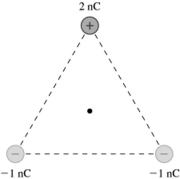
(Multiple Choice)
4.8/5 (86)
(86) Point charges +4.00 μC and +2.00 μC are placed at the opposite corners of a rectangle as shown in the figure.What is the potential at point A,relative to infinity,due to these charges? (k = 1/4πε0 = 8.99 × 10⁹ N ∙ m2/C2) 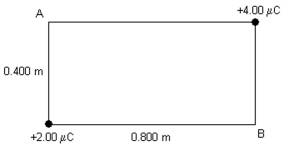
(Multiple Choice)
4.8/5 (69)
(69) A 6.9 μC negative point charge has a positively charged particle in an elliptical orbit about it.If the mass of the positively charged particle is and its distance from the point charge varies from to ,what is the maximum potential difference through which the positive object moves? (k = 1/4πε0 = 9.0 × 10⁹ N ∙ m2/C2)
(Multiple Choice)
4.9/5 (87)
(87) A parallel-plate air-filled capacitor is made from two plates that are 0.070 m on each side and spaced 9.2 mm apart.What must the potential difference between the plates be to produce an energy density of in the region between them? (ε0 = 8.85 × 10⁻¹² C2/N ∙ m2)
(Short Answer)
4.9/5 (77)
(77) A proton is placed in an electric field E = 800 N/C.What are the magnitude and direction of the acceleration of the proton due to this field? (e = 1.60 × 10⁻¹⁹ C,mproton = 1.67 × 10⁻²⁷ kg)
(Multiple Choice)
5.0/5 (87)
(87) An ideal parallel-plate capacitor consists of two parallel plates of area A separated by a distance d.This capacitor is connected to a battery that maintains a constant potential difference across the plates.If the separation between the plates is now doubled,the amount of electrical energy stored on the capacitor will
(Multiple Choice)
4.9/5 (80)
(80) Doubling the capacitance of a capacitor that is holding a constant charge causes the energy stored in that capacitor to
(Multiple Choice)
4.9/5 (81)
(81) If the result of your calculations for a quantity has SI units of C2 ∙ s2/(kg ∙ m2),that quantity could be
(Multiple Choice)
4.8/5 (77)
(77) 
Filters
- Essay(0)
- Multiple Choice(0)
- Short Answer(0)
- True False(0)
- Matching(0)