



 Chat with AI
Exam 16: The Electric Field

Exam 1: Introduction32 Questions
Exam 2: Kinematics: Motion in One Dimension162 Questions
Exam 3: Newtonian Mechanics54 Questions
Exam 4: Applying Newtons Laws178 Questions
Exam 5: Circular Motion119 Questions
Exam 6: Impulse and Linear Momentum82 Questions
Exam 7: Work and Energy191 Questions
Exam 8: Extended Bodies at Rest59 Questions
Exam 9: Rotational Motion124 Questions
Exam 10: Gases84 Questions
Exam 11: Static Fluids65 Questions
Exam 12: Fluids in Motion30 Questions
Exam 13: First Law of Thermodynamics119 Questions
Exam 14: Second Law of Thermodynamics70 Questions
Exam 15: Electric Charge force and Energy78 Questions
Exam 16: The Electric Field151 Questions
Exam 17: Dc Circuits225 Questions
Exam 18: Magnetism136 Questions
Exam 19: Electromagnetic Induction99 Questions
Exam 20: Vibrational Motion94 Questions
Exam 21: Mechanical Waves155 Questions
Exam 22: Reflection and Refraction36 Questions
Exam 23: Mirrors and Lenses221 Questions
Exam 24: Wave Optics135 Questions
Exam 25: Electromagnetic Waves79 Questions
Exam 26: Special Relativity124 Questions
Exam 27: Quantum Optics100 Questions
Exam 28: Atomic Physics141 Questions
Exam 29: Nuclear Physics155 Questions
Exam 30: Particle Physics21 Questions
Select questions type


Point charges +4.00 μC and +2.00 μC are placed at the opposite corners of a rectangle as shown in the figure.What is the potential difference VA - VB? (k = 1/4πε0 = 8.99 × 10⁹ N ∙ m2/C2) 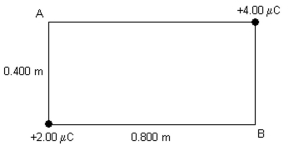
(Multiple Choice)
4.9/5  (82)
(82) Two large closely-spaced parallel metal plates are uniformly and oppositely charged and the magnitude of the field between them is 7.6 × 10⁶ N/C.
(a)What is the charge per unit area on each plate?
(b)If the plates are now moved two times farther apart,what is the magnitude of the field between the plates?
(Short Answer)
4.9/5 (71)
(71) Three equal positive point charges +q are placed at the corners of a square of side d as shown in the figure.Which one of the arrows shown represents the direction of the net field at the center of the square? 
(Multiple Choice)
4.9/5 (67)
(67) A +5.0-µC point charge is 12 cm from a -5.0-µC point charge.What is the magnitude of the field they produce at the point on the line connecting them where their electric potential (relative to infinity)is zero? (k = 1/4πε0 = 9.0 × 10⁹ N ∙ m2/C2)
(Multiple Choice)
4.8/5 (82)
(82) A parallel-plate capacitor with plate separation of 4.0 cm has a plate area of 6.0 × What is the capacitance of this capacitor if a dielectric material with a dielectric constant of 2.4 is placed between the plates,completely filling the space? (ε0 = 8.85 × 10⁻¹² C2/N ∙ m2)
(Multiple Choice)
4.7/5 (69)
(69) Which one of the arrows shown in the figure best represents the direction of the field between the two uniformly charged metal plates? 
(Multiple Choice)
4.8/5 (74)
(74) If the field between the plates of a given air-filled capacitor is weakened by removing charge from the plates,the capacitance of that capacitor
(Multiple Choice)
4.8/5 (87)
(87) In a region where the electric field is uniform and points in the +x direction,the electric potential is -2000 V at x = 8 m and is +400 V at x = 2 m.What is the magnitude of the field?
(Multiple Choice)
4.9/5 (85)
(85) If the electric field exerts a 27 mN force on a point charge of -30 µC at a certain location in the laboratory,what are the magnitude and direction of the field at that location?
(Short Answer)
4.9/5 (77)
(77) The potential (relative to infinity)at the midpoint of a square is 3.0 V when a point charge of +Q is located at one of the corners of the square.What is the potential (relative to infinity)at the center when each of the other corners is also contains a point charge of +Q?
(Multiple Choice)
4.9/5 (88)
(88) Which of the following changes will increase the capacitance of a parallel-plate capacitor? (There could be more than one correct choice.)
(Multiple Choice)
4.7/5 (80)
(80) A capacitor has a voltage of applied across its plates,and then the voltage source is removed.What is the potential difference across its plates if the space between them is then filled with mica,having a dielectric constant of 5.4?
(Multiple Choice)
4.9/5 (60)
(60) When a 4-μF capacitor has a potential drop of 20 V across its plates,how much electric potential energy is stored in this capacitor?
(Multiple Choice)
4.8/5 (80)
(80) A +5.00-μC point charge is placed at the 0.0 cm mark of a meter stick and a -4.00-μC point charge is placed at the 50.0 cm mark.At what point on a line through the ends of the meter stick is the field equal to zero?
(Multiple Choice)
4.9/5 (79)
(79) Two very small +3.00-μC charges are at the ends of a meter stick.Find the electric potential (relative to infinity)at the center of the meter stick.(k = 1/4πε0 = 8.99 × 10⁹ N ∙ m2/C2)
(Multiple Choice)
4.8/5 (68)
(68) Measurements show that it takes 0.30 mJ of work to move 5.0-μC of charge from one plate to another of a certain air-filled capacitor while the potential difference between these plates is kept constant.What is the potential difference between the plates of this capacitor?
(Multiple Choice)
4.7/5 (83)
(83) A square is 1.0 m on a side.Point charges of +4.0 μC are placed in two diagonally opposite corners.In the other two corners are placed charges of +3.0 μC and -3.0 μC.What is the potential (relative to infinity)at the midpoint of the square? (k = 1/4πε0 = 9.0 × 10⁹ N ∙ m2/C2)
(Multiple Choice)
4.9/5 (79)
(79) Which statements must be true about the surface of a charged conductor in which no charge is moving? (There could be more than one correct choice.)
(Multiple Choice)
4.9/5 (85)
(85) A small object with a 5.0-μC charge is accelerating horizontally on a friction-free surface at 0.0050 m/s2 due only to an electric field.If the object has a mass of 2.0 g,what is the magnitude of the field?
(Multiple Choice)
4.9/5 (87)
(87) 
Filters
- Essay(0)
- Multiple Choice(0)
- Short Answer(0)
- True False(0)
- Matching(0)