



 Chat with AI
Exam 16: The Electric Field

Exam 1: Introduction32 Questions
Exam 2: Kinematics: Motion in One Dimension162 Questions
Exam 3: Newtonian Mechanics54 Questions
Exam 4: Applying Newtons Laws178 Questions
Exam 5: Circular Motion119 Questions
Exam 6: Impulse and Linear Momentum82 Questions
Exam 7: Work and Energy191 Questions
Exam 8: Extended Bodies at Rest59 Questions
Exam 9: Rotational Motion124 Questions
Exam 10: Gases84 Questions
Exam 11: Static Fluids65 Questions
Exam 12: Fluids in Motion30 Questions
Exam 13: First Law of Thermodynamics119 Questions
Exam 14: Second Law of Thermodynamics70 Questions
Exam 15: Electric Charge force and Energy78 Questions
Exam 16: The Electric Field151 Questions
Exam 17: Dc Circuits225 Questions
Exam 18: Magnetism136 Questions
Exam 19: Electromagnetic Induction99 Questions
Exam 20: Vibrational Motion94 Questions
Exam 21: Mechanical Waves155 Questions
Exam 22: Reflection and Refraction36 Questions
Exam 23: Mirrors and Lenses221 Questions
Exam 24: Wave Optics135 Questions
Exam 25: Electromagnetic Waves79 Questions
Exam 26: Special Relativity124 Questions
Exam 27: Quantum Optics100 Questions
Exam 28: Atomic Physics141 Questions
Exam 29: Nuclear Physics155 Questions
Exam 30: Particle Physics21 Questions
Select questions type


A particle with a charge of +4.0 μC has a mass of 5.0 g.What magnitude field directed upward will exactly balance the force that Earth exerts on the particle?
(Multiple Choice)
4.9/5  (96)
(96) What charge accumulates on the plates of a 2.0-μF air-filled capacitor when it is charged until the potential difference across its plates is 100 V?
(Multiple Choice)
4.9/5 (80)
(80) A 4.0-g bead carries a charge of 20 μC.The bead is accelerated from rest through a potential difference V,and afterward the bead is moving at 2.0 m/s.What is the magnitude of the potential difference V?
(Multiple Choice)
4.8/5 (78)
(78) Three point charges,-2.00 μC,+4.00 μC,and +6.00 μC,are located along the x-axis as shown in the figure.What is the electric potential (relative to infinity)at point P due to these charges? (k = 1/4πε0 = 8.99 × 10⁹ N ∙ m2/C2) 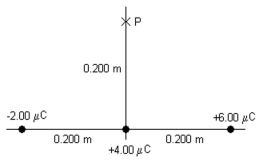
(Multiple Choice)
5.0/5 (86)
(86) An ideal parallel-plate capacitor having circular plates of diameter D that are a distance d apart stores energy U when it is connected across a fixed potential difference.If you want to triple the amount of energy stored in this capacitor by changing only the size of its plates,the diameter should be changed to
(Multiple Choice)
4.9/5 (85)
(85) When a certain capacitor carries charges of ±10 µC on its plates,the potential difference cross the plates is 25 V.Which of the following statements about this capacitor are true? (There could be more than one correct choice.)
(Multiple Choice)
4.8/5 (69)
(69) An electric dipole consists of charges of ±6.00 µC that are 10.0 cm apart,as shown in the figure.Find the magnitude and direction of the field this dipole produces at point P,which is 7.00 cm from each charge.(k = 1/4πε0 = 8.99 × 10⁹ N ∙ m2/C2) 
(Essay)
4.9/5 (71)
(71) A battery maintains the electrical potential difference of 6.0-V between two large parallel metal plates separated by 1.0 mm.What is the magnitude of the field between the plates?
(Multiple Choice)
4.8/5 (72)
(72) Each plate of an ideal air-filled parallel-plate capacitor has an area of 0.0010 ,and the separation of the plates is An field of is present between the plates.What is the capacitance of this capacitor? (ε0 = 8.85 × 10⁻¹² C2/N ∙ m2)
(Multiple Choice)
4.8/5 (68)
(68) A thin spherical copper shell of radius 9.5 cm carries an excess charge of -4.2 nC.How many excess electrons are on (a)the outer surface of the shell,and (b)the inner surface? (e = 1.60 × 10⁻¹⁹C)
(Short Answer)
4.7/5 (74)
(74) The plates of a parallel-plate capacitor are maintained with constant voltage by a battery as they are pulled apart.What happens to the magnitude of the field between the plates during this process?
(Multiple Choice)
4.9/5 (67)
(67) A 12.6-µF isolated capacitor is constructed with Teflon,having a dielectric constant of 2.1,between the plates.The capacitor is initially charged to 1.5 volts,and then the Teflon is removed.
(a)How much excess charge was originally stored on the plates of the capacitor?
(b)After removing the Teflon,what is the potential difference across the capacitor plates?
(Short Answer)
4.8/5 (70)
(70) How much kinetic energy does a proton gain if it is accelerated,with no friction,through a potential difference of 1.00 V? The proton is 1836 times heavier than an electron,and e = 1.60 × 10⁻¹⁹ C.
(Multiple Choice)
4.8/5 (80)
(80) The potential difference between the plates of an ideal air-filled parallel-plate capacitor with a plate separation of 6.0 cm is 60 V.What is the magnitude of the field between the plates of this capacitor?
(Multiple Choice)
4.9/5 (88)
(88) The equipotential surfaces for two point charges are shown in the figure,with the value of potential marked on the line for each surface.
(a)What is the potential difference,VG - VD,between points G and D?
(b)What is the potential difference,VA - VG,between points A and G? 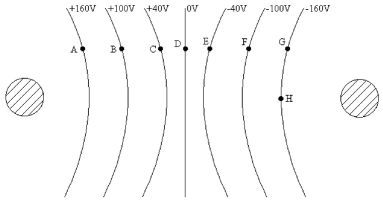
(Short Answer)
4.7/5 (82)
(82) An air-filled capacitor carries enough charge to store of potential energy.It is then accidentally filled with water in such a way as not to discharge its plates.How much energy does it continue to store after it is filled? The dielectric constant for water is 78 and for air it is 1.0006.
(Multiple Choice)
4.9/5 (79)
(79) If a Cu2+ ion that is initially at rest accelerates through a potential difference of 12 V without friction,how much kinetic energy will it gain? (e = 1.60 × 10⁻¹⁹ C)
(Multiple Choice)
4.9/5 (82)
(82) Point charges +4.00 μC and +2.00 μC are placed at the opposite corners of a rectangle as shown in the figure.What is the potential at point B due to these charges? (k = 1/4πε0 = 8.99 × 10⁹ N ∙ m2/C2) 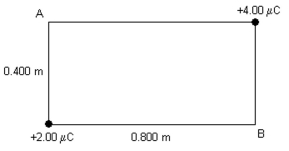
(Multiple Choice)
4.9/5 (71)
(71) A uniform field,with a magnitude of 500 V/m,is points in the +x direction.If the potential at x = 5.0 m is 2500 V,what is the potential at x = 2.0 m?
(Multiple Choice)
4.8/5 (77)
(77) Two +6.0-µC charges are placed at two of the vertices of an equilateral triangle having sides 2.0 m long.What is the electric potential at the third vertex,relative to infinity,due to these charges? (k = 1/4πε0 = 9.0 × 10⁹ N ∙ m2/C2)
(Multiple Choice)
5.0/5 (82)
(82) 
Filters
- Essay(0)
- Multiple Choice(0)
- Short Answer(0)
- True False(0)
- Matching(0)