



 Chat with AI
Exam 43: Nuclear Physics

Exam 1: Units,physical Quantities,and Vectors107 Questions
Exam 2: Motion Along a Straight Line59 Questions
Exam 3: Motion in Two or Three Dimensions50 Questions
Exam 4: Newtons Laws of Motion44 Questions
Exam 5: Applying Newtons Laws95 Questions
Exam 6: Work and Kinetic Energy54 Questions
Exam 7: Potential Energy and Energy Conservation55 Questions
Exam 8: Momentum,impulse,and Collisions50 Questions
Exam 9: Rotation of Rigid Bodies26 Questions
Exam 10: Dynamics of Rotational Motion49 Questions
Exam 11: Equilibrium and Elasticity50 Questions
Exam 12: Fluid Mechanics50 Questions
Exam 13: Gravitation50 Questions
Exam 14: Periodic Motion50 Questions
Exam 15: Mechanical Waves44 Questions
Exam 16: Sound and Hearing65 Questions
Exam 17: Temperature and Heat63 Questions
Exam 18: Thermal Properties of Matter58 Questions
Exam 19: The First Law of Thermodynamics52 Questions
Exam 20: The Second Law of Thermodynamics50 Questions
Exam 21: Electric Charge and Electric Field60 Questions
Exam 22: Gausss Law41 Questions
Exam 23: Electric Potential55 Questions
Exam 24: Capacitance and Dielectrics52 Questions
Exam 25: Current,resistance,and Electromotive Force55 Questions
Exam 26: Direct-Current Circuits53 Questions
Exam 27: Magnetic Field and Magnetic Forces42 Questions
Exam 28: Sources of Magnetic Field52 Questions
Exam 29: Electromagnetic Induction39 Questions
Exam 30: Inductance27 Questions
Exam 31: Alternating Current50 Questions
Exam 32: Electromagnetic Waves47 Questions
Exam 33: The Nature and Propagation of Light28 Questions
Exam 34: Geometric Optics81 Questions
Exam 35: Interference33 Questions
Exam 36: Diffraction49 Questions
Exam 37: Relativity51 Questions
Exam 38: Photons: Light Waves Behaving As Particles38 Questions
Exam 39: Particles Behaving As Waves52 Questions
Exam 40: Quantum Mechanics43 Questions
Exam 41: Atomic Structure53 Questions
Exam 42: Molecules and Condensed Matter31 Questions
Exam 43: Nuclear Physics90 Questions
Exam 44: Particle Physics and Cosmology54 Questions
Select questions type


Rutherfordium-261 has a half-life of 1.08 min.How long will it take for a sample of rutherfordium to lose one-third of its nuclei?
(Multiple Choice)
4.9/5  (80)
(80) Fermium-253 has a half-life of 3.00 d.A sample of fermium contains 7.37 ×  nuclei.How long will it take for there to be only 3.36 ×
 fermium nuclei in this sample?
nuclei.How long will it take for there to be only 3.36 × fermium nuclei in this sample? (Multiple Choice)
4.7/5 (83)
(83) Which of the following statements about the strong nuclear force are correct? (There may be more than one correct choice.)
(Multiple Choice)
4.9/5 (82)
(82) The decay rate of an isotope is initially R0,but after one half-life has gone by,the rate is R0/2.At the end of the NEXT half-life,what will the decay rate be?
(Multiple Choice)
4.8/5 (79)
(79) A radioactive atom has 98 protons and 249 nucleons.If it undergoes alpha decay,what are the number of protons and nucleons,respectively,in the daughter nucleus?
(Multiple Choice)
4.8/5 (86)
(86) Calculate the reaction energy (Q value)for the reaction 7Li + 1H → 4He + 4He,given the following masses: 7Li: 7.016005 u
1H: 1.007825 u
4He: 4.002603 u
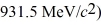
(1 u = 931.5 MeV/c2)
(Multiple Choice)
4.8/5 (87)
(87) Which of the following statements about the atomic nucleus is correct? (There may be more than one correct choice.)
(Multiple Choice)
4.7/5 (64)
(64) How much energy is released when 1.40 μg of 3H have decayed to 3He? The mass of 3He is 3.016029 u,the mass of 3H is 3.016049 u,and 1 u = 931.494 MeV/c2.
(Multiple Choice)
4.9/5 (79)
(79) A 57-kg researcher absorbs 6.3 ×  neutrons in a workday.The energy of the neutrons is 2.6 MeV.The relative biological efficiency (RBE)for fast neutrons is 10.What is the equivalent dosage of the radiation exposure,in mrem,of this worker?
 (Multiple Choice)
4.7/5 (80)
(80) If a nucleus decays by β- decay to a daughter nucleus,which of the following statements about this decay are correct? (There may be more than one correct choice.)
(Multiple Choice)
4.8/5 (71)
(71) The following masses are known:  n (neutron)1.008665 u
 H 1.007825 u
 Fe 56.935399 u What is the binding energy of
 Fe,in MeV? (1 u = 1.6605 × 10⁻²⁷ kg =
n (neutron)1.008665 u H 1.007825 u Fe 56.935399 u What is the binding energy of Fe,in MeV? (1 u = 1.6605 × 10⁻²⁷ kg = (Multiple Choice)
4.9/5 (73)
(73) Two identical nuclei of mass 18 u are made to unite to make a single nucleus of mass 36 u.What is the radius of the result of this fusion?
(Multiple Choice)
4.8/5 (75)
(75) A radioactive isotope decays by β- emission with a half-life of 1.0 min.During the first 1.0 min,a particular sample emits 1000 β- particles.During the next 1.0 min,the number of β- particles this sample will emit will be closest to
(Multiple Choice)
4.9/5 (87)
(87) The half-life of cobalt-60 is 5.3 years,while that of strontium-90 is 28 years.Suppose you have a sample of each,such that they initially contain equal numbers of atoms of these nuclides.How will the activities (number of decays per second)of the samples compare?
(Multiple Choice)
4.7/5 (92)
(92) A sphere made of a radioactive isotope initially has a mass of 6.88 kg.The half-life of this isotope is 1.34 h,and it decays by β- emission.At the end of 2.68 h,what is the mass of this sphere?
(Multiple Choice)
4.8/5 (89)
(89) If a nucleus had a diameter of 8.0 fm,what would be its expected mass,in atomic mass units?
(Multiple Choice)
4.8/5 (78)
(78) When a neutron (n)collides with a uranium-235 nucleus it can induce a variety of fission reactions.One such reaction is  U + n →
 Xe +
 Sr + 2n.How much energy is released in this reaction,given the following mass values:
 Xe: 139.921620 u
 Sr : 93.915367 u
 U: 235.043924 u n: 1.008665 u
(1 u = 931.494 MeV/c2)
U + n → Xe + Sr + 2n.How much energy is released in this reaction,given the following mass values: Xe: 139.921620 u Sr : 93.915367 u U: 235.043924 u n: 1.008665 u
(1 u = 931.494 MeV/c2) (Multiple Choice)
4.9/5 (93)
(93) Two deuterium nuclei,  H,fuse to produce a helium nucleus,
 H,and a neutron.A neutral deuterium atom has a mass of 2.014102 u; a neutral helium atom has a mass of 3.016030 u; a neutral hydrogen atom has a mass of 1.007825 u; a neutron has a mass of 1.008665 u; and a proton has a mass of 1.007276 u.How much energy is released in the process?

H,fuse to produce a helium nucleus, H,and a neutron.A neutral deuterium atom has a mass of 2.014102 u; a neutral helium atom has a mass of 3.016030 u; a neutral hydrogen atom has a mass of 1.007825 u; a neutron has a mass of 1.008665 u; and a proton has a mass of 1.007276 u.How much energy is released in the process? (Multiple Choice)
4.9/5 (84)
(84) For the missing product X in the reaction
neutron +  U →
 Ba + X + 3 neutrons
determine the atomic mass and atomic number of X,and write X in the standard form.It is NOT necessary to identify which atom X is.
U → Ba + X + 3 neutrons
determine the atomic mass and atomic number of X,and write X in the standard form.It is NOT necessary to identify which atom X is. (Short Answer)
4.9/5 (70)
(70) An air sample is contaminated with 15O,which has a half-life of 2.03 min.One possible way to minimize its hazard is to pass it through a long pipe to allow it to decay inside the pipe until it can be safely released into the atmosphere.If the oxygen moves at a speed of 1.1 m/s in the pipe,how long must the pipe be for the sample to have decayed to 3.0% of its original activity just as it leaves the pipe?
(Multiple Choice)
4.9/5 (92)
(92) 
Filters
- Essay(0)
- Multiple Choice(0)
- Short Answer(0)
- True False(0)
- Matching(0)