



 Chat with AI
Exam 17: Temperature and Heat

Exam 1: Units,physical Quantities,and Vectors107 Questions
Exam 2: Motion Along a Straight Line59 Questions
Exam 3: Motion in Two or Three Dimensions50 Questions
Exam 4: Newtons Laws of Motion44 Questions
Exam 5: Applying Newtons Laws95 Questions
Exam 6: Work and Kinetic Energy54 Questions
Exam 7: Potential Energy and Energy Conservation55 Questions
Exam 8: Momentum,impulse,and Collisions50 Questions
Exam 9: Rotation of Rigid Bodies26 Questions
Exam 10: Dynamics of Rotational Motion49 Questions
Exam 11: Equilibrium and Elasticity50 Questions
Exam 12: Fluid Mechanics50 Questions
Exam 13: Gravitation50 Questions
Exam 14: Periodic Motion50 Questions
Exam 15: Mechanical Waves44 Questions
Exam 16: Sound and Hearing65 Questions
Exam 17: Temperature and Heat63 Questions
Exam 18: Thermal Properties of Matter58 Questions
Exam 19: The First Law of Thermodynamics52 Questions
Exam 20: The Second Law of Thermodynamics50 Questions
Exam 21: Electric Charge and Electric Field60 Questions
Exam 22: Gausss Law41 Questions
Exam 23: Electric Potential55 Questions
Exam 24: Capacitance and Dielectrics52 Questions
Exam 25: Current,resistance,and Electromotive Force55 Questions
Exam 26: Direct-Current Circuits53 Questions
Exam 27: Magnetic Field and Magnetic Forces42 Questions
Exam 28: Sources of Magnetic Field52 Questions
Exam 29: Electromagnetic Induction39 Questions
Exam 30: Inductance27 Questions
Exam 31: Alternating Current50 Questions
Exam 32: Electromagnetic Waves47 Questions
Exam 33: The Nature and Propagation of Light28 Questions
Exam 34: Geometric Optics81 Questions
Exam 35: Interference33 Questions
Exam 36: Diffraction49 Questions
Exam 37: Relativity51 Questions
Exam 38: Photons: Light Waves Behaving As Particles38 Questions
Exam 39: Particles Behaving As Waves52 Questions
Exam 40: Quantum Mechanics43 Questions
Exam 41: Atomic Structure53 Questions
Exam 42: Molecules and Condensed Matter31 Questions
Exam 43: Nuclear Physics90 Questions
Exam 44: Particle Physics and Cosmology54 Questions
Select questions type


A substance has a melting point of 20°C and a heat of fusion of  .The boiling point is
 and the heat of vaporization is
 at a pressure of 1.0 atm.The specific heats for the solid,liquid,and gaseous phases are 600 J/(kg • K),1000 J/(kg • K),and 400 J/(kg • K),respectively.The quantity of heat required to raise the temperature of
 of the substance from
 to
 at a pressure of 1.0 atm,is closest to
.The boiling point is and the heat of vaporization is at a pressure of 1.0 atm.The specific heats for the solid,liquid,and gaseous phases are 600 J/(kg • K),1000 J/(kg • K),and 400 J/(kg • K),respectively.The quantity of heat required to raise the temperature of of the substance from to at a pressure of 1.0 atm,is closest to
Free
(Multiple Choice)
4.8/5  (75)
(75) Correct Answer: Verified
A
The hole for a bolt in a brass plate has a diameter of 1.200 cm at 20°C.What is the diameter of the hole when the plate is heated to 220°C? The coefficient of linear thermal expansion for brass is  .(Express your answer to 4 significant figures.)
Free
(Multiple Choice)
4.8/5 (74)
(74) Correct Answer:Verified
VerifiedA
A heat conducting rod,1.40 m long,is made of an aluminum section that is 0.50 m long and a copper section that is  long.Both sections have cross-sectional areas of
 The aluminum end and the copper end are maintained at temperatures of
 and
 respectively.The thermal conductivity of aluminum is
 of copper is
 .The rate at which heat is conducted in the rod is closest to
long.Both sections have cross-sectional areas of The aluminum end and the copper end are maintained at temperatures of and respectively.The thermal conductivity of aluminum is of copper is .The rate at which heat is conducted in the rod is closest toFree
(Multiple Choice)
4.8/5 (82)
(82) Correct Answer:Verified
VerifiedA
Betelgeuse is a red supergiant star in the constellation Orion.It radiates heat at the rate of 2.70 × 1030 W and has a surface temperature of 3000 K.Assuming that it is a perfect emitter,what is the radius of Betelgeuse? The Stefan-Boltzmann constant is 5.670 × 10⁻⁸ W/m2 • K4.
(Multiple Choice)
4.9/5 (73)
(73) If you add 700 kJ of heat to 700 g of water at 70.0°C,how much water is left in the container? The latent heat of vaporization of water is 2.26 ×  J/kg and its specific heat is is
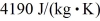 .
J/kg and its specific heat is is . (Multiple Choice)
4.9/5 (88)
(88) An architect is interested in estimating the heat loss (in kcal/s)through a sheet of insulating material as a function of the thickness of the sheet.Assuming fixed temperatures on the two faces of the sheet,which one of the graphs in the figure best represents the rate of heat transfer as a function of the thickness of the insulating sheet? 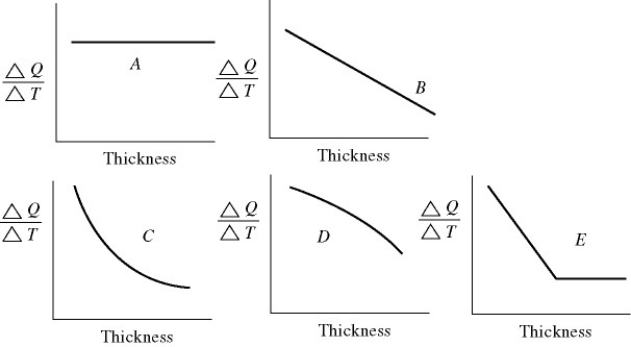
(Multiple Choice)
4.7/5 (79)
(79) A rod has a length 2.00000 m at 10.0°C.The length of the rod increases to 2.00060 m when the temperature increases to 30.0°C.What is the coefficient of linear expansion of the material from which the rod is made?
(Multiple Choice)
4.9/5 (78)
(78) 1)000 L of water at 20.00°C will occupy what volume if it is heated to 80.00°C? Water has a volume expansion coefficient of 210 × 10-6/C°.(Express your answer to 4 significant figures.)
(Multiple Choice)
4.9/5 (83)
(83) A radiating body originally has a Kelvin temperature To,and its surroundings are at 500K  If the Kelvin temperature of the radiating body is increased to
 ,the net rate at which the body radiates increases by a factor of 333.What was the original temperature
 ?
If the Kelvin temperature of the radiating body is increased to ,the net rate at which the body radiates increases by a factor of 333.What was the original temperature ? (Short Answer)
4.8/5 (94)
(94) (a)Internal human body temperature is often stated to be normal at 98.6°F.What is this temperature on the Celsius and Kelvin scales?
(b)Gallium boils at 2205°C.What is the corresponding temperature in the Fahrenheit and Kelvin scales?
(c)The boiling point of liquid nitrogen is 77.0 K.What is the corresponding temperature in the Fahrenheit and Celsius scales?
(Short Answer)
4.9/5 (77)
(77) A 400-g piece of metal at 120.0°C is dropped into a cup containing 450 g of water at 15.0°C.The final temperature of the system is measured to be 40.0°C.What is the specific heat of the metal,assuming no heat is exchanged with the surroundings or the cup? The specific heat of water is 4190 J/(kg • K).
(Multiple Choice)
4.8/5 (86)
(86) Two steel spheres are made of the same material and have the same diameter,but one is solid and the other is hollow.If their temperature is increased by the same amount
(Multiple Choice)
4.7/5 (97)
(97) The coefficient of linear expansion of aluminum is 24 × 10-6 K-1 and the coefficient of volume expansion of olive oil is 0.68 × 10⁻³ K-1.A novice cook,in preparation for deep-frying some potatoes,fills a 1.00-L aluminum pot to the brim and heats the oil and the pot from an initial temperature of 15°C to 190°C.To his consternation some olive oil spills over the top.How much?
(Multiple Choice)
4.9/5 (64)
(64) How many grams of ice at -13°C must be added to 711 grams of water that is initially at a temperature of  to produce water at a final temperature of
 Assume that no heat is lost to the surroundings and that the container has negligible mass.The specific heat of liquid water is 4190 J/kg • C° and of ice is 2050 J/kg • C°.For water the normal melting point is 0.00°C and the heat of fusion is 334 × 103 J/kg.The normal boiling point is 100°C and the heat of vaporization is
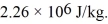
to produce water at a final temperature of Assume that no heat is lost to the surroundings and that the container has negligible mass.The specific heat of liquid water is 4190 J/kg • C° and of ice is 2050 J/kg • C°.For water the normal melting point is 0.00°C and the heat of fusion is 334 × 103 J/kg.The normal boiling point is 100°C and the heat of vaporization is (Short Answer)
5.0/5 (74)
(74) Heat is added to a 2.0 kg piece of ice at a rate of  How long will it take for the ice to melt if it was initially at 0.00°C? (The latent heat of fusion for water is
 and its latent heat of vaporization is

How long will it take for the ice to melt if it was initially at 0.00°C? (The latent heat of fusion for water is and its latent heat of vaporization is (Multiple Choice)
4.8/5 (77)
(77) Two experimental runs are performed to determine the calorimetric properties of an alcohol that has a melting point of -10°C.In the first run,a 200-g cube of frozen alcohol,at the melting point,is added to 300 g of water at 20°C in a styrofoam container.When thermal equilibrium is reached,the alcohol-water solution is at a temperature of 5.0°C.In the second run,an identical cube of alcohol is added to 500 g of water at 20°C and the temperature at thermal equilibrium is 10°C.The specific heat of water is 4190 J/kg • K.Assume that no heat is exchanged with the styrofoam container and with the surroundings.The specific heat of the alcohol is closest to
(Multiple Choice)
4.8/5 (84)
(84) Two identical concrete slabs lie flat and in contact with each other as shown in the figure.If the temperature increases by 40°C,the lower edges opposite the contact edges remained fixed in position,and the lower edges of the contact side remain in contact,at what angle will the slabs be tilted? The coefficient of thermal expansion of the concrete is  .
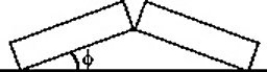
. (Multiple Choice)
4.9/5 (70)
(70) Some properties of glass are listed here. Density: 2300 kg/m3
Specific heat: 840 J/kg·C°
Coefficient of linear thermal expansion: 8.5 × 10⁻⁶ (C°)-1
Thermal conductivity: 0.80 W/(m • C°)
A glass window pane is 2.7 m high,2.4 m wide,and 2.0 mm thick.The temperature at the inner surface of the glass is  and at the outer surface 4.0°C.How much heat is lost each hour through the window under steady state conditions?
 (Multiple Choice)
4.8/5 (84)
(84) If we use 67 W of power to heat 148 g of water,how long will it take to raise the temperature of the water from 15°C to 25°C? The specific heat of water is  .
. (Multiple Choice)
4.9/5 (73)
(73) A thermally isolated system is made up of a hot piece of aluminum and a cold piece of copper; the aluminum and the copper are in thermal contact.The specific heat of aluminum is more than double that of copper.Which object experiences the greater temperature change during the time the system takes to reach thermal equilibrium?
(Multiple Choice)
4.9/5 (62)
(62) 
Filters
- Essay(0)
- Multiple Choice(0)
- Short Answer(0)
- True False(0)
- Matching(0)