



 Chat with AI
Exam 17: Temperature and Heat

Exam 1: Units,physical Quantities,and Vectors107 Questions
Exam 2: Motion Along a Straight Line59 Questions
Exam 3: Motion in Two or Three Dimensions50 Questions
Exam 4: Newtons Laws of Motion44 Questions
Exam 5: Applying Newtons Laws95 Questions
Exam 6: Work and Kinetic Energy54 Questions
Exam 7: Potential Energy and Energy Conservation55 Questions
Exam 8: Momentum,impulse,and Collisions50 Questions
Exam 9: Rotation of Rigid Bodies26 Questions
Exam 10: Dynamics of Rotational Motion49 Questions
Exam 11: Equilibrium and Elasticity50 Questions
Exam 12: Fluid Mechanics50 Questions
Exam 13: Gravitation50 Questions
Exam 14: Periodic Motion50 Questions
Exam 15: Mechanical Waves44 Questions
Exam 16: Sound and Hearing65 Questions
Exam 17: Temperature and Heat63 Questions
Exam 18: Thermal Properties of Matter58 Questions
Exam 19: The First Law of Thermodynamics52 Questions
Exam 20: The Second Law of Thermodynamics50 Questions
Exam 21: Electric Charge and Electric Field60 Questions
Exam 22: Gausss Law41 Questions
Exam 23: Electric Potential55 Questions
Exam 24: Capacitance and Dielectrics52 Questions
Exam 25: Current,resistance,and Electromotive Force55 Questions
Exam 26: Direct-Current Circuits53 Questions
Exam 27: Magnetic Field and Magnetic Forces42 Questions
Exam 28: Sources of Magnetic Field52 Questions
Exam 29: Electromagnetic Induction39 Questions
Exam 30: Inductance27 Questions
Exam 31: Alternating Current50 Questions
Exam 32: Electromagnetic Waves47 Questions
Exam 33: The Nature and Propagation of Light28 Questions
Exam 34: Geometric Optics81 Questions
Exam 35: Interference33 Questions
Exam 36: Diffraction49 Questions
Exam 37: Relativity51 Questions
Exam 38: Photons: Light Waves Behaving As Particles38 Questions
Exam 39: Particles Behaving As Waves52 Questions
Exam 40: Quantum Mechanics43 Questions
Exam 41: Atomic Structure53 Questions
Exam 42: Molecules and Condensed Matter31 Questions
Exam 43: Nuclear Physics90 Questions
Exam 44: Particle Physics and Cosmology54 Questions
Select questions type


A certain metal has a coefficient of linear expansion of 2.00 × 10⁻⁵ K-1.It has been kept in a laboratory oven at 325°C for a long time.It is now removed from the oven and placed in a freezer at -145°C.After it has reached freezer temperature,the percent change in its density during this process is closest to
(Multiple Choice)
4.8/5  (85)
(85) A heat conducting rod,0.90 m long,is made of an aluminum section that is 0.10 m long,and a copper section that is  long.Both sections have cross-sectional areas of
 The aluminum end is maintained at a temperature of
 and the copper end is at
 The thermal conductivity of aluminum is
 and of copper is
 .Steady state has been reached,and no heat is lost through the well-insulated sides of the rod.The temperature of the aluminum-copper junction in the rod is closest to
long.Both sections have cross-sectional areas of The aluminum end is maintained at a temperature of and the copper end is at The thermal conductivity of aluminum is and of copper is .Steady state has been reached,and no heat is lost through the well-insulated sides of the rod.The temperature of the aluminum-copper junction in the rod is closest to (Multiple Choice)
4.8/5 (74)
(74) A block of ice at 0.000°C is added to a well-insulated 147-g aluminum calorimeter cup that holds 200 g of water at 10.0°C.The water and aluminum cup are in thermal equilibrium,and the specific heat of aluminum is 910 J/(kg • K).If all but 2.00 g of ice melt,what was the original mass of the block of ice? The specific heat of water is 4190 J/(kg • K),its latent heat of fusion is 334 kJ/kg,and its latent heat of vaporization is 2260 kJ/kg.
(Multiple Choice)
4.8/5 (83)
(83) Heat is added to a pure substance in a closed container at a constant rate.The figure shows a graph of the temperature of the substance as a function of time.If Lf = latent heat of fusion and Lv = latent heat of vaporization,what is the value of the ratio Lv / Lf for this substance? 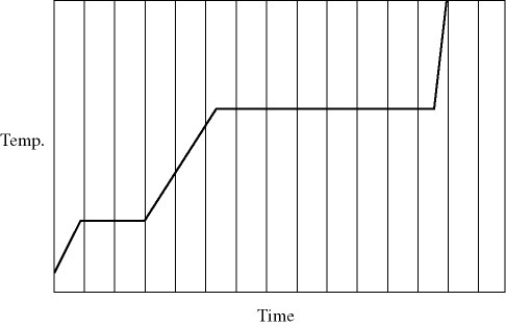
(Multiple Choice)
4.9/5 (78)
(78) A glass flask has a volume of 500 mL at a temperature of 20°C.The flask contains  of mercury at
 The temperature of the mercury and flask is raised until the mercury reaches the
 reference mark.The coefficients of volume expansion of mercury and glass are
 and
 ,respectively.The temperature at which this occurs is closest to
of mercury at The temperature of the mercury and flask is raised until the mercury reaches the reference mark.The coefficients of volume expansion of mercury and glass are and ,respectively.The temperature at which this occurs is closest to (Multiple Choice)
4.9/5 (84)
(84) Two metal rods,one silver and the other copper,are both attached to a steam chamber as shown in the figure,with a temperature of 100°C,at one end,and an ice water bath,with a temperature of 0°C,at the other.The rods are 5.0 cm long and have a square cross-section,  on a side.When steady state has been reached,how much heat flows through the two rods in 1.0 min? The thermal conductivity of silver is
 ,and that of copper is
 .No heat is exchanged between the rods and the surroundings,except at their ends.
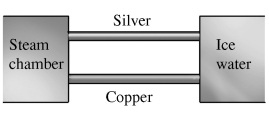
on a side.When steady state has been reached,how much heat flows through the two rods in 1.0 min? The thermal conductivity of silver is ,and that of copper is .No heat is exchanged between the rods and the surroundings,except at their ends. (Multiple Choice)
4.8/5 (81)
(81) Suppose that a steel bridge,1000 m long,was built without any expansion joints and that only one end of the bridge was held fixed.What would the difference in the length of the bridge be between winter and summer,taking a typical winter temperature as 0.00°C,and a typical summer temperature as 40°C? The coefficient of thermal expansion of steel is 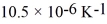 .
. (Multiple Choice)
4.9/5 (74)
(74) It is necessary to determine the specific heat of an unknown object.The mass of the object is measured to be 199.0 g.It is determined experimentally that it takes 16.0 J to raise the temperature 10.0°C.Find the specific heat of the object.
(Multiple Choice)
5.0/5 (88)
(88) The exterior of a supersonic airplane is made of aluminum,which has a coefficient of linear expansion of  .At 15°C,the plane measures 62.1 m in length.When the plane is in flight,friction with the air increases the temperature of the exterior skin to 200°C.What is the change in the length of the outer skin of the plane?
 (Multiple Choice)
4.9/5 (65)
(65) A 200-g metal container,insulated on the outside,holds 100 g of water in thermal equilibrium at  A 21-g ice cube,at the melting point,is dropped into the water,and when thermal equilibrium is reached the temperature is 15.00°C.Assume there is no heat exchange with the surroundings.For water,the specific heat is 4190 J/kg • K and the heat of fusion is
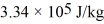 .The specific heat for the metal is closest to
A 21-g ice cube,at the melting point,is dropped into the water,and when thermal equilibrium is reached the temperature is 15.00°C.Assume there is no heat exchange with the surroundings.For water,the specific heat is 4190 J/kg • K and the heat of fusion is .The specific heat for the metal is closest to (Multiple Choice)
4.8/5 (83)
(83) A 905-g meteor impacts the earth at a speed of 1629 m/s.If all of its energy is entirely converted to heat in the meteor,what will be the resulting temperature rise of the meteor,assuming it does not melt? The specific heat for the meteor material is  ,which is about the same as that of iron.
 (Multiple Choice)
4.9/5 (85)
(85) A machinist needs to remove a tight fitting pin of material A from a hole in a block made of material B.The machinist heats both the pin and the block to the same high temperature and removes the pin easily.What statement relates the coefficient of thermal expansion of material A to that of material B?
(Multiple Choice)
4.8/5 (80)
(80) A person makes ice tea by adding ice to 1.8 kg of hot tea,initially at 80°C.How many kilograms of ice,initially at 0.00°C,are required to bring the mixture to 10°C? The heat of fusion of ice is 334 kJ/kg,and we can assume that tea has essentially the same thermal properties as water,so its specific heat is 4190 J/(kg • K).
(Multiple Choice)
5.0/5 (71)
(71) A substance has a melting point of 20°C and a heat of fusion of  .The boiling point is 150°C and the heat of vaporization is
 at a pressure of 1.0 atm.The specific heats for the solid,liquid,and gaseous phases are
 ,
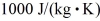 ,and
 ,respectively.The quantity of heat given up by 0.50 kg of the substance when it is cooled from 170°C to 88°C,at a pressure of 1.0 atmosphere,is closest to
.The boiling point is 150°C and the heat of vaporization is at a pressure of 1.0 atm.The specific heats for the solid,liquid,and gaseous phases are , ,and ,respectively.The quantity of heat given up by 0.50 kg of the substance when it is cooled from 170°C to 88°C,at a pressure of 1.0 atmosphere,is closest to (Multiple Choice)
4.8/5 (94)
(94) The coefficient of volume expansion of olive oil is 0.68 × 10⁻³ K-1.A 1.00-L glass beaker is filled to the brim with olive oil at room temperature.The beaker is placed on a range and the temperature of the oil and beaker increases by 25 C°.As a result,  of olive oil spill over the top of the beaker.What is the coefficient of linear expansion of the glass?
 (Multiple Choice)
4.8/5 (76)
(76) A rod,with sides insulated to prevent heat loss,has one end immersed in boiling water 100°C and the other end in a water-ice mixture at 0.00°C.The rod has uniform cross-sectional area of  and length of
 Under steady state conditions,the heat conducted by the rod melts the ice at a rate of
 every 34 seconds.What is the thermal conductivity of the rod? (The heat of fusion of water is
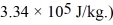
and length of Under steady state conditions,the heat conducted by the rod melts the ice at a rate of every 34 seconds.What is the thermal conductivity of the rod? (The heat of fusion of water is (Short Answer)
4.9/5 (86)
(86) A concrete wall of a cold storage room measures 3.0 m high,5.0 m wide,and 20 cm thick.The room temperature is maintained at -10°C and the outside temperature is 20°C The inside wall is to be covered by a layer of wood in order to reduce the rate of heat loss through the wall BY 90 percent.The thermal conductivities of concrete and wood are 0.80 W/m • K and 0.040 W/m • K,respectively.Under steady state conditions,the thickness of the layer of wood required is closest to
(Multiple Choice)
4.9/5 (84)
(84) A solid concrete wall 4.0 m by 2.4 m and 30 cm thick,with a thermal conductivity of  ,separates a basement at 18°C from the ground outside at 6°C.Under steady state conditions,how much heat flows through the wall in one hour?
 (Multiple Choice)
4.8/5 (94)
(94) 
Filters
- Essay(0)
- Multiple Choice(0)
- Short Answer(0)
- True False(0)
- Matching(0)