



 Chat with AI
Exam 17: Temperature and Heat

Exam 1: Units,physical Quantities,and Vectors107 Questions
Exam 2: Motion Along a Straight Line59 Questions
Exam 3: Motion in Two or Three Dimensions50 Questions
Exam 4: Newtons Laws of Motion44 Questions
Exam 5: Applying Newtons Laws95 Questions
Exam 6: Work and Kinetic Energy54 Questions
Exam 7: Potential Energy and Energy Conservation55 Questions
Exam 8: Momentum,impulse,and Collisions50 Questions
Exam 9: Rotation of Rigid Bodies26 Questions
Exam 10: Dynamics of Rotational Motion49 Questions
Exam 11: Equilibrium and Elasticity50 Questions
Exam 12: Fluid Mechanics50 Questions
Exam 13: Gravitation50 Questions
Exam 14: Periodic Motion50 Questions
Exam 15: Mechanical Waves44 Questions
Exam 16: Sound and Hearing65 Questions
Exam 17: Temperature and Heat63 Questions
Exam 18: Thermal Properties of Matter58 Questions
Exam 19: The First Law of Thermodynamics52 Questions
Exam 20: The Second Law of Thermodynamics50 Questions
Exam 21: Electric Charge and Electric Field60 Questions
Exam 22: Gausss Law41 Questions
Exam 23: Electric Potential55 Questions
Exam 24: Capacitance and Dielectrics52 Questions
Exam 25: Current,resistance,and Electromotive Force55 Questions
Exam 26: Direct-Current Circuits53 Questions
Exam 27: Magnetic Field and Magnetic Forces42 Questions
Exam 28: Sources of Magnetic Field52 Questions
Exam 29: Electromagnetic Induction39 Questions
Exam 30: Inductance27 Questions
Exam 31: Alternating Current50 Questions
Exam 32: Electromagnetic Waves47 Questions
Exam 33: The Nature and Propagation of Light28 Questions
Exam 34: Geometric Optics81 Questions
Exam 35: Interference33 Questions
Exam 36: Diffraction49 Questions
Exam 37: Relativity51 Questions
Exam 38: Photons: Light Waves Behaving As Particles38 Questions
Exam 39: Particles Behaving As Waves52 Questions
Exam 40: Quantum Mechanics43 Questions
Exam 41: Atomic Structure53 Questions
Exam 42: Molecules and Condensed Matter31 Questions
Exam 43: Nuclear Physics90 Questions
Exam 44: Particle Physics and Cosmology54 Questions
Select questions type


A cube at 100.0°C radiates heat at a rate of 80.0 J/s.If the length of each side is cut in half,the rate at which it will now radiate is closest to
(Multiple Choice)
4.9/5  (75)
(75) A blacksmith is flattening a steel plate that measures  .He has heated the plate to 900 K.If the emissivity of the plate is 0.75,what is the total rate at which it radiates energy? The Stefan-Boltzmann constant is 5.670 × 10⁻⁸ W/m2 • K4.Ignore any heat it receives from the surroundings.
 (Multiple Choice)
4.8/5 (69)
(69) If 2.0 g of water at 0.00°C is to be vaporized,how much heat must be added to it? The specific heat of water is 1.0 cal/g • K,its heat of fusion is 80 cal/g,and its heat of vaporization is  .
. (Multiple Choice)
5.0/5 (93)
(93) What is the net power that a person loses through radiation if her surface area is 1.20 m2,if her emissivity is 0.895,if her skin temperature is 300 K,and if she is in a room that is at a temperature of 17°C? The Stefan-Boltzmann constant is 5.670 × 10⁻⁸ W/m2 • K4.
(Multiple Choice)
4.8/5 (84)
(84) A brass rod is 40.1 cm long and an aluminum rod is 79.3 cm long when both rods are at an initial temperature of 0°C.The rods are placed in line with a gap of 0.60 cm between them,as shown in the figure.The distance between the far ends of the rods is maintained at 120.0 cm throughout.The temperature of both rods is raised until the two rods are barely in contact.The coefficients of linear expansion of brass and aluminum are 2.0 × 10⁻⁵ K-1 and 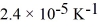 ,respectively.The temperature at which contact of the rods barely occurs is closest to
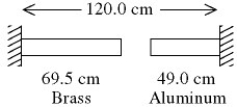
,respectively.The temperature at which contact of the rods barely occurs is closest to (Multiple Choice)
4.9/5 (77)
(77) The filament in a light bulb has a diameter of 0.050 mm and an emissivity of 1.0.The temperature of the filament is 3000°C.What should be the length of the filament so it will radiate 60 W of power? The Stefan-Boltzmann constant is  .
. (Multiple Choice)
5.0/5 (67)
(67) A chunk of ice (T = -20°C)is added to a thermally insulated container of cold water (T = 0°C).What happens in the container?
(Multiple Choice)
4.8/5 (81)
(81) A cube at 100°C radiates heat at a rate of 80.0 J/s.If its surface temperature is increased to 200°C,the rate at which it will now radiate is closest to
(Multiple Choice)
4.8/5 (86)
(86) What is the steady state rate of heat flow through a pane of glass that is 40.0 cm by 30.0 cm with a thickness of 4.00 mm when the outside temperature of the glass is -10.0°C and its inside temperature is 25.0°C? The thermal conductivity of glass is 0.105 W/(m • K),the specific heat of glass is 0.180 cal/(g • °C),and 1 cal = 4.190 J.
(Multiple Choice)
4.9/5 (82)
(82) A spherical object 25.0 cm in diameter having an emissivity of 0.800 is held at a temperature of 275°C by an internal heater.This object is embedded in a very large vat of water at 100.0°C and atmospheric pressure.At what maximum rate (in g/min)is the water evaporating in the vat due to the radiated heat it receives from the object? You can ignore any heat radiated by the water.The latent heat of fusion for water is 33,400 J/kg,its latent heat of vaporization is 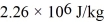 ,and the Stefan-Boltzmann constant is
 .
,and the Stefan-Boltzmann constant is . (Short Answer)
4.8/5 (81)
(81) An 80-g aluminum calorimeter contains 380 g of water at an equilibrium temperature of 20°C.A  piece of metal,initially at
 is added to the calorimeter.The final temperature at equilibrium is 32°C.Assume there is no external heat exchange.The specific heats of aluminum and water are 910 J/kg • K and 4190 J/kg • K,respectively.The specific heat of the metal is closest to
piece of metal,initially at is added to the calorimeter.The final temperature at equilibrium is 32°C.Assume there is no external heat exchange.The specific heats of aluminum and water are 910 J/kg • K and 4190 J/kg • K,respectively.The specific heat of the metal is closest to (Multiple Choice)
4.7/5 (69)
(69) You want to insert an aluminum rod,which at 20°C has a radius of 1.000200 cm into a copper tube which has a radius of 1.000100 cm at the same temperature.You decide to put both of them in the refrigerator.At what temperature will the rod just fit if both are cooled to the same temperature? The coefficient of thermal expansion for aluminum is  ,and that of copper is 1.7 ×

 .
,and that of copper is 1.7 × . (Multiple Choice)
4.8/5 (71)
(71) A 406.0 kg copper bar is put into a smelter for melting.The initial temperature of the copper is 300.0 K.How much heat must the smelter produce to completely melt the copper bar? (The specific heat for copper is 386 J/kg • K,the heat of fusion for copper is  ,and its melting point is 1357 K.)
 (Multiple Choice)
4.9/5 (77)
(77) Two experimental runs are performed to determine the calorimetric properties of an alcohol that has a melting point of -10°C.In the first run,a 200-g cube of frozen alcohol,at the melting point,is added to 300 g of water at 20°C in a styrofoam container.When thermal equilibrium is reached,the alcohol-water solution is at a temperature of 5.0°C.In the second run,an identical cube of alcohol is added to 500 g of water at 20°C and the temperature at thermal equilibrium is 10°C.The specific heat of water is 4190 J/kg • K.Assume that no heat is exchanged with the styrofoam container and with the surroundings.The heat of fusion of the alcohol is closest to
(Multiple Choice)
4.7/5 (85)
(85) A solid metal sphere is 15.0 cm in diameter and has surface of uniform color.When its surface is at 112°C,you measure that it radiates energy at a rate of 71.3 W.What is the emissivity of the surface of this object? Any heat that enters the sphere from the outside environment is negligible.The Stefan-Boltzmann constant is 
(Short Answer)
4.9/5 (70)
(70) A cylindrical bar that us well insulated around its sides connects hot and cold reservoirs and conducts heat at a rate of 10.0 J/s under steady state conditions.If all of its linear dimensions (diameter and length)are reduced by half,the rate at which it will now conduct heat between the same reservoirs is closest to
(Multiple Choice)
4.9/5 (77)
(77) A copper cylinder with a mass of 125 g and temperature of 345°C is cooled by dropping it into a glass beaker containing 565 g of water initially at 20.0°C.The mass of the beaker is 50.0 g and the specific heat of the glass is 840 J/kg • K.What is the final equilibrium temperature of the system,assuming the cooling takes place very quickly,so that no energy is lost to the air? The specific heat of copper is 385 J/kg • K and that of water is 4190 J/kg • K.
(Short Answer)
4.9/5 (90)
(90) It is a well-known fact that water has a higher specific heat than iron.Now,consider equal masses of water and iron that are initially in thermal equilibrium.The same amount of heat,30 calories,is added to each one.Which statement is true?
(Multiple Choice)
4.9/5 (78)
(78) A person pours 330 g of water at 45°C into an 855-g aluminum container with an initial temperature of 10°C.The specific heat of aluminum is  and that of water is
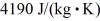 .What is the final temperature of the system,assuming no heat is exchanged with the surroundings?
and that of water is .What is the final temperature of the system,assuming no heat is exchanged with the surroundings? (Multiple Choice)
4.8/5 (79)
(79) 
Filters
- Essay(0)
- Multiple Choice(0)
- Short Answer(0)
- True False(0)
- Matching(0)